
The Gold price (XAU/USD) extended its corrective move during the European trading session on Tuesday, slipping around 0.6% to trade near $4,270. The decline follows an aggressive profit-booking phase after the yellow metal recently revisited its all-time highs just below $4,400.
After an extended bullish run driven by rate-cut optimism, geopolitical uncertainty, and safe-haven demand, traders appear to be locking in gains ahead of a critical macroeconomic event. In this article, Orbisolyx brokers break down the key components of the topic with clarity.
The near-term direction for XAU/USD now hinges on fresh signals from the United States Nonfarm Payrolls (NFP) report, which has emerged as the primary catalyst for short-term volatility across precious metals, US Treasury yields, and the US Dollar (USD).
Profit-Booking Pressures After Record Highs
Gold’s recent rally toward the $4,350–$4,385 region attracted strong selling interest, suggesting exhaustion near elevated price levels. The inability to sustain gains above the prior peak has encouraged short-term traders to unwind long positions, triggering a technical pullback.
This corrective move does not necessarily signal a trend reversal. Instead, it reflects healthy consolidation after a steep upside move. In strong bullish environments, such retracements often reset momentum indicators and create better risk-reward entry levels for medium-term participants.
US NFP Data Takes Centre Stage
The major macro trigger in Tuesday’s session is the combined US Nonfarm Payrolls (NFP) report for October and November, scheduled for release at 13:30 GMT. This employment data is being closely watched as it will shape expectations for the Federal Reserve’s interest rate trajectory.
Market consensus expects the US economy to have added 40,000 new jobs in November, significantly lower than the 119,000 jobs recorded in September. Meanwhile, the Unemployment Rate is projected to remain unchanged at 4.4%, indicating a labor market that is losing momentum but not collapsing outright.
Any deviation from expectations, particularly a weaker-than-forecast headline jobs number, could amplify speculation that the US labor market is cooling faster than anticipated.
Implications for Federal Reserve Policy
The Federal Reserve (Fed) continues to emphasize a data-dependent approach, placing heavy weight on labor market conditions. Signs of further deterioration in employment growth would strengthen the argument for monetary easing sooner rather than later.
According to the CME FedWatch Tool, traders currently price in nearly a 50% probability that the Fed will deliver its next interest rate cut in the March 2026 policy meeting. A soft NFP report would likely push these odds higher, placing downward pressure on US yields and the US Dollar, both of which are traditionally negative for gold.
Why Gold Reacts Strongly to Employment Data
Gold, as a non-yielding asset, is highly sensitive to real interest rates and bond yield expectations. When interest rates are expected to fall, the opportunity cost of holding gold declines, boosting investor demand. Weak employment data typically fuels expectations of policy accommodation, benefiting XAU/USD.
Additionally, employment data influences risk sentiment. A slowing labor market may raise concerns about economic growth, encouraging safe-haven flows into gold despite near-term volatility.
Gold Technical Analysis: Trend Remains Constructive
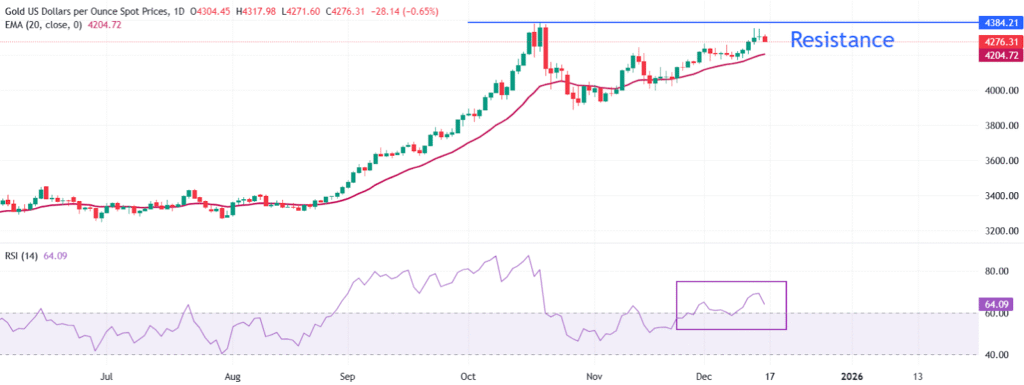
From a technical perspective, the broader gold market structure remains bullish despite the current pullback. Key technical indicators show the 20-day Exponential Moving Average (EMA) at $4,204.71, continuing to slope upward, which confirms a positive near-term trend.
The 14-day Relative Strength Index (RSI) has retreated to around 64.30 after previously testing overbought levels near 70.00, signaling momentum cooling rather than a bearish reversal, suggesting the market is entering a corrective or consolidation phase.
Key Support and Resistance Levels
Key support and resistance levels from a price action perspective show immediate support near the 20-day EMA around $4,205, a critical dynamic buying zone. A daily close below the 20-day EMA could expose the downside toward the November 24 low at $4,040, signaling a deeper retracement within the broader uptrend.
On the upside, fresh bullish momentum would require a decisive break above the all-time high at $4,385, which, if confirmed, could pave the way toward psychological resistance near $4,500 in the medium term.
Outlook: Volatility Likely to Persist
In the near term, gold price action is expected to remain data-driven and volatile, with the US NFP report acting as the primary directional catalyst. While profit-booking may cap gains temporarily, the broader narrative of slowing US growth, eventual Fed rate cuts, and elevated macro uncertainty continues to underpin gold’s longer-term appeal.
As long as XAU/USD holds above key moving averages, pullbacks are likely to be viewed as strategic buying opportunities rather than trend-ending signals. The next decisive move will depend on whether incoming US data validates or challenges expectations for a March 2026 Fed rate cut.


