
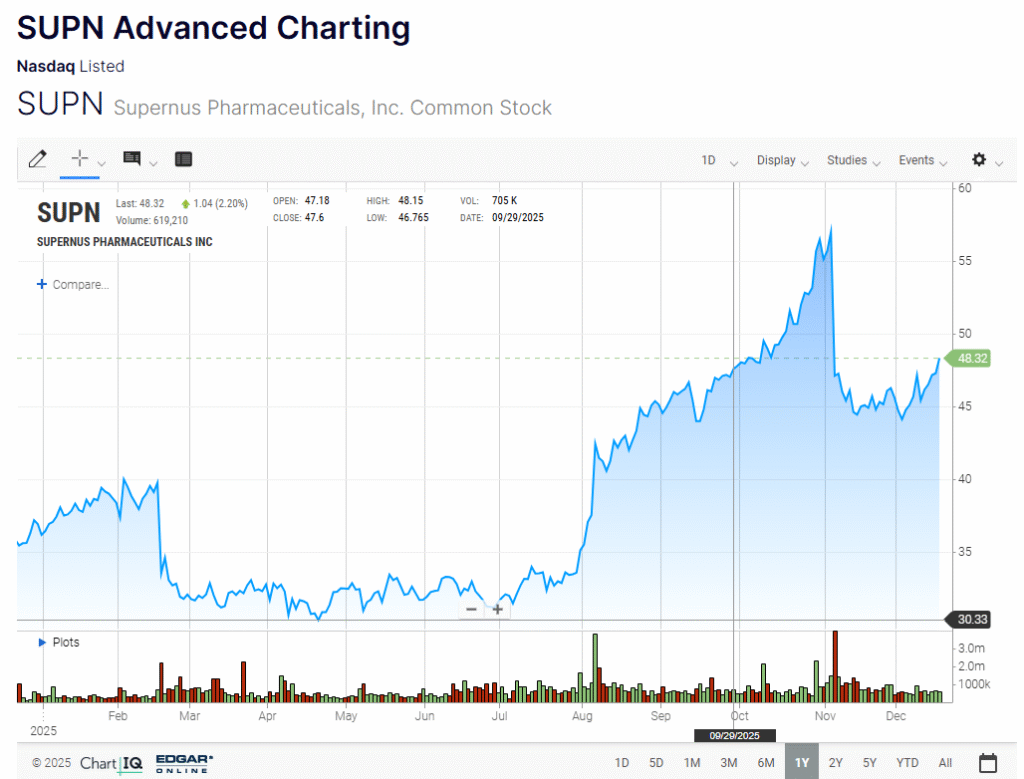
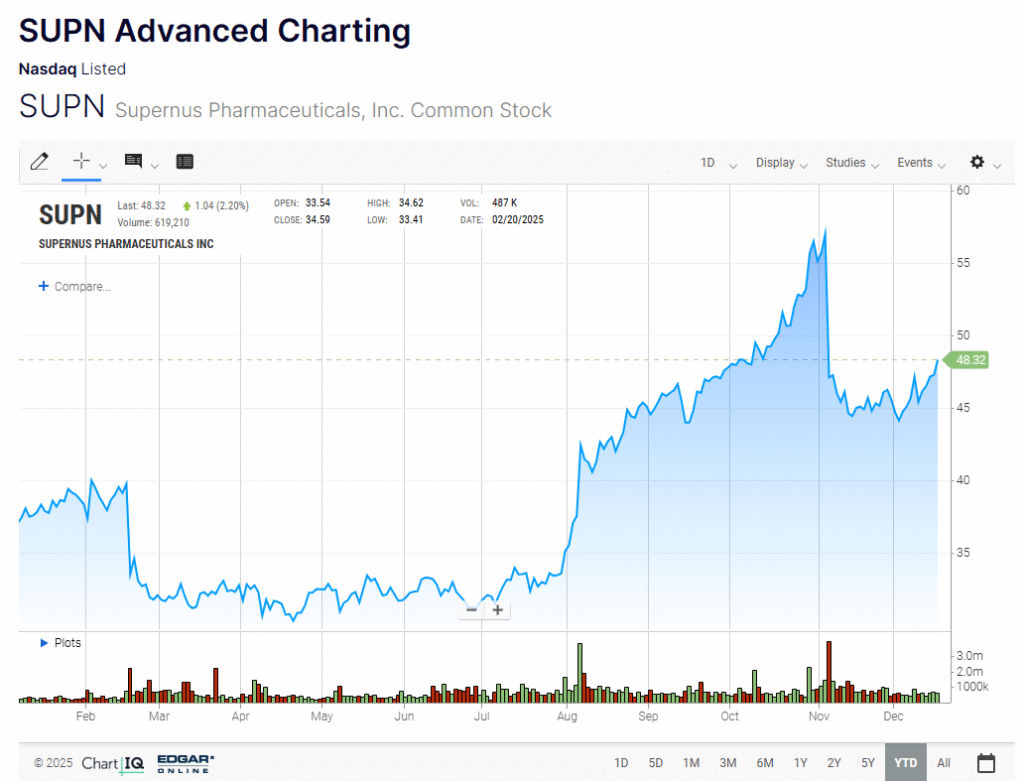
Amid the evolving landscape of the pharmaceutical sector, Supernus Pharmaceuticals (SUPN) has delivered impressive growth, with its stock price rising 31% over the past year. However, despite the recent rally, Supernus still trades 20% below its 2018 highs, leading some investors to question whether the stock can sustain its momentum or if it is time to scale back.
Aristotle Capital Boston, a significant investor in the company, recently disclosed in a SEC filing on November 14, 2025, that it had sold 503,122 shares of Supernus in the third quarter of 2025. This move resulted in a $10.9 million reduction in the fund’s position, leaving it with 305,273 shares valued at $14.6 million as of September 30. The sale was likely part of a profit-taking strategy, signalling caution regarding valuation and the long-term sustainability of the stock’s growth.
Brokers from Arbitics suggest that investors should carefully assess the valuation risks and potential for continued growth before making any decisions.
Supernus Pharmaceuticals: A Snapshot
Supernus is a pharmaceutical company specialising in branded medications for central nervous system (CNS) disorders, including treatments for epilepsy, migraine, Parkinson’s disease, and ADHD. Its product portfolio includes Oxtellar XR, Trokendi XR, Qelbree, and therapies for Parkinson’s disease, catering to a critical market in the U.S. with a focus on neurologists, psychiatrists, and other healthcare professionals.
In Q3 2025, Supernus reported $192.1 million in revenue, marking a 9% year-over-year increase. Key growth products such as GOCOVRI and Qelbree continued to show expansion, while ONAPGO delivered its first full quarter of sales following its launch. The company raised its full-year revenue guidance, reflecting confidence in its near-term execution.
However, despite these positive figures, profitability has been uneven. GAAP results showed a net loss year-over-year, mainly due to acquisition-related costs tied to the Sage deal, and adjusted operating earnings declined, raising concerns about cost management and integration risks.
Profitability Concerns and Market Position
While Supernus continues to deliver strong revenue growth, it faces ongoing pressure from rising operating expenses and integration risks linked to recent acquisitions. Although the company holds over $280 million in cash, giving it meaningful financial flexibility, this strength does not fully offset concerns around cost control and the complexity of integrating new assets into its operations. Investors must weigh these risks carefully, particularly as execution challenges can impact margins and long-term efficiency.
Despite these headwinds, Supernus Pharmaceuticals remains a notable player in the CNS therapeutics sector. The company benefits from a solid product portfolio and a diversified revenue base, which helps support business stability. However, valuation and operational efficiency are under closer scrutiny, especially since the stock remains well below its 2018 highs, even after a recent rally. This gap highlights lingering investor caution around sustainable growth, cost discipline, and long-term value creation.
A Market Outperformer, but Still Below Historical Peaks
Although Supernus’ stock has gained 31% over the past year, it is still trading about 20% below its 2018 highs, prompting ongoing questions around valuation and long-term upside. Despite a strong product pipeline and recent revenue growth, these positives have not been sufficient to lift the stock back to prior peak levels, creating uncertainty for investors considering it as a long-term portfolio holding.
Aristotle Capital Boston’s decision to reduce its stake may reflect a profit-taking strategy, with capital being redirected toward higher-conviction investments offering stronger long-term growth prospects. This move suggests a cautious stance influenced by Supernus’ share price volatility, even though the company’s operational performance remains solid, highlighting the gap between business execution and market sentiment.
Should Investors Follow Suit?
For long-term investors, Supernus remains an intriguing stock, given its strong revenue growth and solid pipeline in the CNS therapeutics sector. However, the company also faces risks tied to rising expenses, integration challenges, and market volatility. The recent pullback in stock price might present a buying opportunity, but investors should be cautious and monitor the company’s progress with product integration and cost control.
Brokers suggest that those considering Supernus should assess its ability to balance growth with cost control and ensure its product portfolio continues to deliver sustainable revenue. For long-term investors, the current market correction may offer a favorable entry point for patient investors.
In conclusion, while Supernus continues to show operational momentum, its valuation remains a key factor to watch, especially as the company faces increasing competition and challenges in managing its expanded portfolio. Investors should proceed with caution, but Supernus may still have the potential to rebound in the long run.


