
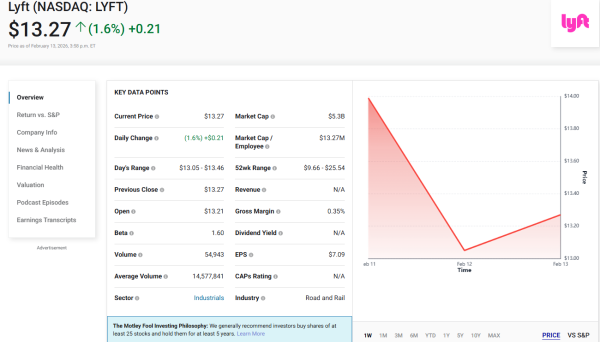
Lyft shares have fallen sharply following the company’s latest earnings report, leaving investors debating whether the pullback reflects deeper structural concerns or simply short-term market disappointment. Despite solid operational performance, the market reaction has been notably negative.
As brokers at Auraleyx observe, post-earnings sell-offs often stem less from what a company reported and more from what investors were expecting. So, is Lyft’s recent decline a warning sign or an opportunity?
Strong Top-Line Growth Still Intact
Looking at the fundamentals, Lyft’s performance does not suggest a collapsing business. The company continues to post double-digit revenue growth, alongside double-digit increases in ride volumes. These figures indicate that demand for Lyft’s services remains robust, even amid economic uncertainty and rising consumer cost pressures.
Growth in rides is particularly important because it reflects underlying user engagement. Higher ride frequency strengthens network effects, improves driver utilization, and enhances pricing power over time.
In addition, Lyft announced a $1 billion share buyback authorization, signaling management’s belief that the stock may be undervalued. Buybacks can reduce share count, boost earnings per share, and demonstrate balance sheet strength, especially when deployed strategically during periods of share price weakness.
Yet despite these positives, the stock declined meaningfully. Why?
Expectations vs. Execution
Markets often react not to results in isolation, but to expectations. Lyft has positioned itself as a company transitioning toward stronger profitability and operational discipline. Investors may have been hoping for more aggressive margin expansion or stronger forward guidance.
While revenue growth remains healthy, investors increasingly demand consistent earnings leverage in growth-oriented businesses. The ride-hailing sector is highly competitive, and profitability remains a focal point for analysts assessing long-term sustainability.
Concerns about macroeconomic headwinds may also be weighing on sentiment. If consumer spending slows, discretionary ride demand could soften. Even if Lyft continues to grow, the pace of that growth may become more sensitive to broader economic trends.
Autonomy: A Transformational Long-Term Bet
One of the most compelling aspects of Lyft’s investment thesis is its ongoing push into autonomous vehicle partnerships. Management continues advancing autonomy initiatives that could dramatically reshape cost structures.
Currently, driver compensation represents a major expense in the ride-hailing model. If autonomous vehicles are successfully integrated at scale, Lyft could potentially reduce labor-related costs and significantly expand margins.
Management has suggested that the long-term addressable market for autonomous mobility exceeds $1 trillion, reflecting broader transportation demand beyond current ride-hailing boundaries.
However, autonomy remains a long-term catalyst. Regulatory approvals, infrastructure investments, and technological hurdles introduce uncertainty. Investors betting on this narrative must maintain patience and tolerance for volatility.
Capital Allocation Signals Confidence
The $1 billion buyback program is not insignificant. For a company once criticized for cash burn and thin margins, committing capital to shareholder returns suggests a stronger financial footing.
Buybacks are particularly impactful when executed during periods of market pessimism. If Lyft sustains growth and improves margins while reducing share count, long-term investors could benefit meaningfully.
Still, capital returns do not eliminate competitive risks. They simply reflect management’s confidence in future cash generation.
Competitive and Industry Risks
Lyft operates in a fiercely competitive environment. Larger competitors and alternative mobility platforms continue to evolve, and pricing dynamics can shift quickly.
Key risks investors should monitor include:
- Intense competitive pricing pressure
- Potential slowdowns in discretionary spending
- Execution risk in autonomy partnerships
- Ongoing investor scrutiny around sustainable profitability
Even with strong ride growth, long-term stock performance will depend on margin improvement and predictable earnings expansion.
Has the Valuation Reset?
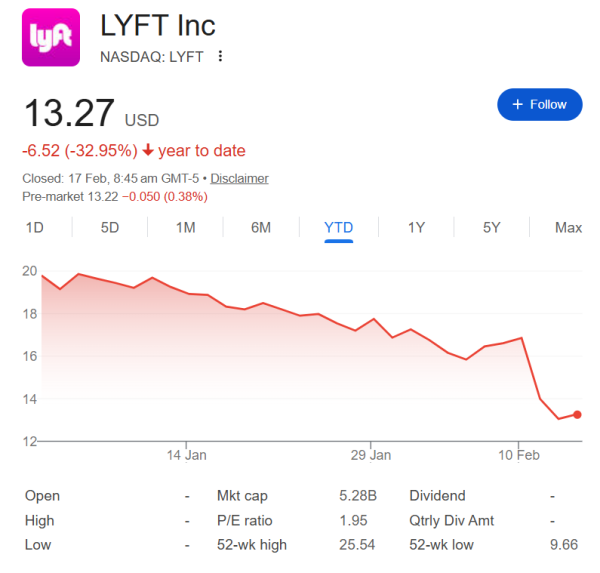
Following the recent sell-off, valuation may look more reasonable compared to earlier in the year. Growth remains intact, and the business continues to scale.
If Lyft demonstrates improving operating leverage over the coming quarters, the current weakness could prove temporary. However, if profitability stalls or guidance disappoints again, volatility may persist.
The broader mobility landscape continues to evolve, and digital platforms remain central to how urban transportation functions. Lyft retains a meaningful position within that ecosystem.
The Bottom Line
Lyft’s earnings report did not reveal a broken business. On the contrary, it showed strong ride growth, healthy revenue expansion, and shareholder-friendly capital allocation. However, markets are forward-looking, and investors appear cautious about the pace of profitability improvements.
For long-term investors who believe in the continued expansion of digital mobility and the long-term impact of autonomous technology, the recent decline could represent an opportunity. For more risk-averse investors, waiting for clearer signs of sustained margin expansion may be the more prudent approach.
Lyft is facing scrutiny, but it is not without operational momentum. Whether the dip becomes a buying opportunity ultimately depends on confidence in management’s ability to convert top-line growth into durable earnings power in the quarters ahead.
.


