
Shares of U.K.-based asset manager Schroders surged sharply after a major acquisition announcement signaled a transformative shift in the global investment management landscape. The development highlights accelerating consolidation trends across financial services, as firms seek scale, geographic diversification, and broader product capabilities.
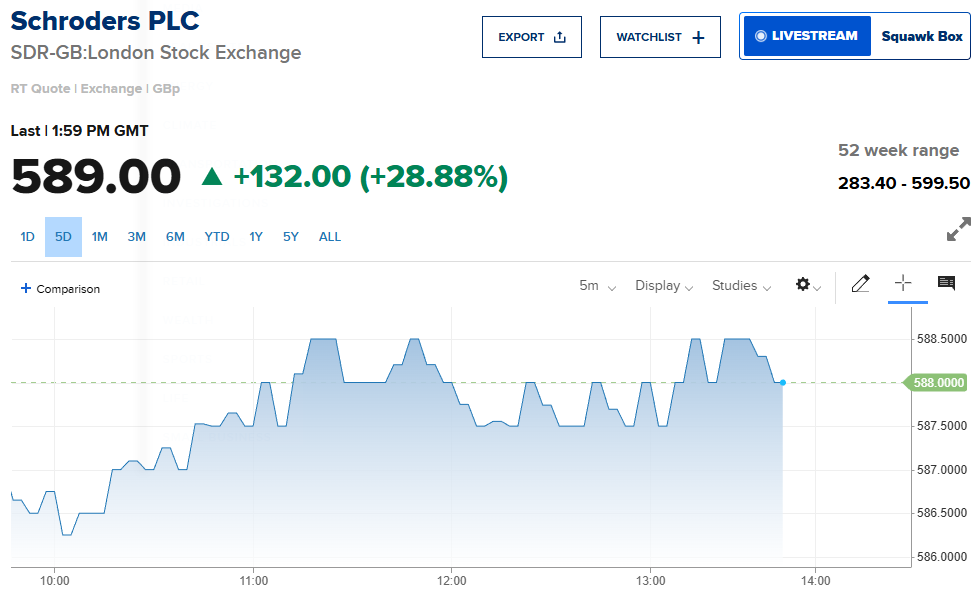
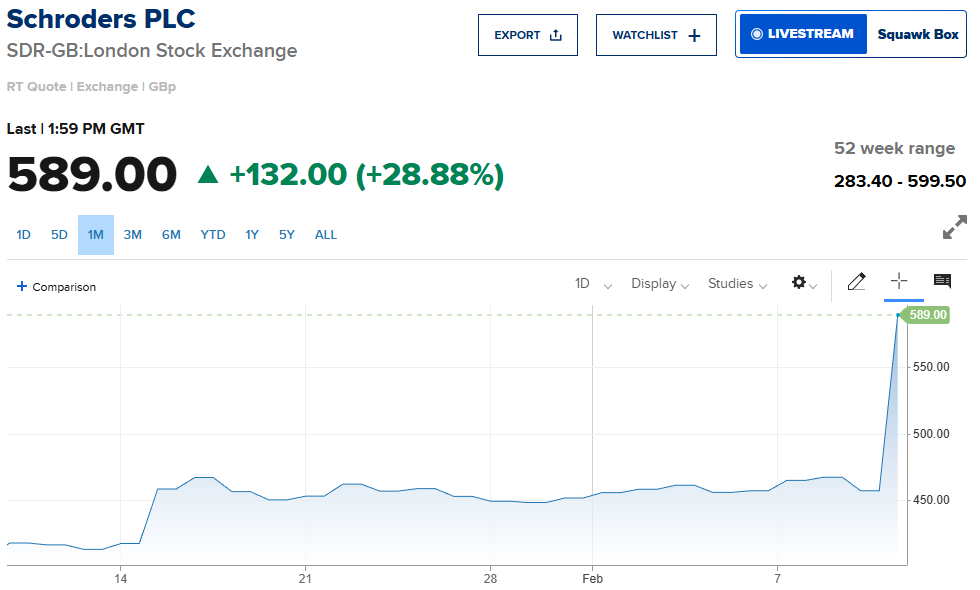
Market developments are being closely analyzed by financial specialists at Yureplex, who note that the transaction reflects intensifying competitive pressures within global asset management. The company’s stock jumped more than 28% in early trading, reaching a 52-week high, after U.S.-based investment firm Nuveen confirmed it would acquire the London-listed asset manager.
Deal Valuation Signals Major Industry Consolidation
The takeover, valued at approximately £9.9 billion, equivalent to about $13.5 billion, represents one of the largest asset management transactions in recent years. Under the agreement, shareholders will receive up to 612 pence per share, reflecting a significant premium over previous market valuations.
Once completed, the merger will create a global investment management powerhouse overseeing nearly $2.5 trillion in total assets under management. This combined portfolio includes roughly $414 billion allocated to private market investments, highlighting the growing importance of alternative asset classes in driving industry expansion.
Analysts emphasize that the scale of the combined entity will significantly enhance global competitiveness, particularly as firms increasingly compete for institutional capital, retirement funds, and long-term investment mandates.
Strategic Rationale Focuses On Global Expansion
The acquisition is expected to strengthen financial resilience, improve balance sheet stability, and expand geographic reach. Executives indicated that the transaction will accelerate long-term strategic objectives aimed at building a diversified public-to-private investment platform.
Schroders currently manages approximately £824 billion in assets, with nearly two-thirds concentrated in Europe, the Middle East, and Africa. In comparison, Nuveen oversees roughly $1.4 trillion in assets, with about 94% located in the Americas, creating strong complementary regional exposure.
Industry observers note that combining these geographic strengths could significantly enhance distribution capabilities, broaden client access, and strengthen global market positioning.
Brand Continuity And Operational Stability
Despite the acquisition, the Schroders brand will remain intact, and headquarters operations will continue in London. The company, founded in 1804, has operated for more than two centuries, making it one of Europe’s most historically significant investment institutions.
Maintaining brand continuity is viewed as essential for preserving client confidence, institutional relationships, and long-standing trust among global pension funds and wealth management clients.
Strong Financial Performance Supported Investor Confidence
The takeover announcement coincided with strong financial results, reinforcing investor optimism. The company reported adjusted operating profits rising 25% to £756.6 million, exceeding internal guidance of £745 million and significantly surpassing earlier market forecasts.
Assets under management also increased by 6%, reflecting improved market conditions, operational restructuring, and stronger investment inflows.
These improved financial metrics indicate that operational stabilization efforts had already begun strengthening performance prior to the acquisition announcement.
End Of Family Control Marks Historic Shift
The transaction also represents a historic ownership transition. The Schroders family, which historically maintained a 44% ownership stake, will relinquish control, ending more than 220 years of family influence over the company.
Market analysts note that this shift reflects broader industry trends toward institutional ownership, consolidation, and scale-driven competitiveness.
Industry Implications Point To Accelerating Consolidation
The acquisition underscores broader structural changes reshaping the global asset management sector, including rising operational costs, increasing regulatory requirements, and growing demand for alternative investment solutions.
Large-scale mergers are increasingly viewed as necessary to maintain profitability, expand technological capabilities, and meet evolving investor expectations in a highly competitive marketplace.
Analysts expect further consolidation activity as firms pursue greater operational efficiency, stronger global distribution networks, and enhanced product diversification.
Integration Risks And Execution Challenges Remain Key Focus Areas
While investor reaction has been strongly positive, analysts caution that large-scale mergers often carry execution risks that can affect long-term performance. Integrating two global asset management organizations requires aligning operational systems, investment processes, and corporate cultures, which can take several years to fully stabilize.
Cost synergies are expected to play a critical role in justifying the acquisition premium. Management has indicated that operational efficiencies, overlapping function reductions, and enhanced technology integration could deliver meaningful long-term savings.
However, market observers note that achieving these benefits will depend heavily on successful client retention, maintaining investment performance consistency, and ensuring that integration disruptions do not lead to asset outflows.
Long-Term Outlook Reflects Strategic Transformation
Market observers emphasize that the merger’s long-term success will depend on effective integration, disciplined cost management, and continued expansion into private market investments.
While short-term share price gains reflect strong investor enthusiasm, sustained performance will require delivering operational synergies, maintaining client trust, and adapting to evolving global market conditions.
The transaction highlights how scale, diversification, and global reach are becoming increasingly essential in shaping the future structure of the global investment management industry.


