
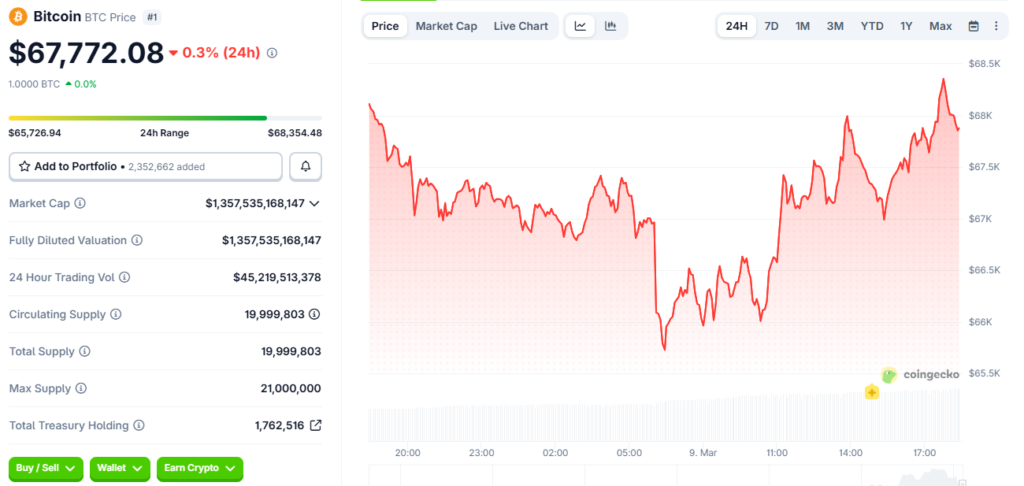
Global markets opened the week under pressure as energy prices surged and geopolitical tensions rattled investor sentiment. While many traditional assets struggled, crypto analysts at Rubizio observed that Bitcoin showed notable resilience during the turbulence, briefly climbing toward $68,000 even as oil prices surged and risk markets weakened.
The world’s largest cryptocurrency experienced sharp price swings during early European trading. Bitcoin moved above $68,000 before stabilizing slightly lower, still maintaining a modest gain of about 0.5 percent during morning trading in London. Earlier in the session, the digital asset had dropped as much as 2.4 percent, touching $65,633, which marked its lowest level in roughly one week.
The volatility came as global markets reacted to dramatic movements in the energy sector. Brent crude oil surged nearly 29 percent, reaching an intraday peak close to $119.50 per barrel, marking the largest single-session jump since April 2020. The rapid rise in oil prices triggered widespread selling across equities, government bonds, and major currencies.
Investment specialists at Altiryus note that Bitcoin’s ability to stabilize despite broad market stress suggests a shift in how the cryptocurrency is behaving relative to traditional risk assets.
Energy Shock Triggers Market Volatility
The spike in oil prices has been closely tied to escalating geopolitical tensions in the Middle East. As concerns grow about potential disruptions to global energy supply, traders have rapidly adjusted their expectations for inflation and economic growth.
Energy markets reacted first, but the ripple effects quickly spread across financial markets worldwide. Rising oil costs often increase inflation expectations, which in turn affects interest rate forecasts and global liquidity conditions.
Equity markets across Asia reacted sharply to the uncertainty. Regional benchmarks declined as investors reassessed risk exposure. South Korea’s Kospi index fell as much as 8.8 percent, reflecting significant investor caution across global markets.
Meanwhile, government bond markets experienced selling pressure as investors reassessed inflation risks. Yields on the benchmark US 10-year Treasury note climbed to a one-month high, signaling shifting expectations for monetary policy.
Bitcoin Shows Relative Strength
Despite the broader market volatility, Bitcoin managed to recover losses relatively quickly. Market strategists suggest that the cryptocurrency’s resilience may be tied to positioning within derivatives markets.
Analysts explain that there are currently very limited leveraged long positions remaining in the Bitcoin market, reducing the risk of large-scale liquidation cascades during sharp price moves.
As oil prices eased slightly later in the trading session, Bitcoin began to recover. This rebound was partly fueled by short sellers closing positions, which often pushes prices higher when bearish traders exit their trades.
The ability of Bitcoin to stabilize during widespread selling across traditional risk assets has drawn attention from institutional investors monitoring the evolving role of digital assets in diversified portfolios.
Inflation Concerns Continue to Shape Market Sentiment
Even with Bitcoin showing relative stability, the broader mood across financial markets remains cautious and defensive. Rising energy costs are widely expected to increase inflationary pressure across major economies.
Higher fuel prices typically translate into increased transportation expenses, manufacturing costs, and consumer prices. As a result, central banks may face additional pressure when determining future interest rate decisions.
Investors are now focusing on upcoming economic data releases that could provide insight into inflation trends. One key indicator scheduled for release later this week is the US Consumer Price Index, widely viewed as one of the most important inflation indicators for global markets.
Market participants will be watching closely to determine whether the latest energy price shock begins to influence broader consumer price dynamics.
Key Price Levels Traders Are Watching
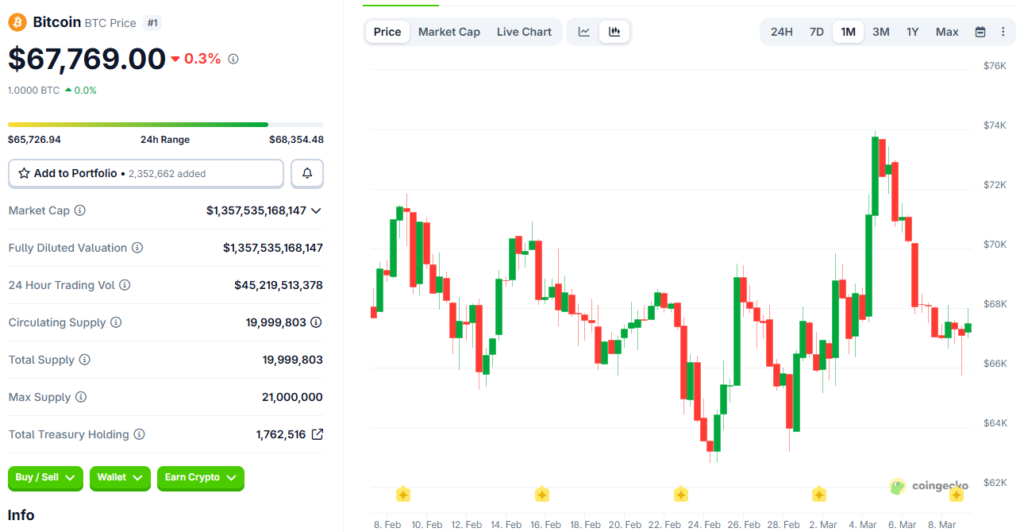
From a technical perspective, traders are now monitoring several critical price levels that may influence Bitcoin’s next directional move.
Market analysts identify $64,000 as the immediate support level that could determine whether prices remain stable in the near term. A break below this threshold could open the path toward the next support region around $61,000.
On the upside, resistance remains near $68,000, where Bitcoin has previously struggled to maintain upward momentum. A decisive move above that level could trigger renewed technical buying interest among traders.
Global Markets Face a More Complicated Risk Environment
For now, global financial markets remain highly sensitive to geopolitical developments and energy price fluctuations. The sudden surge in oil prices has introduced new uncertainty into an already fragile macroeconomic environment.
Investors are balancing multiple forces simultaneously, including geopolitical risk, inflation expectations, central bank policy, and digital asset adoption trends.
While traditional risk assets have struggled amid the latest market shock, Bitcoin’s relative stability has sparked renewed discussion about its potential role during periods of economic stress.
Analysts suggest that if geopolitical tensions persist and energy prices remain elevated, volatility across both traditional financial markets and cryptocurrencies may continue in the weeks ahead.


