
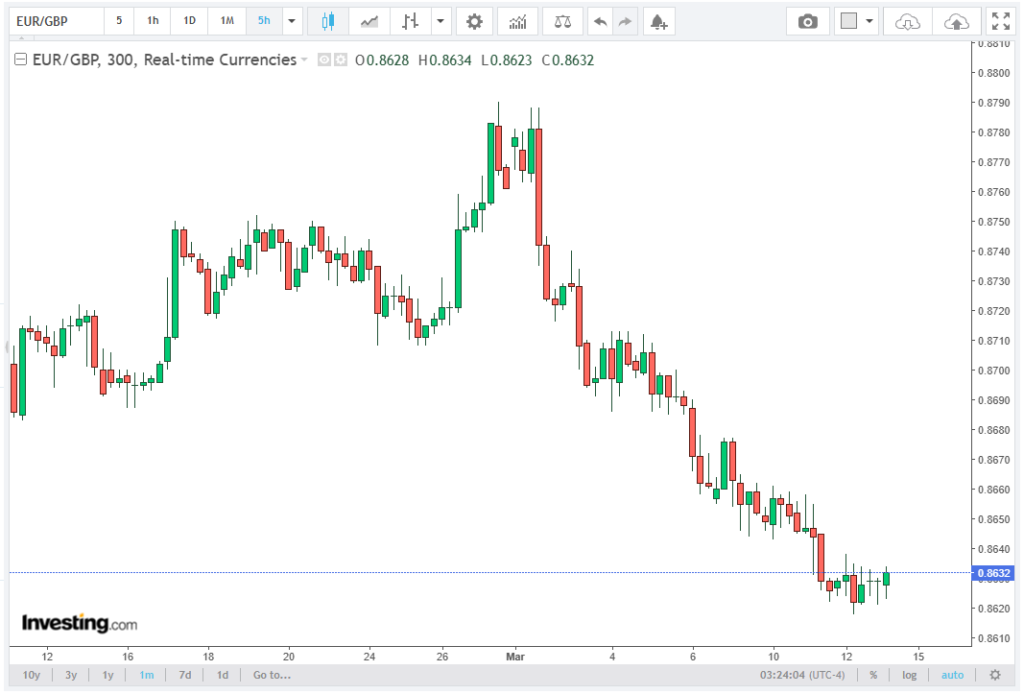
The EUR/GBP cross continues to maintain positive momentum, holding above the 0.8600 mark during Friday’s early European session. The pair edged higher to around 0.8630, supported by weak UK economic data and a hawkish tone from European Central Bank (ECB) policymakers.
Market participants are closely monitoring both UK macroeconomic releases and upcoming Eurozone Industrial Production data, which may influence near-term price action. This article presents an in-depth look at the subject, explained by the brokers at Nummvix.
UK GDP Stagnation Weakens the Pound
Data published by the Office for National Statistics (ONS) on Friday revealed that the UK economy showed no growth in January, posting 0.0% expansion after a 0.1% increase in December. The figure also missed market forecasts, which had projected a 0.2% rise, indicating a cooling pace of economic activity at the start of the year.
The Index of Services for January recorded a 0.2% increase (3M/3M) versus December’s 0.0%, suggesting modest improvements in the services sector. However, UK Industrial Production declined by 0.2% MoM, while Manufacturing Production saw a minor 0.1% increase, both figures falling short of the consensus.
As a result, GBP weakened against EUR, reflecting investor concerns over the sluggish economic growth in the United Kingdom. The immediate market reaction saw the EUR/GBP cross gain ground, hovering around 0.8630 in early trade.
Euro Supported by Hawkish ECB Signals
The Euro (EUR) has been underpinned by a hawkish tone from ECB policymakers, fueling demand against GBP. Key members of the ECB Governing Council have signaled potential monetary tightening, increasing market expectations for interest rate hikes in the near term.
Isabel Schnabel, a prominent ECB policymaker, noted that the upcoming quarterly forecasts will consider the economic impact of the war in Iran, implying that the central bank may need to adjust policy to keep inflation under control. Meanwhile, Peter Kazimir emphasized that a rate hike could occur sooner than anticipated if geopolitical tensions drive inflation expectations higher.
These comments have led traders to reprice the probability of ECB rate hikes, reinforcing the EUR bullish trend versus the Pound Sterling. Swaps pricing data show that markets now expect the ECB to potentially raise rates as early as June, faster than previously anticipated.
Market Reaction and Technical Outlook
Following the release of UK GDP data, traders adjusted their positions on the EUR/GBP cross, reflecting heightened risk sentiment. The Pound reacted negatively to the stagnant growth figures, while the Euro gained support from hawkish ECB commentary and expectations of a more aggressive monetary policy path.
Technically, the 0.8600 level now acts as a key support, while 0.8650 may serve as an immediate resistance for the pair. The EUR/GBP cross is likely to remain sensitive to UK economic data as well as Eurozone industrial figures, particularly the Industrial Production report scheduled for release later on Friday.
EUR/GBP Gains Driven by Diverging Monetary Policies
The recent EUR/GBP rally is increasingly attributed to the divergence in monetary policy between the European Central Bank and the Bank of England. While the ECB signals a hawkish stance with potential rate hikes as soon as June, the BoE faces headwinds from stagnant GDP and underwhelming industrial and manufacturing data.
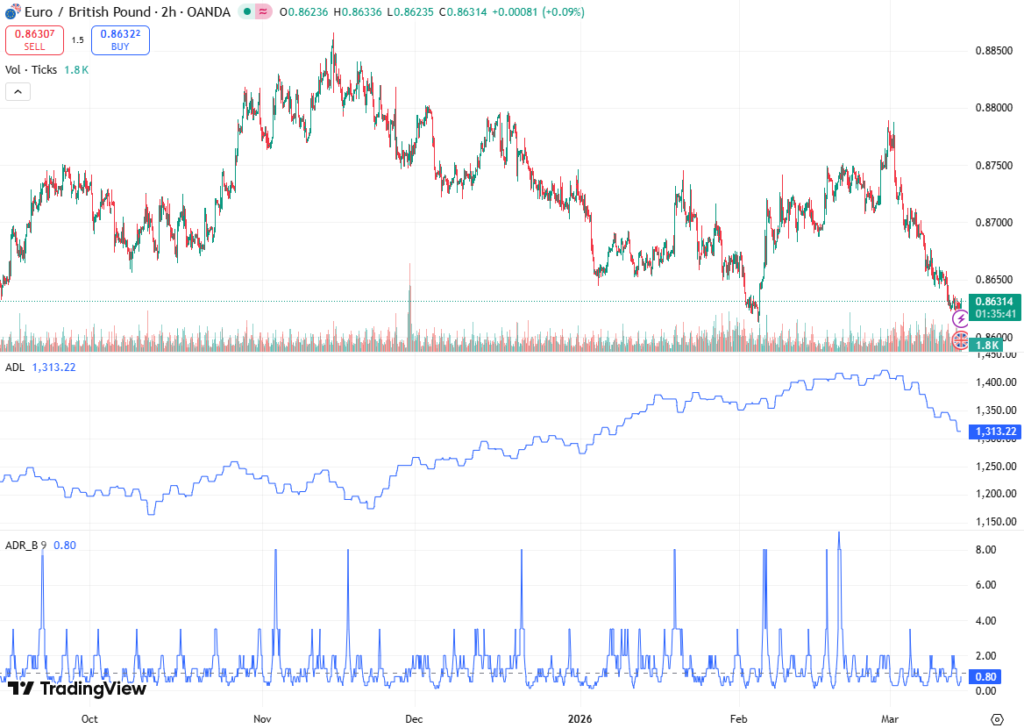
This contrast in policy outlook is prompting investors and forex traders to favor the Euro over the Pound, reinforcing the EUR/GBP uptrend. Analysts note that unless the UK economy shows signs of robust recovery, the Pound Sterling may continue to struggle against the Euro, especially amid geopolitical uncertainties affecting inflation expectations in the Eurozone.
Upcoming Data and Market Implications
Investors will closely monitor Eurozone Industrial Production for January, which may provide further directional cues for the EUR/GBP cross. Stronger-than-expected production figures could reinforce Euro gains, while weaker readings may temper the Euro’s rally despite UK economic weakness.
Meanwhile, market participants will also watch BoE commentary and UK economic releases, as further stagnation or negative surprises could pressure GBP further. The interplay between UK data and ECB policy expectations remains central to trading strategies and positioning in the EUR/GBP market.
Conclusion
The EUR/GBP cross continues to hold gains near 0.8630, driven by weak UK GDP data and a hawkish ECB outlook. Stagnant UK economic growth, lower-than-expected industrial and manufacturing figures, and an increased likelihood of ECB rate hikes have collectively supported the Euro against the Pound Sterling.
With Eurozone Industrial Production data set to be released later on Friday and continued geopolitical concerns, market participants should remain vigilant for potential volatility in the EUR/GBP cross. Current technical levels suggest 0.8600 support and 0.8650 resistance, while broader macro trends point to a favorable environment for EUR strength in the near term.


