
The USD/INR currency pair has rebounded toward record highs, trading near 92.90 in the previous session, even as market participants anticipate potential intervention from the Reserve Bank of India (RBI). The team of brokers at Nummvix explores this topic and outlines the key points in this article.
Despite efforts to stabilize the Indian Rupee (INR), the domestic currency continues to face depreciation pressures due to a combination of volatile energy prices and persistent foreign capital outflows from Indian equities.
Traders indicated that the RBI is likely to step in, selling US Dollars (USD) to support the INR, particularly amid rising oil price concerns. However, the overall sentiment remains tilted toward further rupee weakness, as external factors continue to dominate the market.
Drivers of INR Depreciation
The Indian Rupee has struggled despite probable central bank intervention. Analysts point to the persistent volatility in global energy markets, especially crude oil, as a key driver of INR depreciation. Additionally, foreign institutional investors (FIIs) continue to withdraw funds from local equities, adding further downward pressure on the currency.
Oil prices remain the primary factor shaping FX, bond, and equity markets. West Texas Intermediate (WTI) crude, for instance, edged lower to around $94.50 per barrel, following a more than 9% surge in the previous session. The drop came after Chris Bowen, Australia’s Energy Minister, announced the release of up to 762 million litres of fuel from reserves, aiming to mitigate supply disruptions linked to the Iran conflict.
US Dollar Strength and Fed Policy
The USD/INR pair is further supported by the strength of the US Dollar (USD), which remains firm as expectations for Federal Reserve rate cuts diminish. Futures markets and economists largely anticipate that the Fed will keep interest rates unchanged at its upcoming policy meeting, maintaining the federal funds rate at 3.50%–3.75%.
Market participants are also closely watching key US economic data releases, including the Personal Consumption Expenditures (PCE) Price Index, the fourth-quarter GDP growth, and March consumer confidence metrics. The PCE serves as the Fed’s preferred inflation gauge, and upcoming figures are expected to provide insights into price pressures in the economy.
Latest US inflation figures suggest that price pressures remain moderate, offering little immediate reason for alarm. Data for February’s Consumer Price Index (CPI) revealed a 0.3% increase month-over-month (MoM) and a 2.4% rise year-over-year (YoY), broadly matching economists’ forecasts and signaling that inflation is moving largely in line with expectations.
Meanwhile, Core CPI, which removes volatile food and energy components, climbed 0.2% MoM and 2.5% YoY. This steady reading strengthens expectations that the Federal Reserve may maintain its current policy stance in the short term.
Technical Analysis: USD/INR Approaches All-Time Highs
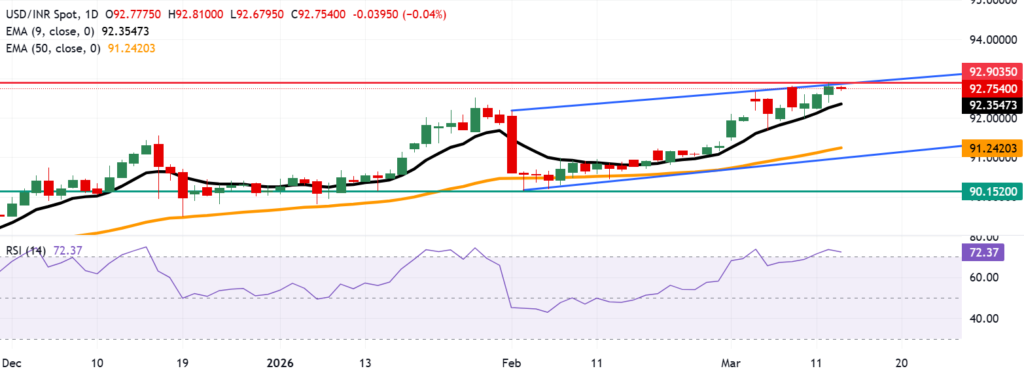
On the technical front, USD/INR continues to demonstrate a bullish bias, recovering its daily losses and testing the upper boundary of the ascending channel. At the time of writing, the pair trades around 92.70, maintaining levels well above the nine- and 50-day Exponential Moving Averages (EMAs), which track the established advance from 90.60.
The 14-day Relative Strength Index (RSI) currently sits at 71, indicating that momentum remains strongly bullish within overbought territory. Traders are closely watching the all-time high of 92.90, reached on March 12, as a critical resistance level. A sustained break above this threshold could open the door to further upside potential, potentially targeting the 93.00 mark.
On the downside, primary support lies at the nine-day EMA at 92.35. A break below this level may signal short-term weakness, exposing the 50-day EMA at 91.24, followed by the lower boundary of the ascending channel near 91.00. Analysts suggest that maintaining levels above these key EMAs is crucial for continuing the bullish momentum in the USD/INR pair.
Outlook: INR Likely to Remain Under Pressure
Overall, the Indian Rupee faces continued depreciation risks, with the trajectory heavily influenced by global oil prices, foreign investor flows, and the Fed’s monetary stance. Traders expect that RBI intervention may provide temporary relief, but external pressures could maintain a downward bias in the near term.
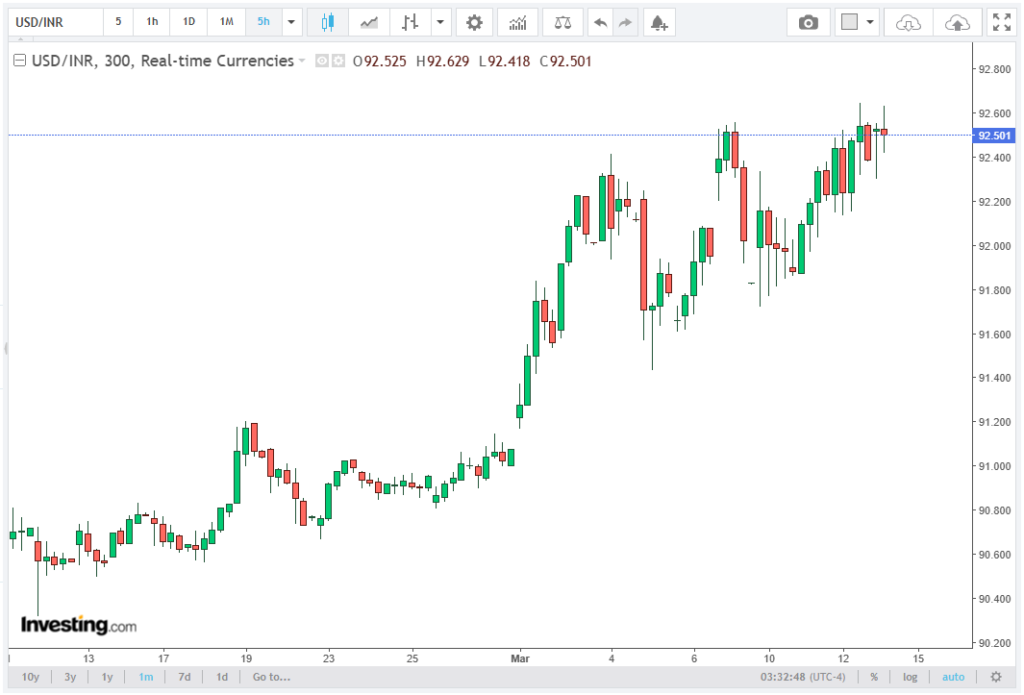
With energy prices remaining volatile and geopolitical uncertainties unresolved, USD/INR could continue to test record highs, while short-term technical indicators suggest the pair remains in a bullish trend. Investors and traders should monitor oil markets, FX flows, and key US economic data for signs of potential reversals or continuation in currency momentum.
Conclusion
In summary, the USD/INR rebound highlights a complex interplay between domestic interventions by the RBI, persistent global energy volatility, and a resilient US Dollar supported by steady Fed policy expectations. While short-term technicals indicate continued bullish pressure, the INR remains vulnerable to external shocks, making it essential for market participants to stay vigilant in a highly dynamic forex environment.


