
Gold (XAU/USD) edged lower during the early European session on Wednesday, slipping just below the $5,200 level after trimming part of its modest intraday gains. Despite the minor pullback, the precious metal remains close to a one-week high, highlighting the resilience of bullish sentiment in the broader market structure. This article includes a full breakdown of the topic prepared by the brokers at Byronixel.
The decline in the US Dollar (USD) has provided underlying support for the non-yielding yellow metal, as investors increasingly price in the possibility that the US Federal Reserve (Fed) may retain flexibility to cut interest rates in the coming months. A softer USD typically enhances the attractiveness of gold, since the metal is priced in dollars globally, making it cheaper for international buyers when the currency weakens.
Crude Oil Pullback Reduces Inflation Concerns
A major factor affecting the gold market is the recent sharp reversal in Crude Oil prices. Earlier this week, oil surged to its highest level since June 2022, driven by escalating tensions in the Middle East. However, the rally quickly lost steam after signals emerged that the conflict could eventually de-escalate.
Comments from the US President, suggesting that the Middle East conflict may end sooner than expected, contributed to the decline in oil prices. Adding to the downward pressure, a report from the International Energy Agency (IEA) indicated that the organization has proposed the largest coordinated release of oil reserves in history in order to stabilize global energy markets amid the US-Israel conflict with Iran.
The potential release of strategic reserves is viewed as a powerful intervention mechanism designed to prevent a war-driven surge in energy prices. If successful, it could significantly reduce the risk of inflationary spillovers from energy markets into the broader global economy.
US CPI Report Becomes the Key Market Catalyst
While geopolitical developments remain significant, the primary focus for financial markets now shifts to the upcoming US Consumer Price Index (CPI) report. This data release is widely considered one of the most influential indicators of inflation trends in the United States.
The CPI figures will play a crucial role in shaping expectations regarding the future path of Federal Reserve monetary policy. If inflation shows signs of cooling more rapidly than anticipated, it could reinforce market expectations for multiple interest-rate cuts in the coming quarters.
Conversely, stronger-than-expected inflation data could force the Fed to maintain a more cautious stance, potentially delaying the easing cycle. Such an outcome would likely strengthen the USD and temporarily weigh on gold prices.
Adding another layer of complexity is the strategic importance of the Strait of Hormuz, a critical global shipping route for oil exports. Market participants remain concerned that any prolonged disruption to energy supply chains could re-ignite inflation pressures globally.
Technical Outlook: Bullish Structure with Short-Term Weakness
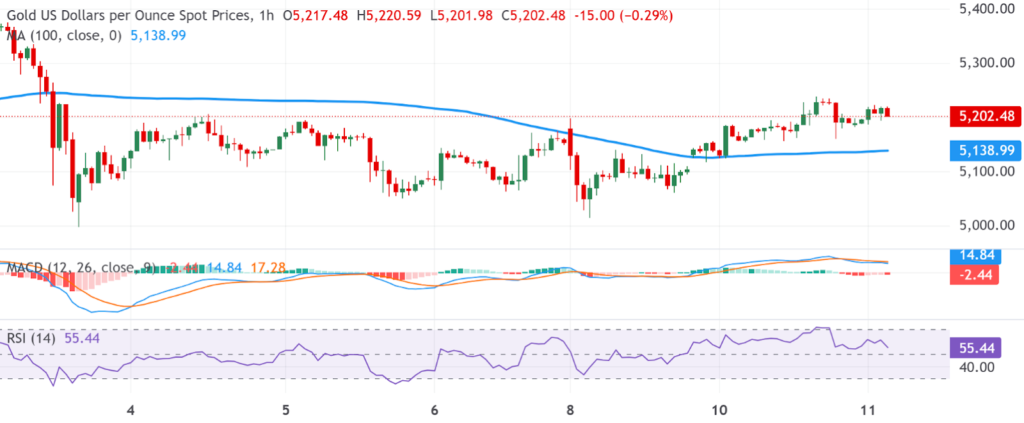
From a technical perspective, gold recently triggered bullish signals after breaking above the rising 100-hour Simple Moving Average (SMA). This move initially encouraged buyers to re-enter the market, reinforcing the broader uptrend in XAU/USD.
However, the lack of sustained follow-through buying has introduced a degree of caution among traders. The Moving Average Convergence Divergence (MACD) indicator remains below its signal line, accompanied by a negative histogram, suggesting that upside momentum is fading after the recent rally.
Similarly, the Relative Strength Index (RSI) has retreated from overbought territory above 70 to the mid-50 range, indicating that the market is undergoing a natural cooling phase after a strong upward move.
In terms of key technical levels, the immediate resistance zone sits near $5,228, corresponding to the latest intraday high. A decisive breakout above this level could open the door for a fresh bullish leg toward $5,260, potentially reviving the upward momentum.
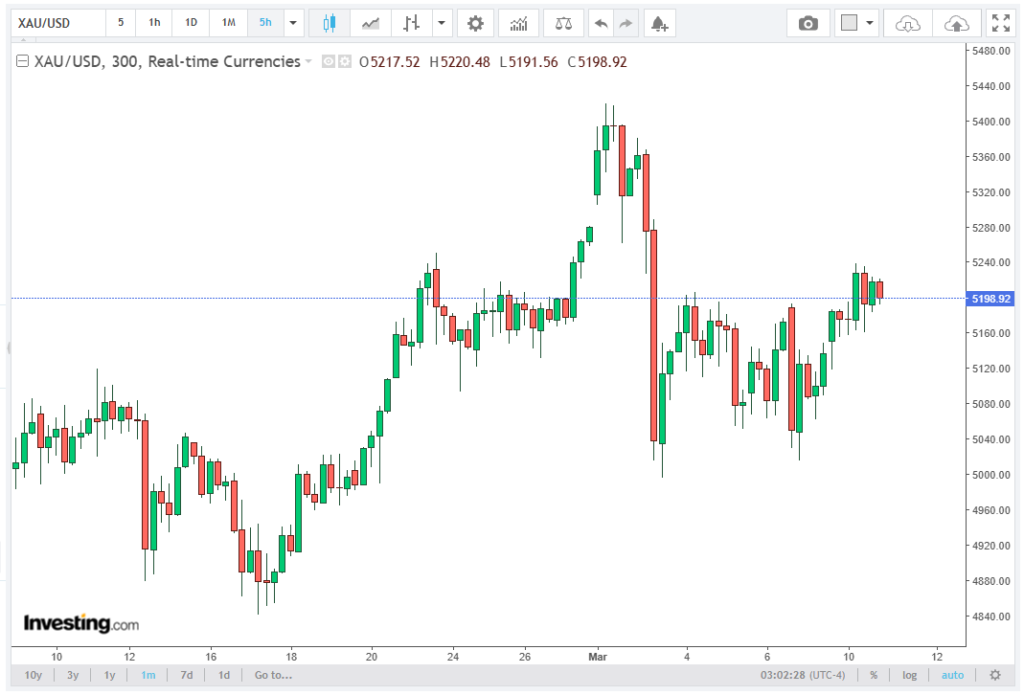
On the downside, initial support emerges near $5,190, followed by a more critical demand zone around $5,160, where previous reaction lows align with the rising 100-period SMA. A sustained drop below this level could undermine the short-term bullish structure, exposing the next support near $5,140.
Nevertheless, as long as gold remains above the $5,190 support region, the broader outlook remains constructive, with any pullbacks likely to attract fresh buying interest.
Outlook: Bullish Bias Remains Intact
Overall, the fundamental backdrop for gold continues to favor bullish traders. A combination of geopolitical uncertainty, softer USD dynamics, and expectations of future Fed rate cuts provides a supportive environment for the precious metal.
Although short-term technical indicators point to temporary consolidation, the underlying market narrative still supports the longer-term upward trajectory. If upcoming inflation data aligns with expectations of easing price pressures, gold could resume its upward momentum in the near term.
For now, traders remain in a wait-and-see mode, with the US CPI report likely to serve as the next major catalyst for gold and broader financial markets.


