
The EUR/USD exchange rate has remained under pressure in recent sessions as macroeconomic uncertainty and geopolitical tensions continue to influence global currency markets. On Tuesday, the pair was trading around 1.1580, slightly above the year-to-date low of 1.1500, after a notable decline from the January peak of 1.2080.
This downward movement signals a growing bearish sentiment among traders as the euro struggles against a relatively resilient US dollar. The brokers at Byronixel explore this topic thoroughly in the following article.
Several fundamental drivers are contributing to the negative outlook for the euro, including declining European confidence, rising energy prices, and increased geopolitical risks stemming from tensions in the Middle East. At the same time, technical indicators suggest that the currency pair may continue moving lower if key support levels fail to hold.
European Confidence Drops as Options Market Turns Bearish
One of the primary catalysts behind the recent weakness in EUR/USD is the decline in Eurozone economic confidence. Data released on Monday revealed that consumer sentiment deteriorated after three consecutive months of improvement.
The widely followed Sentix Investor Confidence Index fell by 7.3 points, dropping to −3.1 in March, indicating a significant deterioration in investor expectations regarding the European economy. The decline comes as the new war involving Iran has introduced fresh uncertainty into global markets, particularly through its impact on energy prices.
The conflict has triggered a sharp rise in crude oil and natural gas prices, both of which have substantial implications for the European Union. The region relies heavily on energy imports, especially from the Middle East, making it particularly vulnerable to supply disruptions and price volatility.
As a result, traders in the currency options market have turned increasingly bearish on the euro, with positioning reaching its most negative levels since the beginning of the Russia-Ukraine conflict four years ago. This shift in market sentiment reflects expectations that prolonged geopolitical instability could weigh heavily on European economic growth.
Upcoming US Economic Data Could Influence Market Direction
In addition to geopolitical developments, traders are closely monitoring key US economic indicators that could influence the direction of the EUR/USD pair.
One of the near-term releases is the existing home sales report, which is scheduled to be published on Tuesday. Economists anticipate that US existing home sales will decline slightly to 3.90 million in February, compared with 3.91 million in January. While this data may generate moderate volatility, it is unlikely to significantly alter the broader market outlook.
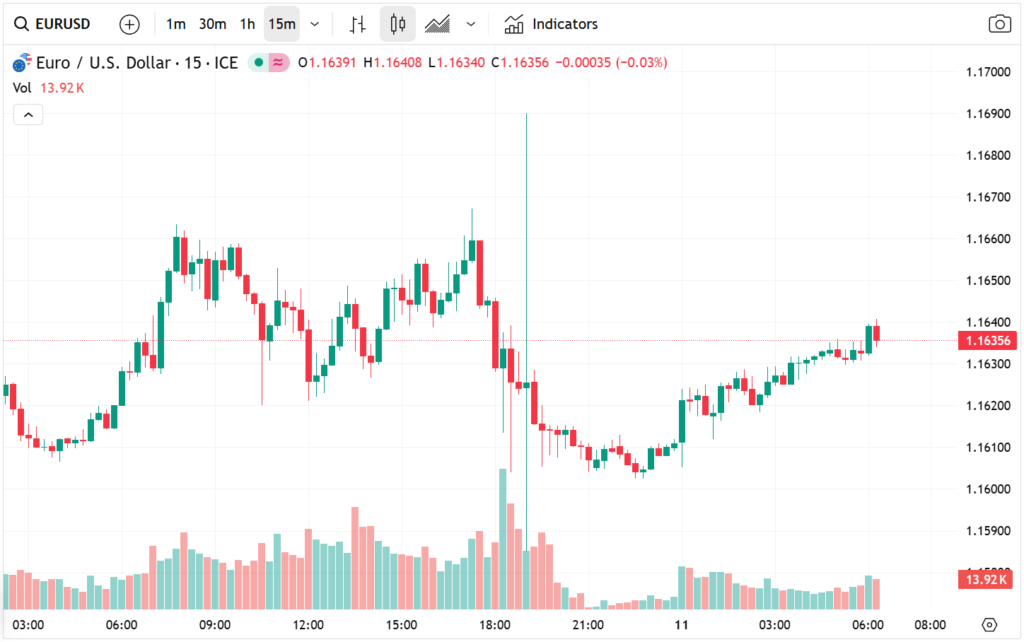
A more important event will occur on Wednesday, when the United States releases the latest Consumer Price Index (CPI) report. Market participants expect headline inflation to increase by 2.4% year-over-year in February, while core CPI, which excludes volatile food and energy prices, is forecast to rise 2.5%.
EUR/USD Technical Analysis
From a technical analysis perspective, the outlook for EUR/USD remains bearish after the pair broke below a critical ascending trendline that had connected the lowest price swings since August of last year.
On the daily timeframe chart, the pair has fallen significantly from the January high of 1.2080 to the current level near 1.1582, confirming the presence of a strong downward trend. The break below the 50-day Exponential Moving Average (EMA) is another key signal that bearish momentum is gaining strength.
Momentum indicators further support the negative outlook. The Relative Strength Index (RSI) has been trending lower, reflecting weak buying pressure and increasing seller dominance. Meanwhile, the Percentage Price Oscillator (PPO) has also continued to decline, reinforcing the view that the broader market momentum favors short positions.
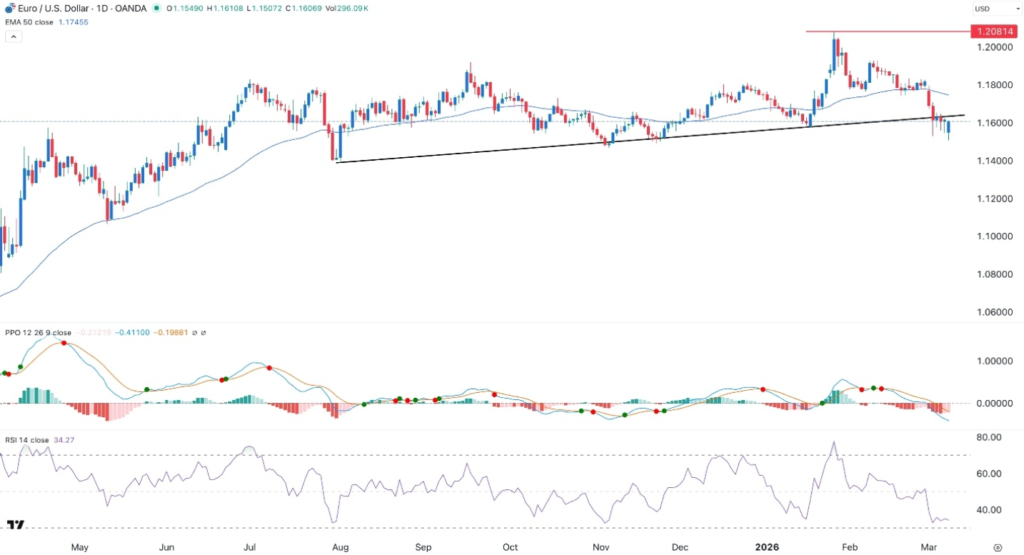
From a support and resistance perspective, the next critical support level lies around 1.1400. If sellers maintain control, the pair could test this level in the coming sessions. A decisive break below 1.1400 would open the door to even deeper declines.
On the other hand, the bearish outlook would be invalidated if EUR/USD manages to recover above the previously broken ascending trendline and reestablish momentum above the 50-day EMA. Such a move would signal a potential shift in sentiment and could trigger short covering among traders.
Outlook for Traders
Given the combination of weak European economic sentiment, rising energy prices, geopolitical uncertainty, and bearish technical indicators, the near-term outlook for EUR/USD remains tilted to the downside.
Unless there is a significant improvement in global risk sentiment or a sharp shift in monetary policy expectations, sellers are likely to remain in control. Traders will therefore be closely watching Middle East developments, US inflation data, and key technical levels to determine the pair’s next major move.
For now, the market structure suggests that downside risks remain dominant, with 1.1400 emerging as the next major target for bearish traders.


