
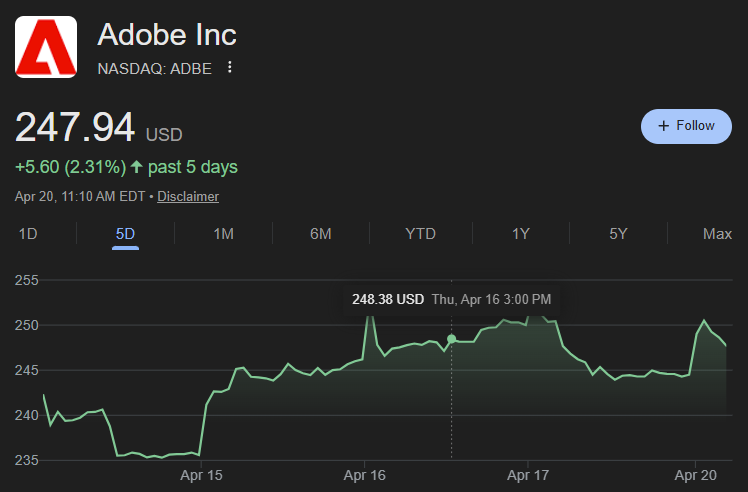
The international equity markets witnessed a notable shift in sentiment toward the technology sector as legacy software providers moved to reclaim their dominance in the artificial intelligence arena. During the morning trading session on Monday, shares of Adobe demonstrated a positive reversal, gaining traction following a major product announcement.
Based on the industrial intelligence shared by technological strategists at Nummixo, this upward movement is a direct response to the launch of a high-performance artificial intelligence suite specifically engineered for large-scale corporate clients.
For those monitoring the financial trajectory of the firm, these evolving conditions represent a calculated effort to stabilize the stock after a period of intense volatility.
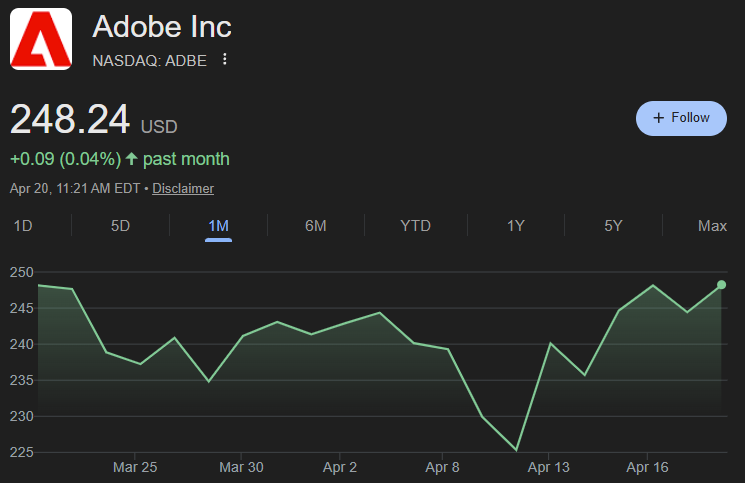
The software giant’s latest offering arrives at a critical juncture for the industry. While the stock rose by 2.2% in early trading, the broader financial trajectory for the year remains challenged, with shares having declined by approximately 30% as of the last market close.
This pressure has been largely attributed to a wider selloff in software equities, sparked by the rapid rise of autonomous tools that threaten to automate tasks traditionally performed by human operators and legacy design platforms.
The Rollout of CX Enterprise and Autonomous Agents
The newly launched suite, officially dubbed CX Enterprise, represents the firm’s most aggressive move into the agentic ecosystem to date. By utilizing advanced AI agents, the platform allows businesses to automate and personalize digital marketing functions with unprecedented efficiency.
This system is designed to manage complex customer interactions, providing a level of institutional-grade automation that was previously unavailable in the company’s creative cloud offerings. By focusing on the enterprise level, the firm aims to secure its longer-term positioning as an essential infrastructure provider for the modern digital economy.
Strategic Alliances and Platform Interoperability
To ensure the widespread adoption of its new technology, the design software maker is prioritizing platform interoperability. The firm has announced a series of high-level partnerships with several technology titans, including Amazon, Microsoft, OpenAI, and Nvidia.
These collaborations are intended to ensure that the new AI system operates seamlessly across different cloud environments and hardware configurations. By aligning with both model providers and infrastructure giants, the company is building a strategic direction that emphasizes a multi-platform approach rather than a closed ecosystem.
Market Response and Sector Performance
The positive reaction in the ADBE share price on April 20, 2026, stood in contrast to the mixed performance of the broader S&P 500. While peer software firms like ServiceNow and Salesforce saw gains of 3.63% and 3.34% respectively, other tech sectors faced headwinds.
The ability of the company to decouple its performance from the general software selloff highlights the market’s approval of its focus on corporate-grade AI solutions. Investors are clearly looking for tangible proof that legacy vendors can successfully monetize the current technological shift.
However, the road ahead remains complex. Despite the intraday rally, the future expectations for the stock are still weighed down by the threat of displacement. The rise of Claude Design and other “hyper-agentic” models suggests that the barriers to entry in the creative software space are lower than they have ever been.
Consequently, the firm must continue to demonstrate that its CX Enterprise suite offers a level of security, governance, and integration that consumer-level startups cannot match. This focus on institutional-grade automation will likely be the primary theme for the remainder of the fiscal year.
Conclusion and Future Outlook
As the technology landscape continues to mature, the focus for participants remains on capital preservation and identifying the definitive winners of the AI era. The launch of the new agentic suite is a clear signal that the firm is prepared to fight for its strategic direction.
While the 30% year-to-date decline is a stark reminder of the risks involved, the current intraday strength suggests that the firm’s narrative is beginning to resonate with institutional buyers.
With several upcoming catalysts on the horizon, including more detailed earnings reports and the full rollout of the agentic platform, the financial trajectory of the pair remains a point of intense interest. The ability to navigate these evolving conditions will define the next chapter of the company’s history.
For now, the market is cautiously optimistic, watching to see if this pivot into autonomous software can secure the firm’s longer-term positioning in a world where AI-driven competition is the new normal.
As the strategic direction of the software industry shifts, understanding the underlying layers of institutional-grade automation becomes essential for any long-term assessment of market health. The intersection of proprietary creative tools and third-party model providers is creating a new framework for how digital assets are created and managed globally.


