
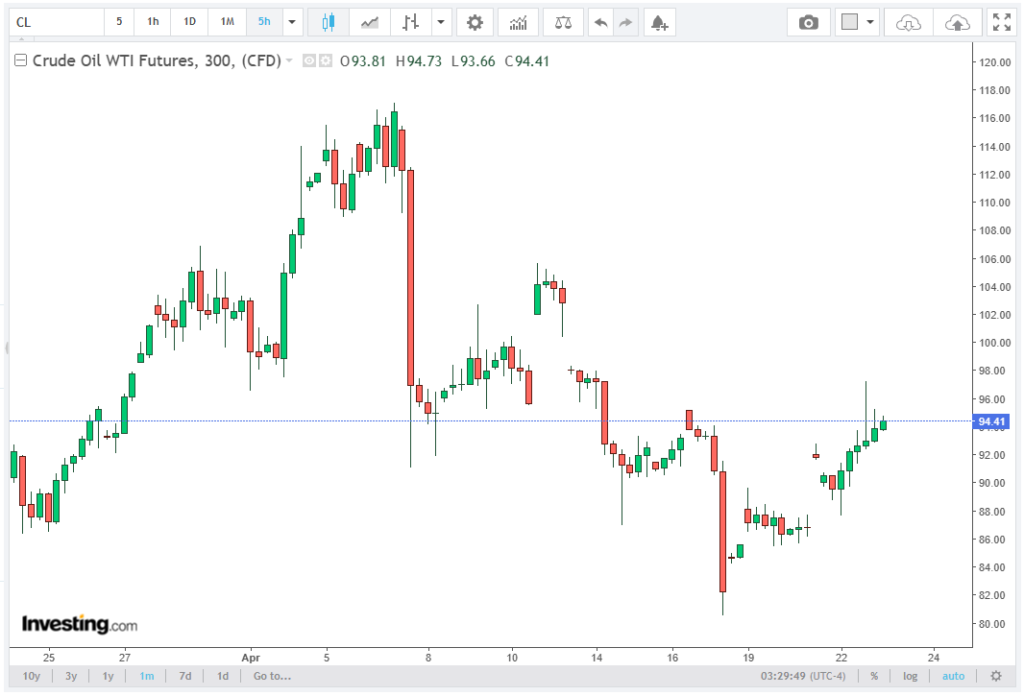
West Texas Intermediate (WTI) crude oil continues its upward trajectory, rising for a third consecutive session and trading near $93.00 per barrel during Asian hours on Thursday. The latest price action reflects a combination of geopolitical supply risks, shifting global trade flows, and mixed U.S. inventory data that collectively reinforce a bullish crude oil sentiment in the short term.
The market is increasingly pricing in the risk of supply chain disruption stemming from escalating tensions in the Middle East, particularly around the strategically vital Strait of Hormuz, one of the world’s most critical energy transit chokepoints. The article from Achievements AI gives a clear and in-depth explanation of this subject.
Geopolitical Risk: Strait of Hormuz Escalation
Oil markets were jolted by reports that Iran fired on three commercial vessels in the Strait of Hormuz, subsequently escorting two of them into Iranian waters on Wednesday. According to the Wall Street Journal, the incident marks a notable escalation in maritime tensions.
Iranian state media further confirmed that the Islamic Revolutionary Guard Corps (IRGC) had taken control of the vessels, signaling heightened enforcement activity in the region. Despite this, White House press secretary Karoline Leavitt stated that the seizures did not constitute a breach of the existing ceasefire framework.
The Strait of Hormuz is responsible for roughly 20% of global oil transit flows, making it one of the most sensitive geopolitical pressure points for energy markets. Any perceived disruption to shipping routes immediately translates into a risk premium embedded in crude oil pricing, as traders reassess potential supply bottlenecks.
Political Rhetoric and Escalating Tensions
Adding to market uncertainty, Iranian parliamentary speaker and chief negotiator Mohammad Bagher Ghalibaf declared that reopening the Strait of Hormuz would be “impossible” as long as the United States and Israel continue what Tehran describes as “flagrant ceasefire violations,” including alleged naval restrictions.
These statements underscore a deteriorating diplomatic environment, where energy infrastructure and maritime routes are increasingly intertwined with geopolitical bargaining strategies. Meanwhile, the U.S. President stated that the current ceasefire arrangement would remain in place indefinitely, while Washington awaits a renewed peace proposal from Tehran.
Global Supply Dynamics: U.S. Export Surge
On the supply side, U.S. energy data revealed a significant expansion in outbound crude flows. According to Reuters, U.S. crude oil and petroleum product exports increased by 137,000 barrels per day (bpd), reaching a record 12.88 million bpd.
This surge highlights the growing role of the United States as a structural energy exporter, particularly as demand from Asia and Europe strengthens in response to Middle East supply uncertainty. The increase in exports reflects both competitive pricing of U.S. crude grades and strategic stockpiling behavior by international buyers seeking to diversify supply sources.
Inventory Data: Bearish Surprise from EIA
Contrary to the geopolitical bullishness, the latest Energy Information Administration (EIA) Crude Oil Stocks Change report introduced a mildly bearish surprise. U.S. crude inventories rose by 1.925 million barrels, against market expectations for a 1.2 million-barrel draw.
The unexpected build suggests that domestic supply remains relatively resilient despite strong export activity. It may also indicate slower refinery demand absorption or timing distortions in import/export flows.
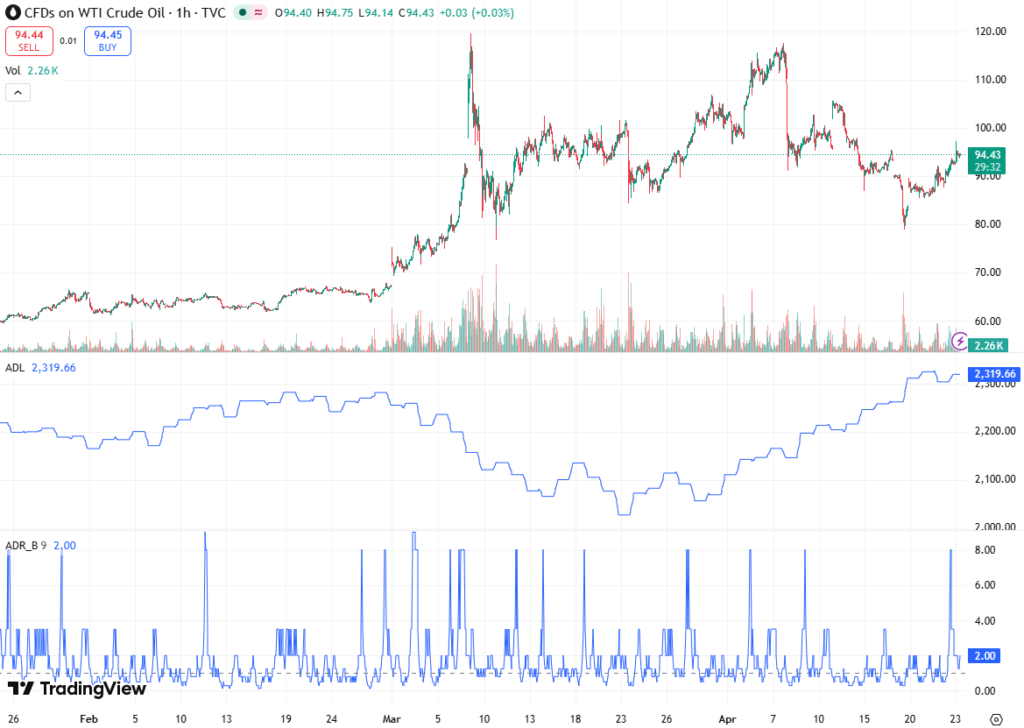
From a trading perspective, the inventory increase tempers some of the upside momentum, highlighting a key tension in the current market: geopolitical risk premiums versus fundamental supply adequacy.
Market Implications: Risk Premium vs Fundamentals
The WTI rally toward $93.00 is primarily driven by a rising geopolitical risk premium, rather than purely demand-side fundamentals. The Strait of Hormuz disruption has forced traders to reassess the probability distribution of extreme supply scenarios, including partial shipping delays or temporary route closures.
At the same time, strong U.S. export performance underscores robust global demand, particularly from non-OECD regions, where industrial consumption and strategic reserves remain active. This creates a dual narrative: tightening global supply perception versus stable or slightly expanding physical availability.
The rise in U.S. inventories introduces a counterweight, suggesting that while global flows are strong, domestic balancing mechanisms remain functional. However, in highly sensitive geopolitical environments, risk perception often outweighs inventory fundamentals in the short term.
Outlook: Volatility Likely to Persist
Looking ahead, crude oil markets are expected to remain highly sensitive to developments in the Middle East maritime corridor, particularly any further incidents involving tanker seizures or naval engagements in the Strait of Hormuz.
If tensions escalate further, WTI could maintain upward pressure above the $90–$95 per barrel range, with potential spikes depending on perceived supply interruption severity. Conversely, stabilization in shipping lanes or diplomatic de-escalation could quickly reduce the embedded risk premium.
For now, the combination of geopolitical instability, record U.S. exports, and mixed inventory signals suggests that the oil market remains in a high-volatility equilibrium, where sentiment can shift rapidly based on headlines rather than purely structural fundamentals.


