
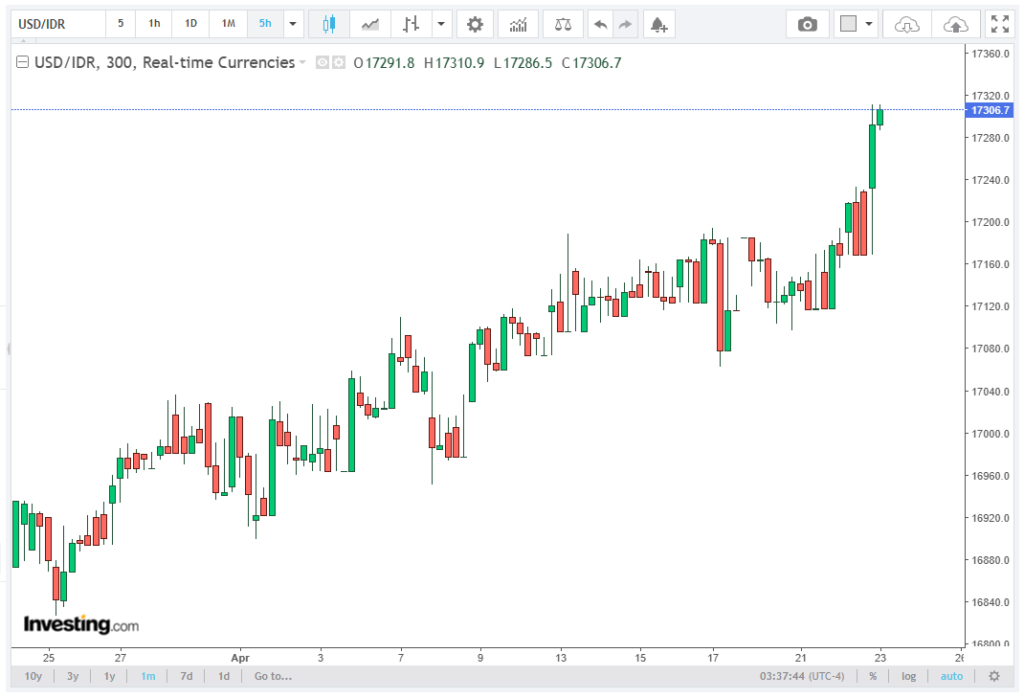
The Indonesian Rupiah (IDR) extended its decline sharply on Thursday, with the USD/IDR pair surging beyond the psychologically significant 17,300 level to print a fresh record high at approximately 17,324. This marks a continuation of the aggressive bullish trend in the pair, as it advances for the third consecutive trading session. The team at Achievements AI outlines this topic in a precise and accessible way in their article.
The move underscores persistent weakness in the Rupiah, which is now among the worst-performing emerging Asian currencies this month. Broader macroeconomic headwinds, combined with escalating geopolitical tensions in the Middle East, have reinforced downside pressure on the IDR, while simultaneously boosting demand for the US Dollar (USD).
Geopolitical Tensions Drive Risk-Off Flows
A key catalyst behind the Rupiah’s depreciation is the escalation in Middle East tensions, particularly the ongoing US–Iran standoff involving the Strait of Hormuz, a critical global oil shipping route. Markets remain sensitive to any disruption risks in this corridor, which has historically triggered sharp spikes in energy prices.
As a result, Crude Oil prices remain elevated, raising concerns over import-driven inflation in energy-dependent economies such as Indonesia. Higher oil prices also worsen Indonesia’s trade balance outlook, increasing external vulnerability and putting additional strain on the currency.
The prevailing environment has triggered a strong risk-off sentiment across global markets, with investors reducing exposure to emerging market assets and reallocating capital into perceived safe havens.
US Dollar Strength Fueled by Safe-Haven Demand
The US Dollar Index (DXY) has continued to strengthen, supported by persistent safe-haven inflows amid geopolitical instability. Investors are increasingly seeking refuge in USD-denominated assets, reinforcing upward pressure on the currency.
In addition, expectations that the Federal Reserve (Fed) will maintain a less dovish policy stance have further supported the dollar. Despite some cooling inflation metrics, underlying US economic resilience and sticky core price pressures continue to reduce expectations for aggressive rate cuts.
This combination of geopolitical uncertainty and interest rate differentials has significantly bolstered the USD, amplifying the upside momentum in USD/IDR.
Indonesian Economic Fundamentals Under Pressure
On the domestic front, the Indonesian Rupiah continues to struggle despite verbal reassurances from policymakers. Rising global uncertainty has exposed structural vulnerabilities in emerging market currencies, particularly those reliant on commodity-linked trade flows.
Bank Indonesia Deputy Governor Thomas Djiwandono acknowledged that recent IDR depreciation is largely driven by external global shocks. He reiterated that the central bank is actively working to strengthen the interest rate structure to attract foreign portfolio inflows and stabilize the currency.
Additionally, he confirmed that Bank Indonesia will intensify foreign exchange intervention measures, aiming to smooth excessive volatility in the currency market.
However, these measures have so far provided limited relief, as external pressures continue to dominate price action in USD/IDR.
Government Commentary Fails to Stabilize Sentiment
Adding to the policy narrative, Indonesia’s Chief Economic Minister Airlangga Hartarto projected that first-quarter economic growth could reach around 5.5%, driven by holiday-related consumption and ongoing fiscal stimulus measures.
While this outlook suggests underlying domestic demand resilience, it has failed to materially support the Rupiah. Markets appear more focused on global macro risk factors, particularly energy prices, US monetary policy expectations, and geopolitical uncertainty.
The disconnect highlights a key market dynamic: strong domestic growth projections are currently being overshadowed by external risk shocks, limiting positive spillover effects on currency performance.
Technical Outlook: Overbought Conditions Emerge
From a technical perspective, the USD/IDR rally remains strongly bullish, with the pair showing consistent follow-through buying pressure above key resistance levels. The breakout above 17,300 signals continued momentum-driven trading, with trend-following flows reinforcing upward movement.
However, analysts caution that the pair is approaching extremely overbought conditions, increasing the likelihood of short-term consolidation or corrective pullbacks. Momentum indicators suggest stretched positioning, which may prompt profit-taking if geopolitical headlines stabilize.
Despite this, the broader structure remains intact, with buyers maintaining control as long as risk sentiment remains weak and USD demand persists.
Conclusion: External Shocks Dominate Rupiah Trajectory
The latest surge in USD/IDR to 17,324 underscores the dominant influence of global risk sentiment over domestic fundamentals. Escalating Middle East tensions, persistent safe-haven USD flows, and expectations of a less dovish Federal Reserve continue to drive capital away from emerging markets.
While Bank Indonesia and government officials maintain a constructive domestic growth outlook, these factors have been insufficient to counteract the magnitude of external pressures.
Until geopolitical risks ease or global risk appetite improves, the Indonesian Rupiah is likely to remain under pressure, with volatility in USD/IDR expected to stay elevated in the near term.


