
The EUR/USD exchange rate has experienced a two-day pullback, reflecting renewed caution among traders as markets reassess geopolitical and macroeconomic risks tied to the ongoing US–Iran conflict. In their article, the Fondesia team offers a detailed and easy-to-understand explanation of this topic.
Despite this recent weakness, the broader structure of the pair remains constructive. The currency pair declined to approximately 1.1710, retreating from this month’s peak at 1.1847, yet still holding within a technically bullish framework.
This correction is largely viewed as a profit-taking phase rather than a trend reversal, with traders closely monitoring macro catalysts that could dictate the next directional move.
US Dollar Strength and Macro Drivers Behind the Pullback
The recent weakness in EUR/USD has been driven primarily by a modest recovery in the US Dollar (USD). The US Dollar Index (DXY) has climbed to around 98.55, rebounding from this month’s low near 97.00. This rebound reflects a combination of risk sentiment shifts, commodity price pressures, and expectations surrounding future monetary and labor market data.
At the same time, broader financial markets have experienced a synchronized upward move in both crude oil prices and U.S. Treasury yields, which has contributed to the U.S. dollar’s short-term strength.
In the energy market, Brent crude oil surged to approximately $102 per barrel, while WTI crude oil climbed to around $99 per barrel. This rise in oil prices often reinforces inflation expectations and can influence broader risk and currency dynamics.
Meanwhile, in fixed income markets, the 10-year U.S. Treasury yield rose to 4.30%, and the 2-year yield advanced to 3.80%. The upward movement in yields reflects shifting expectations around interest rates, and it typically provides additional support for the U.S. dollar in the short term.
Rising yields tend to support the dollar by improving relative returns on USD-denominated assets. Meanwhile, higher oil prices reinforce inflation expectations, which can delay expectations for aggressive rate cuts and further strengthen the dollar in the short term.
Upcoming Macroeconomic Catalysts: PMI and Jobless Claims
Attention now shifts toward a series of high-impact economic indicators, particularly flash PMI data and US labor market statistics, which are expected to significantly influence short-term price action.
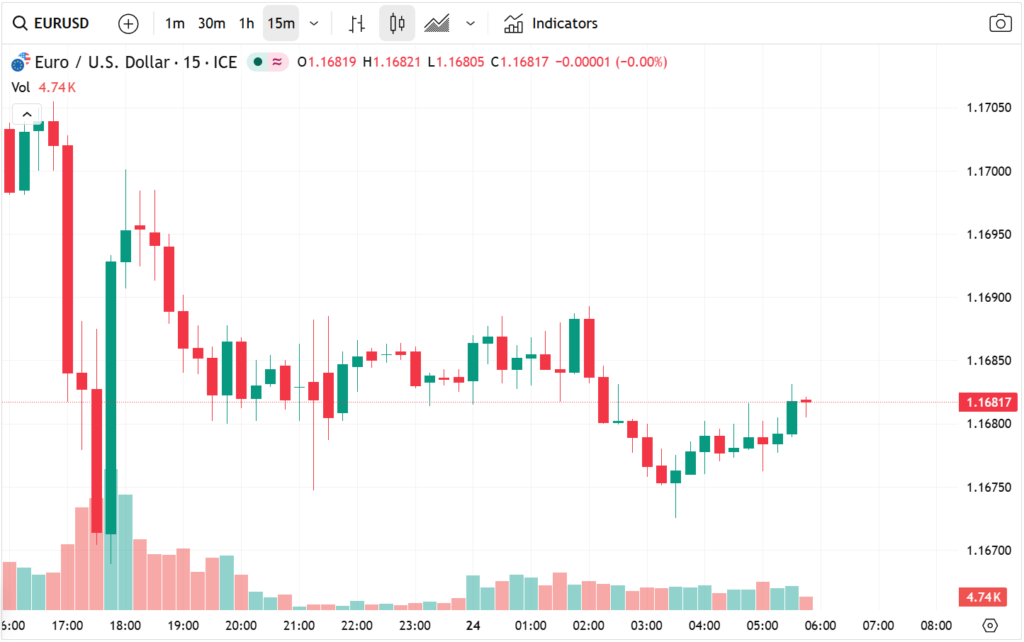
European PMI Data
Economists expect mixed signals from the upcoming Eurozone PMI reports. The Manufacturing PMI is forecast to decline from 51.6 to 50.8, suggesting a possible loss of momentum in the industrial sector. In contrast, the Services PMI is expected to rise slightly from 52.3 to 52.5, indicating a modest improvement in the services sector and a continued, though uneven, economic expansion across the Eurozone.
A reading above 50.0 indicates expansion, while values below that threshold signal contraction. The divergence between manufacturing weakness and services resilience highlights an uneven recovery across the eurozone economy. If manufacturing continues to slow, it may limit upside momentum in the euro.
US Labor Market Data
On the US side, the focus will be on initial jobless claims, which are expected to rise to around 212,000. This figure remains consistent with a still-resilient labor market but may signal gradual softening.
Additional attention will be given to continuing claims, which provide insight into labor market persistence. Strong labor data tends to support the USD by reinforcing expectations of a higher-for-longer Federal Reserve stance.
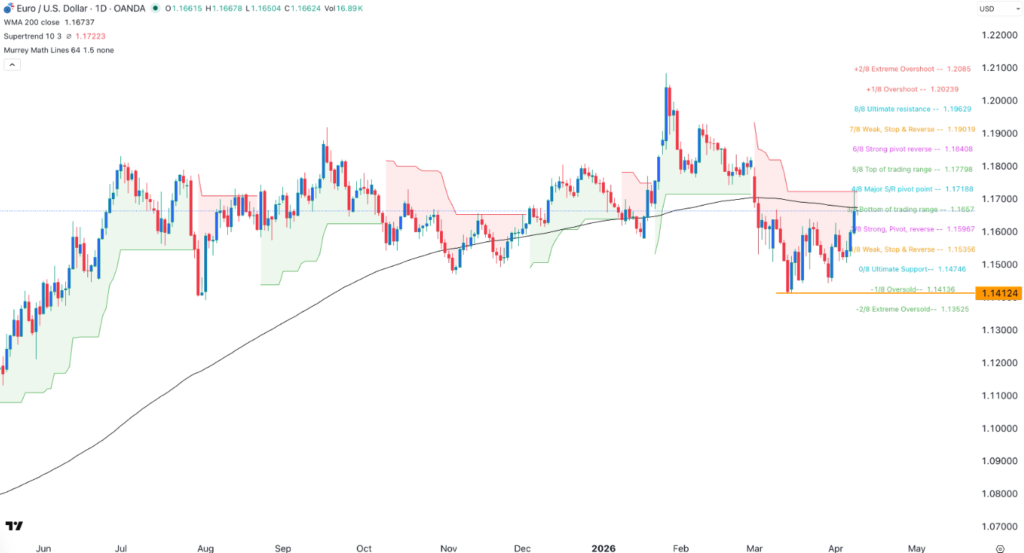
EUR/USD Technical Analysis: Bullish Structure Intact
From a technical perspective, the EUR/USD daily chart continues to reflect a medium-term bullish structure, despite the recent pullback.
The pair has declined from 1.1847 to approximately 1.1715, marking its lowest level since April 13. However, this retracement remains within a controlled corrective channel rather than a breakdown.
The key technical indicators show that the pair remains in a broadly bullish structure. Price is holding above both the 50-day EMA and the 100-day EMA, reinforcing the presence of a sustained uptrend. A confirmed bullish EMA crossover is still intact, which typically signals continued positive momentum over the medium term.
In addition, price remains above the Supertrend indicator, further supporting the view that buyers are maintaining control. Collectively, these signals suggest that the underlying trend momentum remains upward-biased, with no clear indication of a reversal at this stage.
The presence of both the 50-day and 100-day EMAs acting as dynamic support strengthens the case for continued upside potential once short-term selling pressure fades.
Conclusion: Bullish Bias Persists Amid Volatility
Despite recent weakness driven by a stronger US Dollar, rising bond yields, and geopolitical uncertainty, the EUR/USD outlook remains cautiously bullish. The broader technical structure continues to favor upside continuation, supported by key moving averages and sustained trend alignment.
As long as EUR/USD holds above 1.1675, the prevailing bias favors a potential retest of 1.1847, with a breakout opening the path toward 1.1900 in the medium term.


