
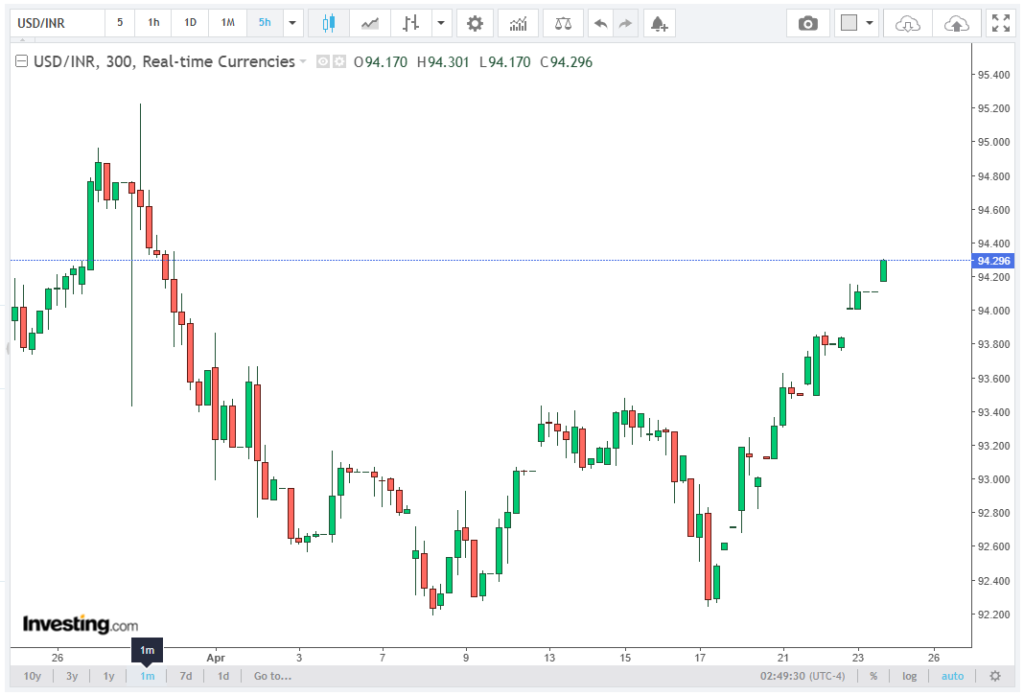
The Indian Rupee (INR) remains under consistent pressure against the US Dollar (USD), extending its downtrend for a fifth straight trading session. The USD/INR pair is holding firmly near the weekly high of 94.38, indicating persistent bearish pressure on the domestic currency. The rupee’s underperformance is being driven by a combination of higher crude oil prices, renewed Foreign Institutional Investors (FII) selling, and a broadly stronger US Dollar Index (DXY).
At the same time, global risk sentiment remains fragile, with investors closely watching geopolitical developments and upcoming central bank decisions. The broader macro environment continues to favor the USD over emerging market currencies like the INR. Fondesia’s team has written an article that explains this topic in a thorough and accessible manner.
Higher Oil Prices Weigh on the Indian Rupee
One of the most significant headwinds for the Indian Rupee is the sharp rise in global crude oil prices. India is a major net oil importer, and higher crude prices directly worsen the country’s trade balance and current account deficit, increasing pressure on the currency.
The recent surge in WTI crude oil prices, which are holding near $95 per barrel, has intensified concerns. The rally has been driven by fears of a prolonged disruption in oil supply through the Strait of Hormuz, a critical maritime route responsible for nearly 20% of global oil flows.
Reports suggest that geopolitical tensions have escalated after Iran suspended oil transit through the region in retaliation against the United States. The uncertainty surrounding a potential reopening of the Strait has created a risk premium in oil markets, further fueling inflationary concerns globally.
For India, higher oil prices translate into a higher import bill, a widening current account deficit, stronger inflationary pressure, and reduced currency stability. As a result, the INR (Indian Rupee) tends to remain structurally weak when facing sustained energy price shocks, since the economy becomes more dependent on costly imports and more vulnerable to external price fluctuations.
FIIs Accelerate Selling in Indian Equities
Another major factor contributing to the weakness in the rupee is the renewed Foreign Institutional Investors (FII) selling pressure in the Indian equity market. Over the last four trading sessions, FIIs have remained net sellers, offloading approximately ₹8,311.99 crore worth of Indian equities.
This sustained outflow reflects weakening foreign investor sentiment amid rising global oil prices, concerns over corporate earnings growth, expectations of tight global financial conditions, and potential fiscal constraints caused by elevated energy imports.
Foreign investors are increasingly cautious about the risk-reward profile of Indian equities, especially as higher oil prices may force the government to redirect spending toward energy subsidies or imports, potentially limiting capital expenditure growth.
Market Focus Shifts to Federal Reserve Policy
Investors are now turning their attention to the upcoming Federal Reserve policy meeting, scheduled for next week. Markets are widely pricing in a hold on interest rates, with the benchmark range expected to remain at 3.50%–3.75%.
However, the key focus will be on the Fed’s forward guidance, particularly regarding potential rate hikes later in the year, the assessment of inflation risks driven by energy prices, and the overall tone on financial tightening.
Given the recent rise in oil prices, the Fed may emphasize upside inflation risks, which could further support the US Dollar. A hawkish tone would likely maintain pressure on emerging market currencies, including the Indian Rupee.
Technical Analysis: USD/INR Maintains Bullish Structure
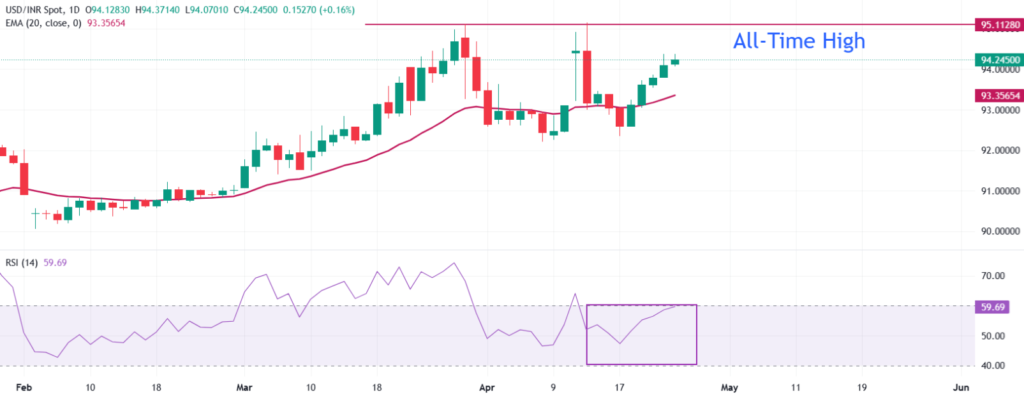
From a technical standpoint, the USD/INR pair continues to display a constructive bullish bias. The pair is currently trading above 94.20, comfortably positioned above the 20-period Exponential Moving Average (EMA) at 93.3565, which acts as a key dynamic support level.
This positioning indicates that buyers remain in control, and the short-term trend continues to favor upside momentum.
Key technical indicators show the Relative Strength Index (RSI 14) near 59, indicating positive momentum without being overbought, sustained trading above the short-term moving average support, and a bullish structure forming higher lows.
On the downside, immediate support is located at 93.3565 (20-EMA). A decisive break below this level would weaken the bullish structure and potentially trigger a short-term correction.
On the upside, the next major resistance is the all-time high near 95.20. A sustained breakout above current levels could open the path for a retest of this psychological and historical resistance zone.
Conclusion: INR Under Pressure Amid Global Headwinds
The Indian Rupee remains under sustained pressure due to a convergence of adverse factors. The combination of higher crude oil prices, persistent FII selling, and a strong US Dollar continues to weigh on sentiment.
Unless there is a meaningful correction in oil prices or a reversal in foreign portfolio flows, the USD/INR pair is likely to remain biased toward the upside, with the market eyeing a potential retest of its all-time high near 95.20.


