
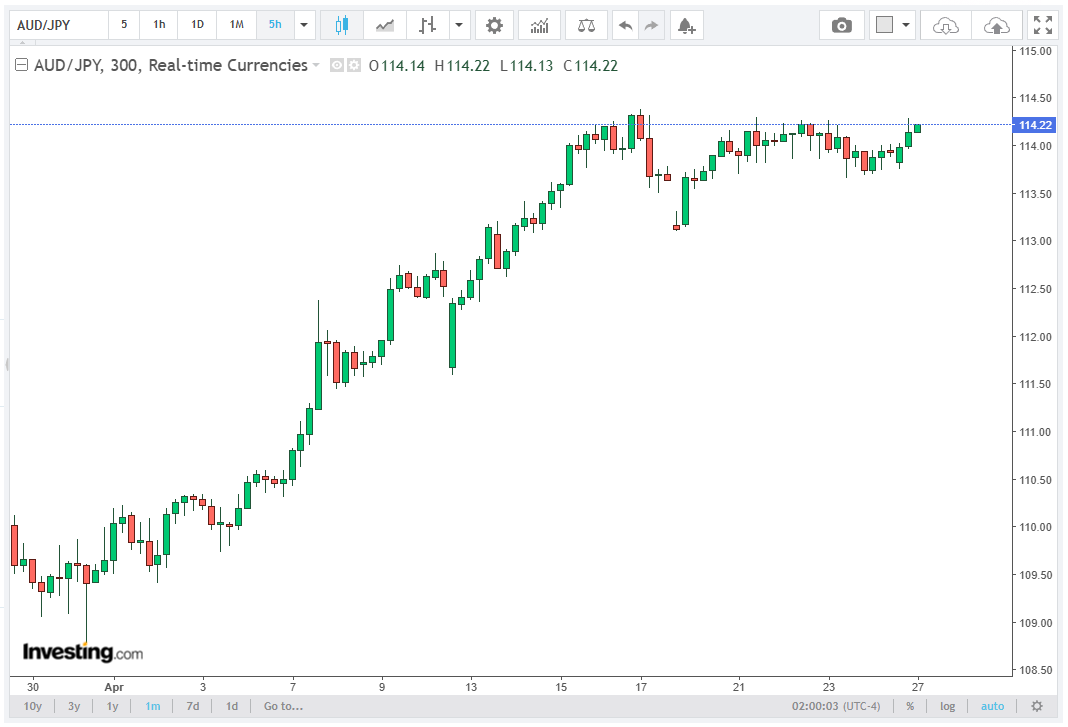
The AUD/JPY currency cross continued to demonstrate upward momentum in Monday’s early European session, climbing toward the 114.15 level after successfully holding above the psychologically significant 114.00 threshold.
The move reflects a broader improvement in global risk sentiment, driven primarily by geopolitical developments and shifting expectations around monetary policy in both Australia and Japan. Achievements AI’s brokers present a detailed and easy-to-understand explanation of this topic in their article.
The Australian Dollar (AUD) benefited from renewed demand for risk-sensitive assets, while the Japanese Yen (JPY) softened modestly as investors reduced safe-haven positioning. The cross remains highly sensitive to macroeconomic catalysts this week, particularly the upcoming Bank of Japan (BoJ) policy decision and Australian inflation data.
AUD Supported by Rate Expectations and Inflation Dynamics
Beyond geopolitics, the Australian Dollar is also being supported by shifting expectations surrounding domestic monetary policy.
Markets are closely awaiting the release of the Australian March Consumer Price Index (CPI) later this week. Consensus forecasts suggest headline inflation will rise to 4.7% year-on-year, a significant acceleration from the 3.7% recorded in February.
A stronger-than-expected inflation print would likely reinforce expectations that the Reserve Bank of Australia (RBA) may be forced to tighten policy further. Traders are increasingly pricing in a potential 25 basis point (bps) rate hike at the upcoming May 5 RBA meeting.
From a macro-FX perspective, higher expected interest rates tend to increase yield attractiveness, providing structural support for the AUD/JPY cross. This is particularly relevant in a diverging environment where Australian monetary policy is potentially tightening while Japanese policy remains ultra-accommodative.
BoJ Policy Decision: Yen Stability Anchored by Ultra-Low Rates
On the other side of the pair, the Bank of Japan (BoJ) is expected to maintain its policy stance at the upcoming meeting on Tuesday, with markets broadly anticipating that the central bank will keep its benchmark interest rate unchanged at 0.75%.
The BoJ remains in a delicate position, balancing persistent inflation pressures against the need to support fragile domestic demand. Recent data has shown that Japanese consumer inflation accelerated for the first time in five months in March, largely driven by rising energy costs and imported price pressures.
Despite this, policymakers are expected to maintain a cautious approach, avoiding premature tightening as they assess the sustainability of inflation trends. This policy inertia continues to weigh on the JPY, as interest rate differentials between Japan and higher-yielding economies remain wide.
In FX markets, the BoJ’s commitment to accommodative conditions reinforces the structural carry trade appeal of selling JPY against higher-yielding currencies like the AUD.
Technical Outlook: Bullish Bias Above 114.00 Support Zone
From a technical analysis standpoint, the AUD/JPY pair has shown an improving bullish structure after reclaiming and holding above the 114.00 support level. This zone now acts as a key short-term pivot for traders monitoring momentum continuation.
Immediate resistance is observed near 114.50, followed by a broader congestion zone around 115.00, which could act as a medium-term psychological barrier. A sustained breakout above these levels would likely signal a continuation of the broader risk-on rally.
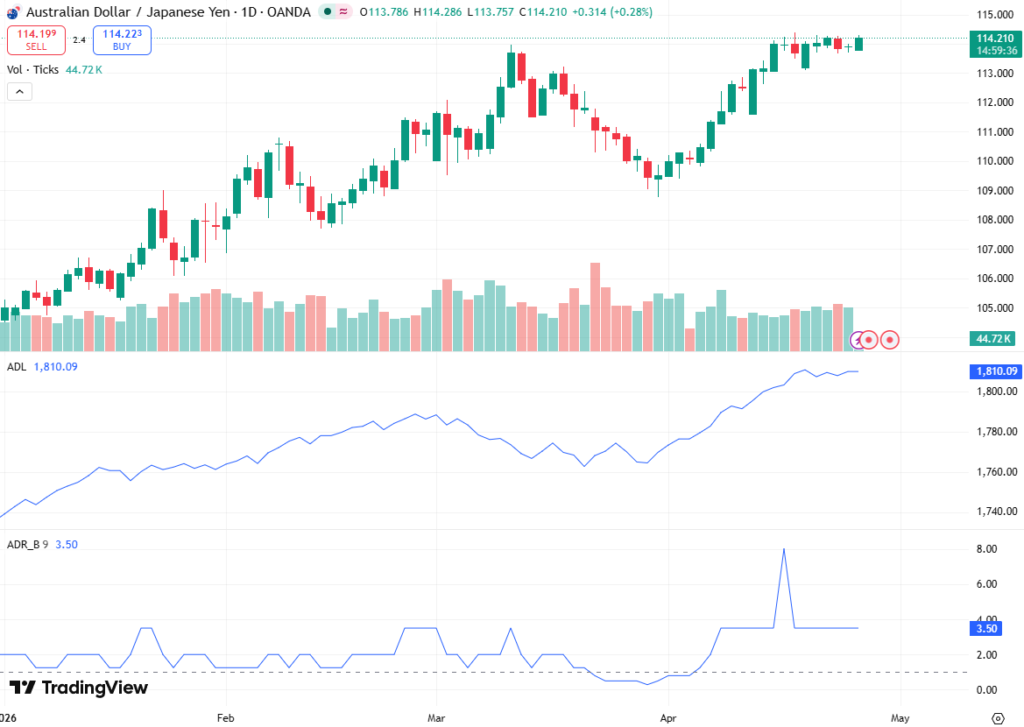
On the downside, initial support remains anchored at 114.00, with stronger structural support seen near 113.50, where buyers previously re-entered the market during consolidation phases.
Momentum indicators suggest improving short-term strength, with buyers currently regaining control following a period of sideways consolidation.
Intermarket Dynamics: Risk Sentiment and Yield Differentials Drive Flows
The recent price action in AUD/JPY highlights the importance of intermarket correlations between geopolitics, interest rate expectations, and global risk appetite.
When geopolitical tensions ease, as seen with the Iran–US diplomatic signaling, markets typically rotate into risk-on positioning, favoring currencies like the Australian Dollar, which is closely tied to global growth and commodity demand.
Simultaneously, the persistence of ultra-loose monetary policy in Japan continues to suppress the Japanese Yen, particularly in an environment where global yield differentials remain wide.
The combination of these forces creates a supportive backdrop for further upside in the AUD/JPY cross, provided upcoming data does not materially disrupt current expectations.
Conclusion: Bullish Momentum Builds, But Data Risk Remains Key
The AUD/JPY exchange rate has strengthened above the 114.00 level, driven by a combination of geopolitical easing expectations, improving risk sentiment, and diverging monetary policy outlooks between Australia and Japan.
While the Iran truce proposal has provided a short-term catalyst for risk assets, the next major directional driver will likely come from Australian inflation data and the BoJ policy decision.
For now, the bias remains cautiously bullish, but traders will be closely watching whether upcoming macroeconomic releases confirm or challenge the current narrative of AUD strength and JPY softness.


