
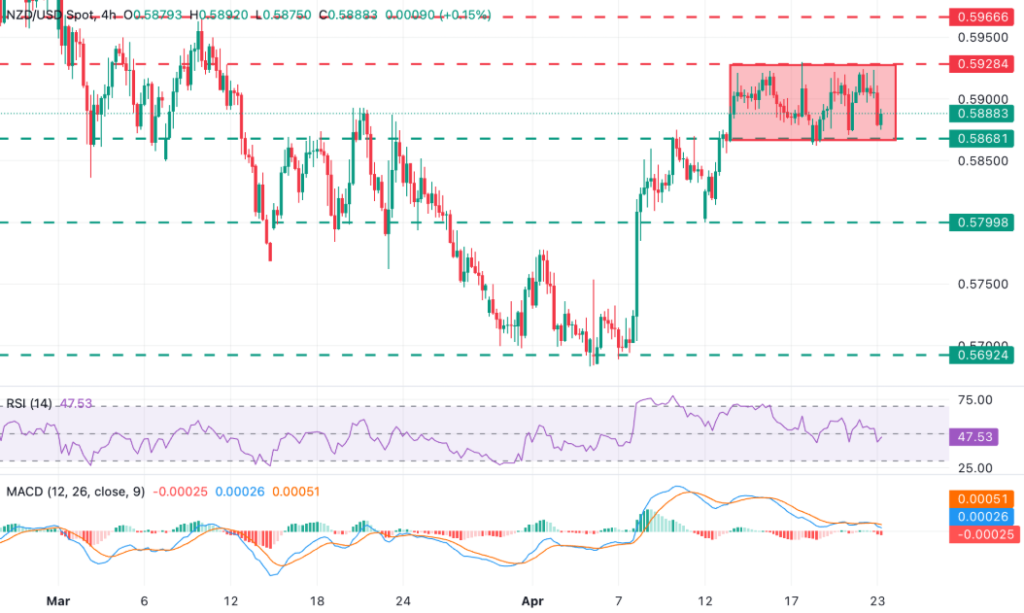
The NZD/USD currency pair is trading with a mild downside bias on Thursday, yet remains firmly locked within a well-defined consolidation range between 0.5870 and 0.5930. Despite intermittent volatility, price action continues to reflect a lack of decisive directional conviction, with neither bulls nor bears able to establish control. In their article, the team at Achievements AI presents a well-structured explanation of this topic.
The New Zealand Dollar is under modest pressure against a broadly stronger US Dollar (USD), as global investors rotate into safe-haven assets amid rising geopolitical uncertainty. However, the pair’s movement remains structurally contained, reinforcing the theme of a range-bound market environment.
Fundamental Drivers: Risk Aversion Limits Kiwi Upside
A key driver behind the current tone in NZD/USD is the deterioration in global risk sentiment, triggered by escalating tensions between the United States and Iran. These geopolitical developments have weighed on risk-sensitive currencies like the NZD, traditionally viewed as a pro-cyclical and high-beta currency.
As a result, investors are reluctant to take on significant exposure in the New Zealand Dollar, preferring instead the relative safety of the US Dollar. This dynamic has capped upside momentum and reinforced the upper boundary near 0.5930 resistance.
On the domestic side, recent New Zealand inflation data showed that price pressures remain above the Reserve Bank of New Zealand (RBNZ) target band. In theory, this supports a more hawkish monetary outlook and provides a fundamental cushion for the NZD. However, the impact has been limited, as macro uncertainty dominates short-term positioning.
Technical Structure: Rangebound but Leaning Bearish
From a technical analysis perspective, NZD/USD retains a broader constructive structure originating from early April lows, but momentum has clearly stalled. Price action on the 4-hour chart suggests a gradual shift toward mild bearish pressure, even as the pair remains trapped in its established range.
Momentum Indicators Turning Soft
Technical indicators are beginning to reflect this slowdown in bullish momentum. The Relative Strength Index (RSI) has slipped just below the 50 midline, signaling a loss of upside strength and a shift toward neutral-to-bearish momentum.
Meanwhile, the Moving Average Convergence Divergence (MACD) histogram has turned slightly negative, indicating fading bullish momentum and a gradual increase in downside risk.
Key Support Zone: 0.5870–0.5860 Under Pressure
Immediate focus now shifts to the 0.5870 support area, a level that has repeatedly contained bearish attempts in recent sessions. A further intraday breakdown below 0.5860–0.5870 would be technically significant, as it would indicate that buyers are losing control of the near-term range.
If this support zone fails to hold, the next key downside target would be the April 13 lows near 0.5800, which represent a critical structural floor in the short-term trend.
Beyond that, a deeper bearish extension could expose the early April swing lows below 0.5700, marking a potential transition from consolidation into a broader downtrend phase if momentum accelerates.
Resistance Ceiling: 0.5930 Remains a Key Barrier
On the upside, NZD/USD continues to face firm resistance at 0.5930, which aligns with recent April 17 and April 22 highs. This level has repeatedly capped recovery attempts, reinforcing its role as a short-term supply zone.
A decisive break above 0.5930 would be required to invalidate the current range-bound structure and reintroduce bullish momentum into the market.
If bulls succeed in pushing beyond this ceiling, the next upside objectives include the March 10 high near 0.5965 and the psychologically significant 0.6000 level, which represents a major medium-term resistance zone. However, without a clear macro catalyst, sustained upside continuation appears technically challenging in the near term.
Short-Term Outlook: Range Trade Dominates
In the immediate term, NZD/USD is expected to remain dominated by rangebound trading conditions, with price oscillating between 0.5870 support and 0.5930 resistance.
The market lacks a strong catalyst capable of triggering a decisive breakout, while geopolitical uncertainty continues to suppress risk appetite. This creates an environment where mean-reversion strategies may outperform trend-following approaches, at least in the short run.
Key intraday dynamics to watch include repeated rejection near 0.5930 resistance, buyer defense around 0.5870 support, and volatility spikes driven by geopolitical headlines or USD strength.
Conclusion: Market Awaits Breakout Catalyst
The NZD/USD pair is currently navigating a fragile equilibrium, where fundamental uncertainty and technical compression are keeping price action confined within a tight range.
While inflation resilience in New Zealand offers underlying support, broader risk aversion and USD strength continue to dominate sentiment. At the same time, technical indicators are signaling a moderate bearish tilt, suggesting downside risk is gradually building.
Ultimately, a clear break of either 0.5870 support or 0.5930 resistance will be required to define the next directional phase. Until then, NZD/USD remains firmly in a rangebound, low-conviction trading environment.


