
Gold (XAU/USD) struggles to capitalize on modest Asian session gains, retreating from a three-week high as the US Dollar (USD) gains traction ahead of the US Consumer Price Index (CPI) release. The team at Marbrisse presents a thorough analysis of this matter in their recent article.
Despite earlier optimism fueled by geopolitical tensions, the precious metal is facing pressure from a combination of hawkish Federal Reserve (Fed) bets and renewed Middle East risks, leaving traders cautious before committing to a decisive market direction.
Geopolitical Risks and USD Strength Cap Gold
During the Asian trading session on Tuesday, Gold briefly touched a three-week peak, supported by rising Crude Oil prices and renewed fears of regional instability. However, the positive momentum was short-lived as USD strength emerged, curbing the metal’s upward trajectory.
Reports of ongoing tension between the United States and Iran have kept traders on edge. Iranian proposals to end the protracted conflict have been dismissed by US officials, further complicating expectations for a diplomatic resolution.
The persistence of elevated Crude Oil prices amid regional tensions also stokes inflation concerns, reinforcing bets on tightening US monetary policy. As traders weigh the likelihood of further Fed rate hikes, the bullion market remains sensitive to any headline risk or macroeconomic shift.
US Inflation Data in Focus
The market’s attention has now shifted to the impending US CPI report, which is expected to shape Fed policy expectations. Economists anticipate that rising energy prices and geopolitical uncertainties could keep inflationary pressures elevated, increasing the probability of a 25% chance of a rate hike by year-end.
A stronger-than-expected CPI reading could trigger further USD strength, pressuring Gold further, while a softer reading may provide relief for the precious metal. Traders are thus positioning cautiously, balancing risk-on and risk-off sentiment in anticipation of the official inflation figures.
Technical Analysis: Gold’s Near-Term Outlook
From a technical standpoint, Gold shows mixed signals. The XAU/USD pair rebounded from the 38.2% Fibonacci retracement of its April-May decline, suggesting that bullish momentum is still intact. However, the intraday retracement below the 100-period Simple Moving Average (SMA) on the 4-hour chart indicates resistance to further gains in the immediate term.
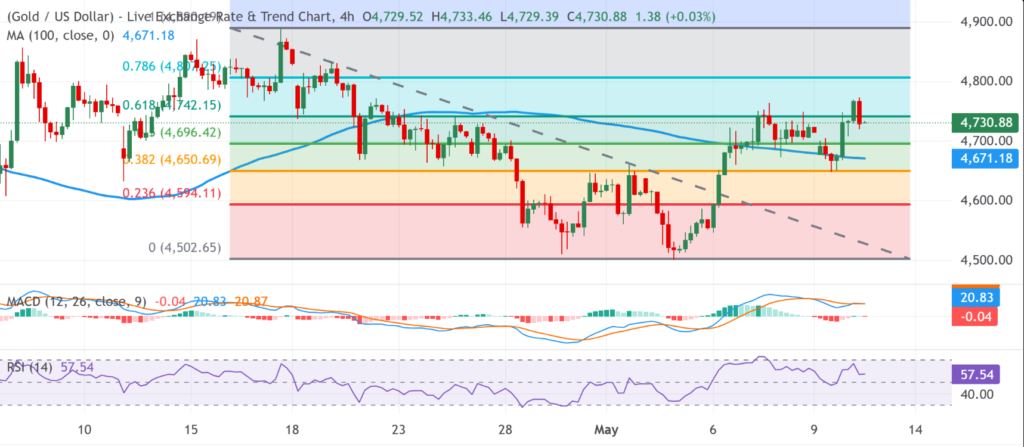
Momentum indicators suggest a moderate bullish bias. The Relative Strength Index (RSI) sits at approximately 58, signaling steady momentum, while the MACD histogram remains slightly below zero, indicating that the market has not yet entered a strong trend.
Immediate resistance levels are observed at the 61.8% Fibonacci retracement near $4,742, followed by the 78.6% level around $4,807 and the recent swing high at $4,890. On the downside, support levels include the 50% retracement at $4,696, the 100-period SMA around $4,671, and the 38.2% retracement near $4,651. A deeper pullback could test the 23.6% retracement at $4,594 and the structural floor around $4,503.
Market Sentiment: Caution Ahead of CPI
Investor sentiment remains cautiously optimistic, with bullish traders monitoring price action around key technical levels. While the USD’s uptick has capped Gold, the precious metal’s underlying demand persists, fueled by ongoing geopolitical tensions and elevated energy costs.
Analysts suggest that a decisive move above the recent swing highs could signal renewed bullish momentum, while failure to hold the 100-SMA support may prompt a sharper retracement. Given the non-yielding nature of Gold, the metal’s trajectory remains highly sensitive to real yields, USD dynamics, and inflation expectations.
Implications for Traders
For short-term traders, intraday retracements offer potential trading opportunities, but caution is warranted given the highly reactive nature of the market to macro news. Longer-term investors may continue to view Gold as a hedge against inflation and geopolitical uncertainty, especially amid ongoing tensions in the Middle East and persistent global economic volatility.
The forthcoming US CPI report is expected to act as a key catalyst. A stronger-than-anticipated reading may prompt renewed Fed tightening expectations, further supporting the USD and exerting downward pressure on XAU/USD. Conversely, a softer CPI print could rekindle bullish sentiment in Gold, particularly if risk-off sentiment drives demand for safe-haven assets.
Conclusion
Gold’s retreat from a three-week high underscores the delicate balance between geopolitical factors, USD strength, and monetary policy expectations. While the metal retains bullish potential, immediate trading is constrained by the 100-period SMA and key Fibonacci levels.
Traders will closely monitor the US CPI release as it is poised to provide critical insight into inflation trends and the Fed’s policy trajectory. Until then, Gold may continue to oscillate within its technical ranges, with resistance and support levels providing a framework for short-term positioning.
In essence, XAU/USD’s near-term performance will remain a tug-of-war between safe-haven demand, USD strength, and inflationary pressures, making cautious trading strategies essential in the current market environment.


