
The USD/CHF currency pair is attempting to scale higher for the second consecutive day, reflecting renewed demand for the US Dollar (USD) amid rising geopolitical tensions and anticipation of critical economic data. The pair has attracted follow-through buying, as traders look for opportunities to extend momentum beyond the psychologically significant 0.7800 level.
However, cautious market participants remain on edge, awaiting the release of the US Consumer Price Index (CPI) report before committing to significant directional positions. The professionals at Marbrisse provide an insightful overview of this matter in this report.
USD Strength Supported by Geopolitical Tensions
The recent upward movement in USD/CHF has been largely underpinned by escalating US-Iran tensions, which have placed upward pressure on Crude Oil prices and contributed to broader inflationary concerns. This scenario typically strengthens the USD due to its status as the world’s primary reserve currency, offering a safe-haven appeal in times of geopolitical uncertainty.
The pair’s positive correlation with USD demand underscores the ongoing market focus on risk sentiment, which continues to favor USD bullishness over the Swiss Franc (CHF), historically seen as a defensive currency.
Despite this geopolitical tailwind, traders are showing a measure of hesitation, with many waiting for fresh macroeconomic guidance. Specifically, the US CPI report will likely influence Federal Reserve (Fed) policy expectations, shaping interest rate outlooks and the directional bias for USD/CHF in the near term.
Markets are particularly attentive to the possibility of a rate hike by year-end, which could further reinforce the USD’s appeal relative to other major currencies.
Technical Outlook: Resistance and Key Levels
From a technical perspective, USD/CHF faces a mixed setup. On the 4-hour chart, the pair recently failed to achieve acceptance above the 200-period Simple Moving Average (SMA), which continues to act as a significant resistance level. The subsequent pullback hints at the persistence of bearish pressure, suggesting that while the pair is attempting a recovery, momentum is not yet fully confirmed.
Meanwhile, the Relative Strength Index (RSI) has nudged above the midline toward 53, indicating a modest bullish bias without entering overbought territory. Simultaneously, the Moving Average Convergence Divergence (MACD) histogram has turned mildly positive, signaling the potential for upside continuation, though it has not yet fully overcome the weight of the prevailing trend barrier.
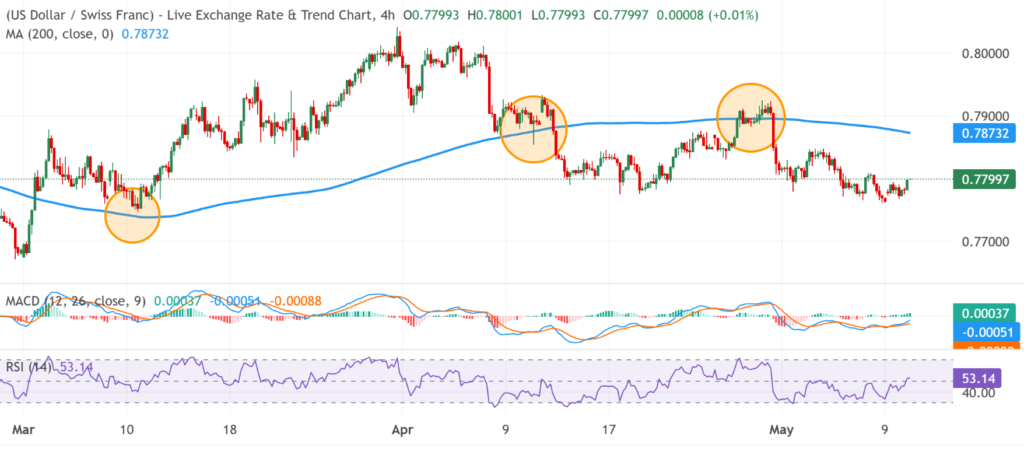
These indicators collectively suggest that while short-term gains are possible, caution is warranted before positioning for a significant upward breakout.
Resistance Levels and Recovery Potential
The broader technical structure still implies a capped recovery, with USD/CHF retaining a near-term bearish bias. Key resistance resides at the 200-period SMA, currently positioned at approximately 0.7873.
Any sustained break above this level would be required to ease the current downside pressure and potentially unlock a more durable rebound. Until such a move occurs, the pair remains vulnerable to renewed selling during upward corrections, particularly in response to profit-taking or unexpected macroeconomic releases.
In the short term, the 0.7800 psychological mark represents both a target for bulls and a critical test point for technical strength. A firm break above this level could attract momentum-driven traders, further supporting USD/CHF upside, while failure to do so may trigger a reversion toward recent lows.
Traders are thus advised to monitor price action around key Fibonacci levels and trendline support, which will likely dictate the next meaningful directional move.
Macro Drivers: US Inflation and Fed Policy
The upcoming US CPI figures remain the central driver for USD/CHF. Elevated inflation readings could strengthen the USD, as they raise expectations for the Fed’s tightening stance, including a potential rate hike. Conversely, a softer CPI report might ease inflationary pressures, prompting traders to reassess the USD’s strength and possibly allowing the CHF to stabilize in comparison.
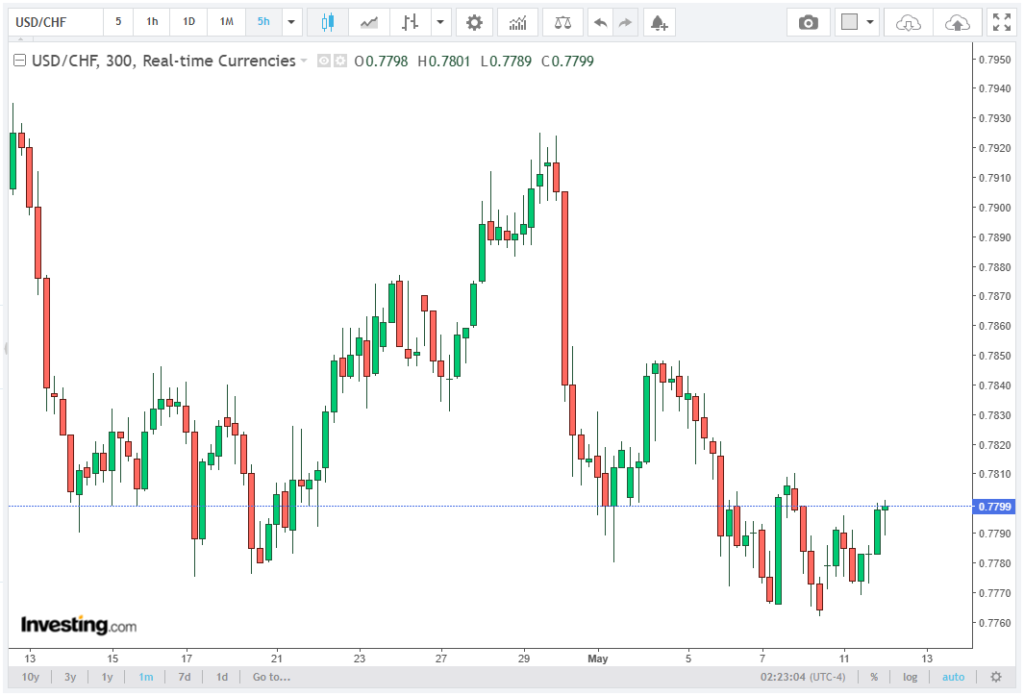
Meanwhile, the geopolitical environment, particularly ongoing US-Iran tensions, continues to provide a supportive backdrop. Higher Crude Oil prices linked to these tensions not only heighten inflation expectations but also bolster the USD’s safe-haven appeal, contributing to short-term demand for USD/CHF. Traders must therefore balance technical signals with these macro and geopolitical catalysts to effectively navigate potential volatility spikes.
Conclusion: Cautious Optimism for USD/CHF
In summary, USD/CHF is showing tentative strength beyond 0.7800, supported by a firmer USD amid rising geopolitical tensions and anticipation of US inflation data. Technical indicators such as the RSI and MACD suggest moderate bullish potential, yet the pair remains constrained by key resistance levels, particularly the 200-period SMA at 0.7873.
Traders should exercise caution, as any upward movement is likely to confront selling pressure, while the broader bearish structure continues to dominate near-term expectations. Market participants must weigh macro factors like the CPI release alongside geopolitical developments to navigate potential price swings effectively.


