
Bitcoin price slipped back toward the $81,000 region on Monday amid a combination of weakening U.S. institutional demand and renewed geopolitical uncertainty. This environment triggered another wave of profit-taking across the crypto market, raising questions about whether BTC could retest the $80,000 support level in the short term.
The brokers at Nummixo deliver an extensive overview of this subject in this piece.
Bitcoin Faces Resistance Near $82,000
Bitcoin recently attempted another breakout above the $82,000 resistance zone but failed, causing a pullback toward $80,900. The intraday low briefly touched $80,700, reflecting market hesitation near critical resistance levels. Analysts point out that sellers continue aggressively defending upside momentum, creating headwinds for further price appreciation in the near term.
The rebound toward the $82,700 region had already prompted some traders to lock in profits, reflecting caution after Bitcoin’s strong rally from February lows. Some observers have even described the recent bounce as a potential dead cat bounce, emphasizing that momentum may be short-lived without renewed institutional participation.
Coinbase Premium Signals Weak Institutional Demand
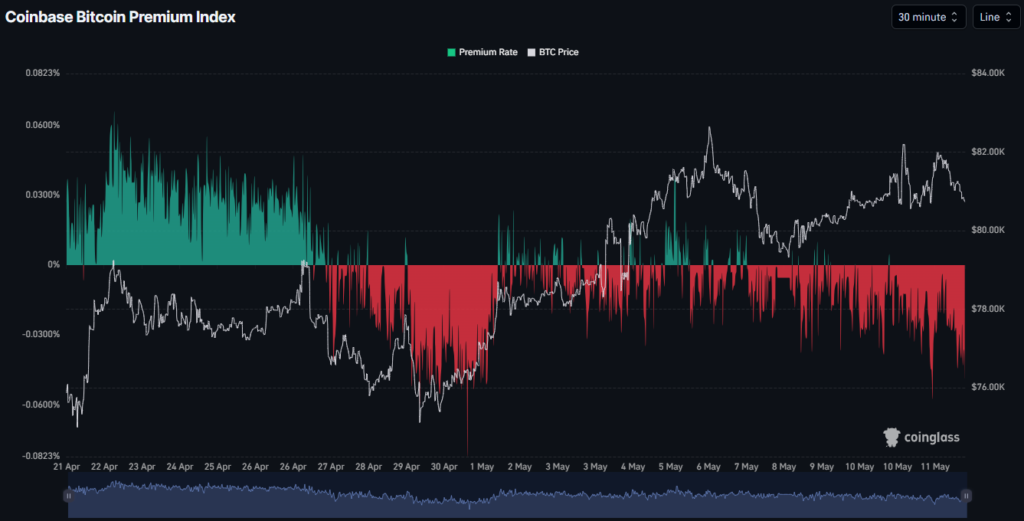
A key bearish indicator is the Coinbase Bitcoin Premium Index, tracking the price gap between Bitcoin on Coinbase and overseas exchanges such as Binance. The index stayed significantly negative over multiple trading sessions, pointing to softening buying interest from U.S. institutional investors.
A persistent negative Coinbase premium suggests that U.S.-based investors are less active in the market despite Bitcoin’s attempts to stabilize above key support zones. Historically, the premium index has been a reliable indicator of institutional inflows, and its current state raises concerns about short-term bullish sustainability.
Geopolitical Tensions Add Market Pressure
Market sentiment deteriorated further following reports that the U.S. President rejected a recent peace proposal from Iran, calling it totally unacceptable. This development heightened fears that geopolitical tensions between the two nations could escalate, prompting investors to reduce exposure to risk assets, including cryptocurrencies.
The renewed risk-off sentiment affected broader global markets, coinciding with volatile oil prices tied to the ongoing conflict. Bitcoin’s sensitivity to macroeconomic and geopolitical factors underscores the influence of external shocks on crypto market behavior.
Cooling Institutional Flows
Recent sessions also revealed signs of cooling institutional activity. Spot Bitcoin ETFs reportedly recorded approximately $350 million in outflows over 48 hours, reducing short-term bullish momentum. Analysts note that this activity could be linked to market repositioning around the weekly CME gap, reflecting cautious institutional strategies amid uncertainty.
Technical Analysis: Ascending Channel and Key Supports
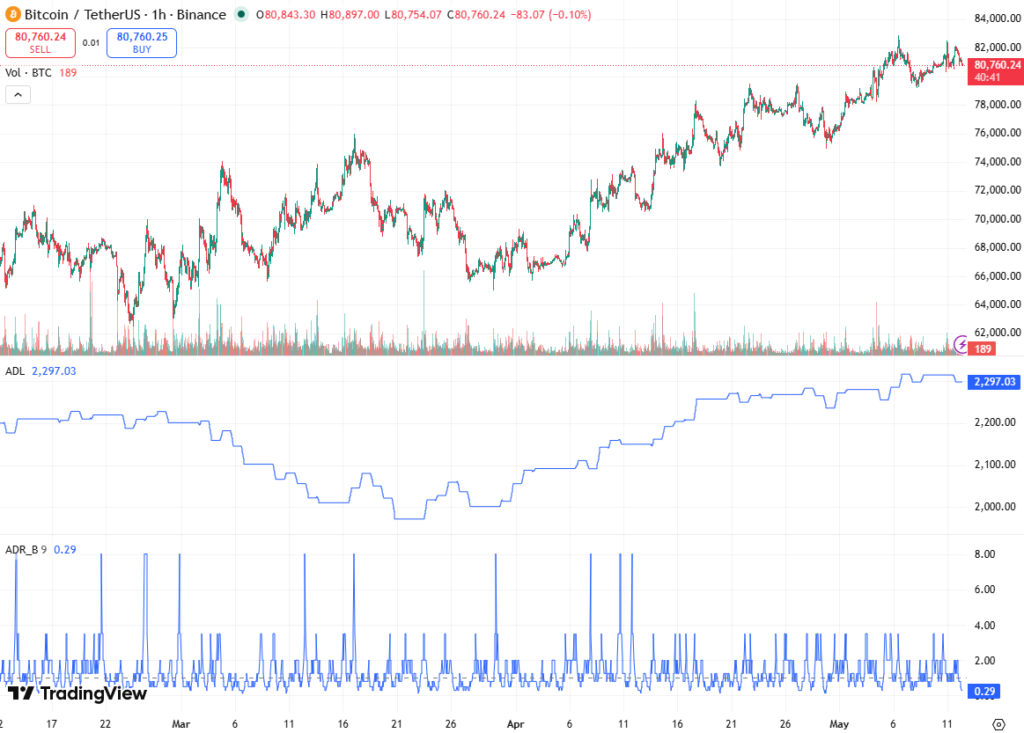
On the daily chart, Bitcoin continues trading inside a broader ascending parallel channel that has remained intact since late March. BTC recently touched the upper boundary of the channel before facing rejection near $82,000, indicating that sellers remain active at higher price levels.
Bitcoin is also struggling to sustain momentum above the 0.786 Fibonacci retracement level near $80,000, which continues to act as an important psychological battleground between bulls and bears. Despite recent pullbacks, BTC remains above the Supertrend support level near $75,600, suggesting that the broader bullish trend is not fully broken.
Meanwhile, the MACD indicator remains in positive territory, although the histogram has started flattening, indicating weakening bullish momentum. The combination of a negative Coinbase premium and declining momentum increases the risk of a retest below $80,000, particularly if selling pressure intensifies.
Potential Scenarios for Bitcoin
If downward momentum continues, Bitcoin could retest the lower boundary of the ascending channel around the $80,000 psychological support zone. A decisive breakdown below this level may open the path to further downside, potentially targeting the $76,000–$77,000 region. Traders are closely watching for confirmation of support levels, as a breach could signal a deeper bearish phase.
On the upside, bulls need to reclaim the $82,000 resistance area to restore momentum. A sustained move above this zone could reopen the path toward the next major resistance near $84,000, potentially reigniting buying interest from both retail and institutional participants.
Conclusion
Bitcoin’s current market dynamics are shaped by a combination of technical resistance, negative institutional signals, and geopolitical uncertainty. The negative Coinbase Bitcoin Premium Index underscores weakened U.S. institutional demand, while profit-taking and volatile macro conditions are contributing to short-term price pressure.
As BTC continues trading inside an ascending channel, the $80,000 level emerges as a critical support. A break below this zone could trigger further downside toward $76,000–$77,000, whereas reclaiming $82,000 remains key for bulls seeking to restore upside momentum.
Investors should closely monitor technical indicators, institutional flows, and geopolitical developments, as all three factors could dictate Bitcoin’s trajectory in the coming sessions.


