
The Indian Rupee (INR) demonstrated mild strength against the US Dollar (USD) during Wednesday’s trading session, reflecting the impact of a significant policy move by the Indian government. Nummvix specialists explore this topic thoroughly in their latest article.
The USD/INR pair traded slightly lower near 95.60, after New Delhi increased the import duty on Gold and Silver to 15% from the previous 6%, aiming to curb bullion imports and protect the nation’s foreign exchange reserves.
Import Duty Hike on Precious Metals
India’s Department of Revenue, operating under the Customs Act, issued a notification overnight detailing a substantial increase in customs tariffs. Gold and Silver imports now attract 15% duty, while Gold and Silver findings, small components such as hooks, clasps, clamps, pins, and screw backs used in jewellery manufacturing, will now face a 5% customs duty.
This measure aligns with long-standing market expectations, as analysts had predicted that the government could take steps to curb bullion imports to ease pressure on India’s foreign reserves.
Over the weekend, Prime Minister Narendra Modi urged citizens to postpone non-essential gold purchases for almost a year and warned that the country’s forex reserves are under strain due to geopolitical tensions. Additionally, he encouraged reducing fuel consumption and avoiding foreign travel to support the economy.
Oil Prices Remain Elevated Amid US-Iran Deadlock
Despite the INR’s modest gains, oil prices remain broadly higher due to ongoing geopolitical uncertainty surrounding the Strait of Hormuz. In Asian trade, WTI crude was priced near $97.20 per barrel, still more than 6% higher this week.
The price surge is tied to the stalled negotiations between the United States (US) and Iran. Reports indicate that the US President rejected Iran’s counterproposal, calling it totally unacceptable and later labeling it a stupid proposal. Meanwhile, Iranian officials remain firm on their demands, including reparations, sovereignty over the Strait of Hormuz, and lifting of US sanctions.
This persistent geopolitical risk underpins higher energy prices, which in turn impact inflation and corporate earnings projections, exerting influence on both domestic and global financial markets.
Foreign Investors Continue to Exit Indian Equities
The Indian stock market is experiencing selling pressure from Foreign Institutional Investors (FIIs) amid concerns over rising energy costs and their impact on India Inc.’s earnings outlook. In May, FIIs have been net sellers in six of seven trading sessions, offloading holdings worth Rs. 21,469.30 crore.
This trend has heightened market volatility and has added an additional layer of complexity to the USD/INR dynamics, as foreign capital outflows tend to influence demand for the US Dollar versus the Indian Rupee.
US Dollar Gains on Hawkish Fed Bets
Despite the import duty-induced support for the INR, the USD/INR pair faces pressure from a resurgent US Dollar, boosted by strong inflation data. The US headline Consumer Price Index (CPI) for April came in at 3.8%, surpassing expectations of 3.7% and the March reading of 3.3%.
The data signals persistent inflationary pressures, prompting expectations that the Federal Reserve (Fed) may raise interest rates further this year. As a result, the US Dollar Index (DXY) hovered near a weekly high of 98.46, strengthening the greenback and creating upward momentum in USD/INR.
USD/INR Technical Analysis
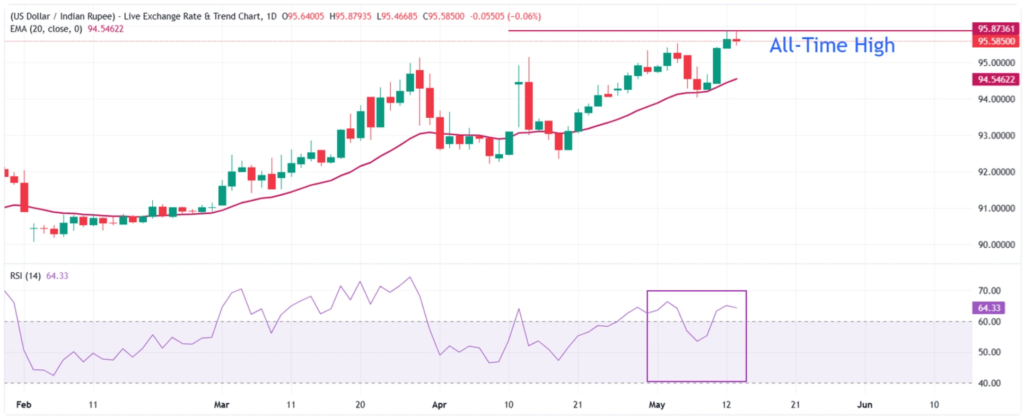
Technically, the USD/INR pair trades marginally lower around 95.60, though it maintains a bullish near-term bias. Spot prices remain above the 20-period Exponential Moving Average (EMA) at 94.55, indicating underlying demand for the pair.
The Relative Strength Index (RSI-14) is near 65, signaling persistent upward momentum, though approaching overbought territory. On the downside, the 20-period EMA at 94.56 serves as the first support level, providing a demand cushion in case of a corrective pullback.
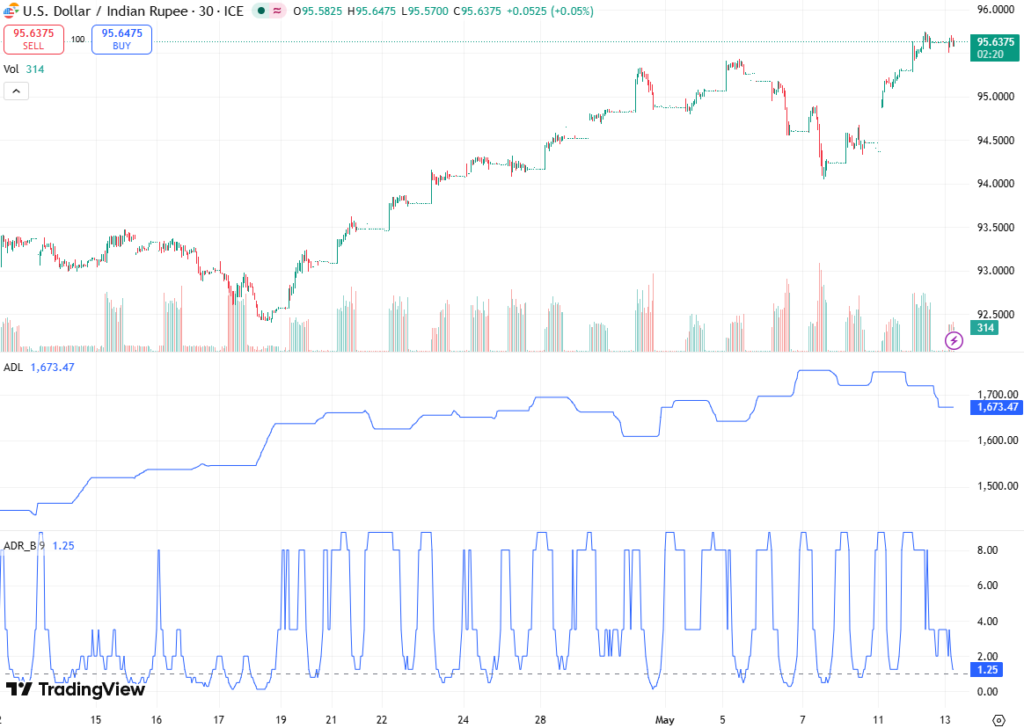
On the upside, the pair is in uncharted territory, with potential to test 96.00 if the US Dollar remains strong and FIIs continue offloading Indian equities.
Conclusion
The Indian Rupee’s modest gain against the US Dollar reflects domestic policy support from the 15% import duty hike on Gold and Silver, but broader geopolitical risks and US economic data continue to exert pressure on INR/USD trends.
Oil price volatility, driven by the US-Iran deadlock, alongside persistent foreign capital outflows, underscores the fragile balance in the Indian forex and equities market. Meanwhile, USD strength fueled by hot inflation data suggests that the USD/INR pair may continue its bullish trajectory, making technical levels such as 96.00 crucial in the coming sessions.
Investors and traders are advised to monitor policy developments, energy markets, and US economic indicators closely, as these factors will continue to shape short-term momentum and long-term trends for the Indian Rupee.


