
The AUD/USD currency pair remains on the back foot for the second consecutive day amid a bullish US Dollar (USD), highlighting the ongoing market caution as traders await the highly anticipated US-Chinese summit.
Despite attempts to capitalize on an overnight bounce from the 0.7200 neighborhood, the pair continues to trade with a negative bias, currently hovering around the 0.7235 region. In this article, the team at Nummvix presents a detailed examination of the issue.
US Dollar Strength Maintains Pressure on AUD/USD
The USD remains firm near its highest level in over a week, supported by renewed expectations of a US Federal Reserve (Fed) interest rate hike. Tuesday’s hot US consumer inflation figures reinforced the hawkish monetary policy outlook, bolstering the greenback’s safe-haven appeal.
At the same time, diminishing hopes for a US-Iran peace deal have reinforced the USD’s status as a risk-off currency, indirectly capping the upside potential of risk-sensitive assets like the Australian Dollar (AUD).
Despite these headwinds, the Reserve Bank of Australia’s (RBA) hawkish outlook provides a tailwind for the AUD/USD pair, offering a potential supportive framework for buyers in the medium term.
Technical Indicators Suggest Mixed Momentum
From a technical perspective, the AUD/USD continues to exhibit a constructive bias, despite short-term downside pressure. Spot prices are holding well above the 100-period Exponential Moving Average (EMA), which indicates that the broader bullish trend remains intact.
Similarly, the Relative Strength Index (RSI) hovers just above the neutral 50 line, pointing to modest upside potential. However, the Moving Average Convergence Divergence (MACD) has flattened slightly below zero, suggesting tentative momentum and a lack of follow-through in either direction.
Traders should exercise caution and wait for clear confirmation before entering fresh bullish positions. Specifically, acceptance above the mid-0.7200s is necessary to validate further upside targets and reduce the risk of false breakouts. In the absence of this confirmation, the AUD/USD pair may continue to oscillate in a narrow range, reflecting investor uncertainty ahead of major global developments.
Support and Resistance Levels
Immediate support is identified near the 100-period EMA at approximately 0.7190. Should the pair fall below this level, it could trigger a deeper corrective decline, putting the current bullish momentum at risk. On the other hand, as long as AUD/USD stays above this moving average, buyers are likely to step in on dips, reinforcing the overall upward trend.
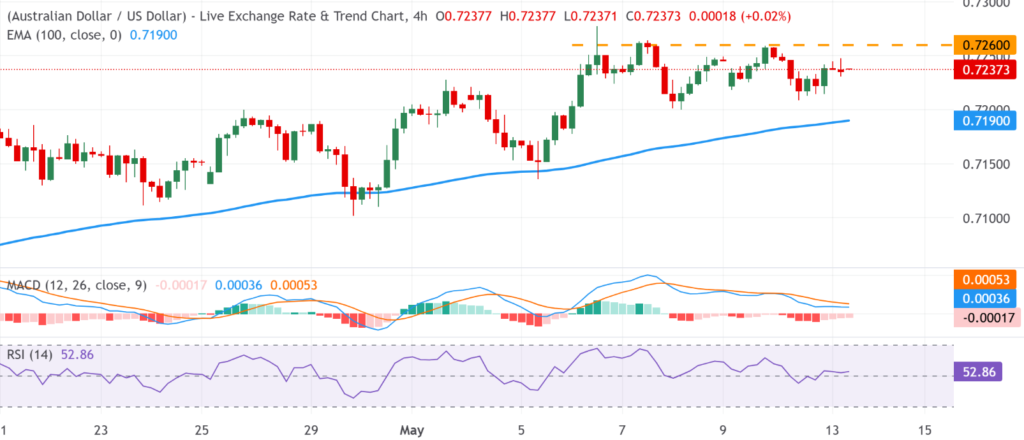
On the upside, a decisive move above the mid-0.7200s could pave the way for further gains, with psychological resistance forming near the 0.7250 and 0.7280 levels. Breaking these levels convincingly would signal renewed bullish momentum, attracting trend-following traders and potentially shifting the short-term sentiment from neutral to positive.
Market Sentiment Ahead of Geopolitical Events
The US-Chinese summit looms large as a key catalyst for market participants. Investors are expected to adopt a cautious stance, opting to wait on the sidelines until clarity emerges regarding trade negotiations and bilateral agreements. Any unexpected developments could trigger heightened volatility, particularly in risk-sensitive pairs like AUD/USD.
While the USD currently benefits from a safe-haven bid and hawkish monetary policy expectations, the AUD continues to find support from domestic fundamentals, including the RBA’s hawkish commentary and resilient Australian economic data. This combination suggests that while near-term downside risks exist, broader technical and fundamental factors could encourage dip-buying opportunities at lower levels.
Trading Strategy and Outlook
Given the current technical setup, the AUD/USD appears to be in a holding pattern, trading The AUD/USD is currently in a holding pattern, trading just below the mid-0.7200s, as traders assess near-term momentum and key technical levels. A bullish bias remains intact as long as the pair stays above the 100-period EMA (0.7190), providing a foundational support level for potential upside.
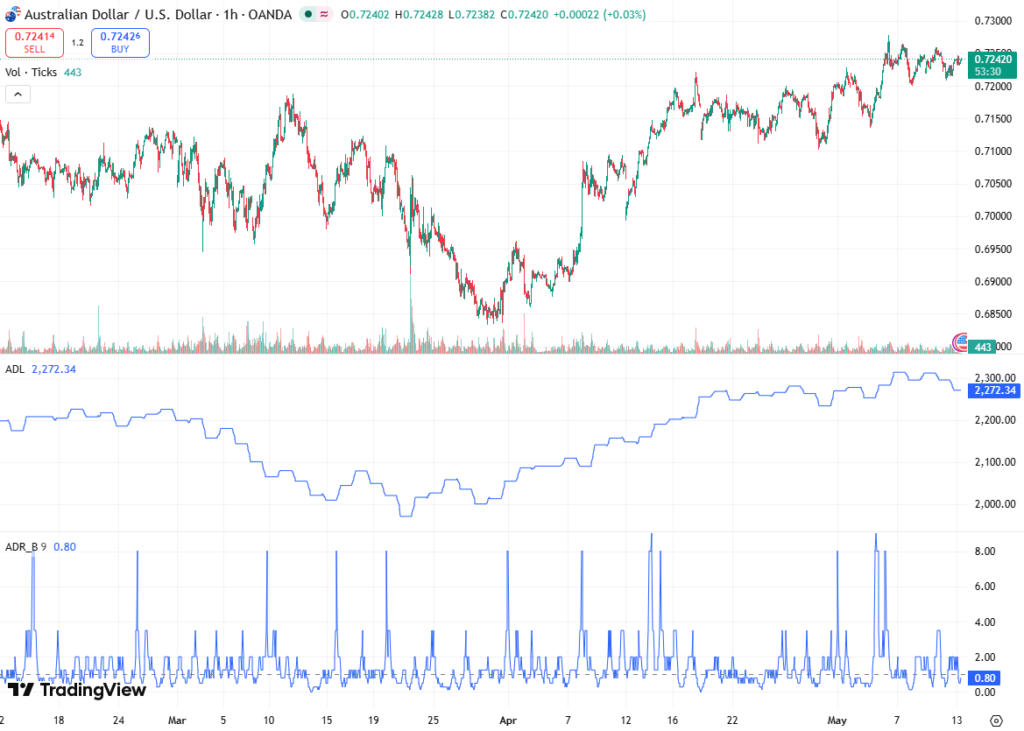
The RSI above 50 signals modest upside pressure, indicating that dip-buying opportunities may be favored by traders looking for entries on pullbacks. Meanwhile, the MACD near zero reflects tentative momentum, suggesting that confirmation above resistance levels is important before opening new positions, as the trend lacks strong conviction at this stage.
In essence, the AUD/USD pair is navigating a complex environment, balancing USD strength against RBA hawkishness and geopolitical uncertainty. Short-term traders may consider range-bound strategies around 0.7190–0.7250, while longer-term participants should monitor the US-Chinese summit and upcoming US economic data releases for decisive directional cues.
Conclusion
The AUD/USD remains under modest pressure below mid-0.7200s, reflecting the interplay between a resurgent USD and geopolitical caution. Despite this, technical indicators suggest the potential for dip-buying at lower levels, supported by the RBA’s hawkish stance and sustained support above the 100-period EMA.
Traders are advised to exercise prudence, waiting for confirmation of a breakout above resistance levels before committing to new bullish positions.


