
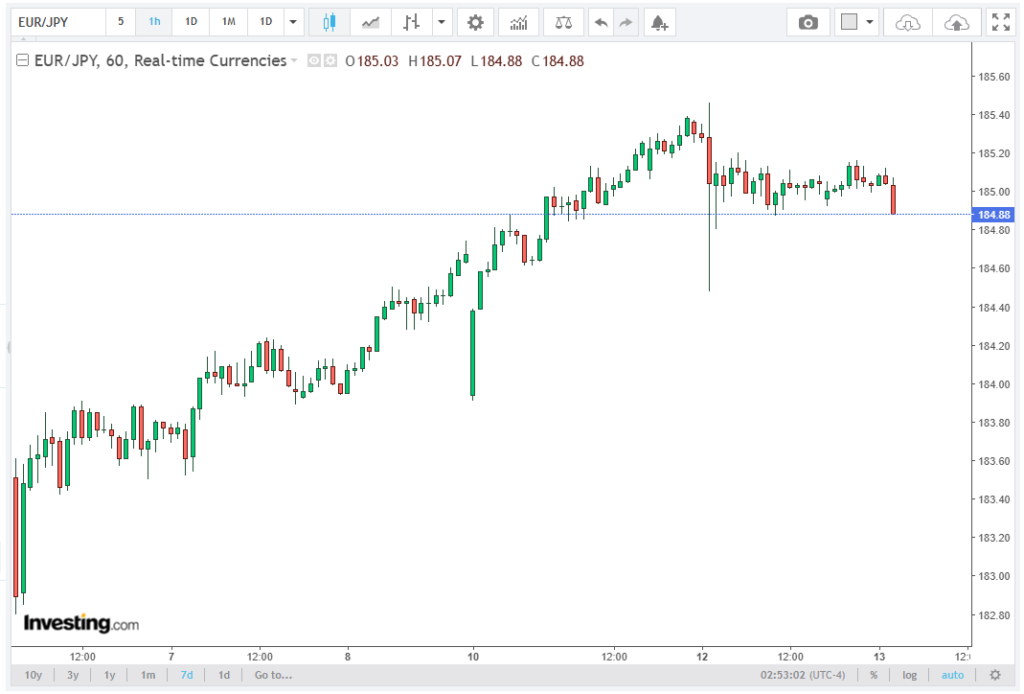
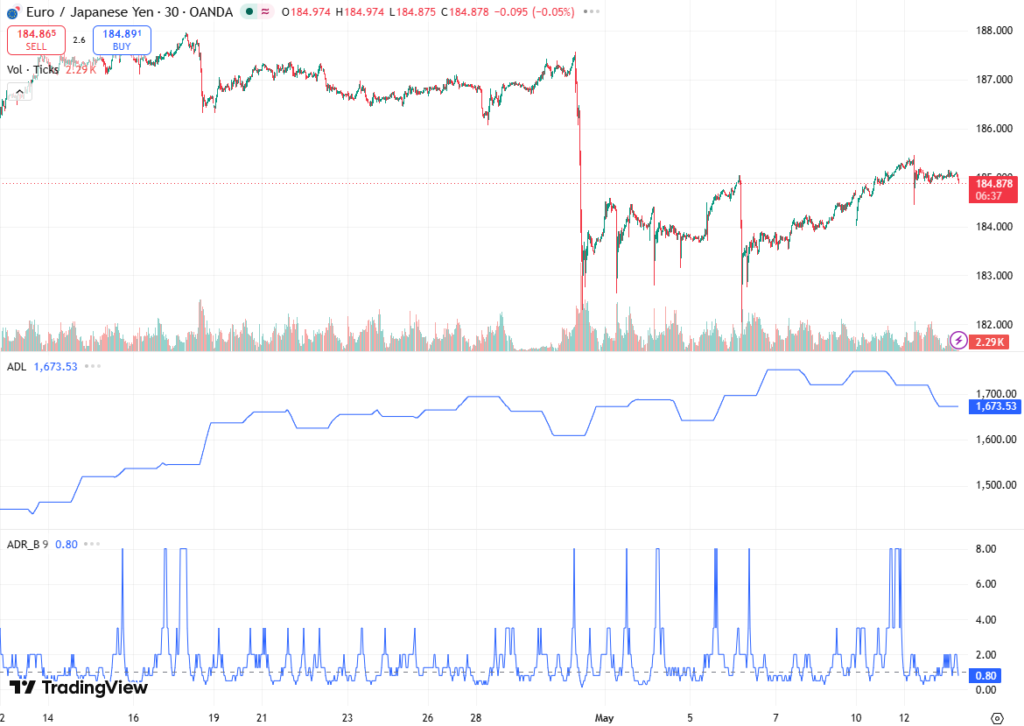
EUR/JPY remained largely flat during Asian trading hours on Wednesday, hovering around the 185.00 mark after registering modest losses in the previous session. Market participants attributed the relative stability to a complex interplay between Euro weakness and Yen softness, reflecting heightened risk aversion following renewed geopolitical concerns in the Middle East. The article written by Nummvix’s experts sheds extensive light on this issue.
EUR/JPY Stability Amid Declining Euro
The EUR/JPY currency pair’s resilience comes as the Euro (EUR) continues to edge lower in response to global risk-off sentiment. Investors are increasingly cautious due to faded hopes for Middle East peace, a factor that has weighed on broader European equities and encouraged flows into traditionally safer assets, including the Japanese Yen (JPY).
Despite the Euro’s slide, JPY weakness, partly driven by expectations of the Bank of Japan’s (BOJ) continued accommodative policy, has offset much of the Euro’s decline, leaving the cross-rate relatively unchanged.
Analysts note that while EUR/JPY has not experienced sharp swings, the currency pair remains sensitive to both geopolitical risks and monetary policy signals from the ECB and BOJ.
Bank of Japan Signals Potential Rate Hikes
The Japanese Yen could experience renewed strength against its major peers in the coming months as the BOJ hints at a more hawkish policy stance. According to the April Summary of Opinions, policymakers are considering further short-term policy rate increases as early as the next meeting. These discussions are largely motivated by inflationary pressures tied to rising oil prices and broader commodity price shocks.
The Organisation for Economic Co-operation and Development (OECD) has recommended that Japan focus on consumption tax increases to bolster national revenue, complementing the BOJ’s monetary strategies. Market projections suggest that the BOJ may raise short-term policy rates to 2% by the end of 2027. However, the central bank is expected to retain flexibility, adjusting the pace and maturity of its bond-buying programs to mitigate any potential financial market disruptions.
The implication for EUR/JPY is significant: any decisive move by the BOJ toward rate normalization could lend the Yen renewed strength, potentially challenging the Euro’s brief resilience.
European Central Bank Faces Pressure from Energy Costs
While the Euro has faced headwinds from global risk aversion, it may receive support from a hawkish tone in ECB communications. Bundesbank President Joachim Nagel highlighted on Wednesday that escalating energy costs, particularly in the wake of the Iran conflict, increase the likelihood of a future ECB interest rate hike.
Nagel emphasized that the probability of raising borrowing costs is rising as Europe grapples with inflationary pressures. Similarly, ECB Governing Council member Martin Kocher stated that there is no reason to delay rate increases if energy prices do not ease promptly.
This backdrop suggests that while the Euro is under pressure from geopolitical risks, support from monetary tightening expectations could counterbalance declines, stabilizing the EUR/JPY cross.
Japanese Economic Data Provides Support for Yen
Recent Japanese economic data adds nuance to the market outlook. Japan’s current account surplus rose to JPY 4,681.5 billion in March, up from JPY 3,625.3 billion a year earlier. This figure exceeded market forecasts of JPY 3,879 billion, marking the largest surplus on record.
The increase reflects both a robust trade balance and continued capital inflows, which may support the Yen despite its current weakness. Traders are closely monitoring whether this trend will influence the BOJ’s policy trajectory, particularly in the context of rising inflation and commodity price shocks.
Market Outlook and Upcoming Data
Market participants are now awaiting key Eurozone economic indicators, including quarterly GDP and Employment Change data for the first quarter of 2026. These releases are expected later in the day and could provide fresh momentum for EUR/JPY, especially if the Euro demonstrates resilience in response to stronger-than-expected growth or employment figures.
Analysts caution that EUR/JPY is likely to remain range-bound in the near term. The currency pair’s direction will depend on the balance between risk sentiment, geopolitical developments, and evolving central bank policies in both Europe and Japan.
Conclusion
In summary, EUR/JPY remains steady amid a complex environment characterized by risk aversion, geopolitical tensions, and divergent monetary policy signals. The Euro faces downward pressure due to fading peace hopes in the Middle East, yet this is partially offset by Yen softness.
Looking ahead, the BOJ’s potential rate hikes and the ECB’s hawkish guidance on interest rates could introduce renewed volatility to the cross. Market watchers will continue to focus on economic data releases, energy price developments, and central bank communications as they shape the trajectory of EUR/JPY in the coming months.


