
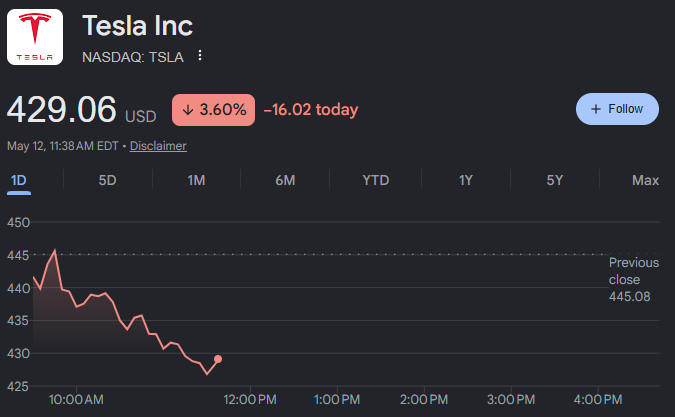
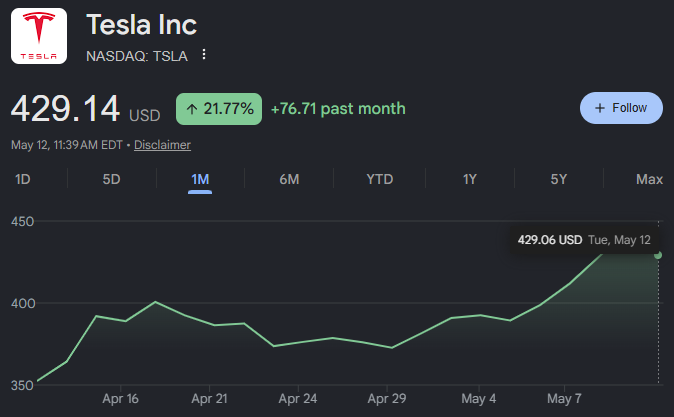
The high-growth automotive sector experienced a notable period of profit-taking on Tuesday as market participants reassessed valuations following a significant multi-day surge. Tesla (TSLA) shares slipped in early trading, falling 4.13% to reach the $426.71 level. This retracement follows a robust performance over the previous five sessions, during which the stock gained nearly 15% and touched an intraday high of $450.
The current volatility comes as a high-level American corporate delegation prepares to engage in pivotal diplomatic and trade discussions in Beijing later this week. One of the investment researchers from Fondesia suggests that while the immediate price action reflects a technical pullback, the underlying narrative is increasingly focused on regulatory breakthroughs in the Eastern market.
Optimism had previously been bolstered by the company’s progress on its advanced semiconductor fabrication facility in Austin, known as the Terafab, and bullish analyst reports suggesting that at the $400 threshold, investors were effectively receiving the humanoid robotics division at a zero-dollar valuation.
The FSD Regulatory Hurdle in the Mainland
The primary catalyst for the upcoming diplomatic mission is the pursuit of regulatory authorization for the company’s Full Self-Driving (FSD) software within the Chinese market. While institutional leadership had previously signaled an early spring approval window, that deadline has passed without a definitive resolution.
On the recent Q1 earnings call, the organization shifted its target to a third-quarter timeline, though analysts remain cautious given the heightened scrutiny of autonomous systems by Chinese authorities. The regulatory environment in China has become increasingly conservative following recent incidents where local autonomous vehicles reportedly obstructed traffic, leading to a temporary pause in certain licensing categories.
Furthermore, domestic competitors have faced public criticism regarding the erratic performance of their own automated driving systems. For Tesla, securing a formal sign-off for FSD would serve as a critical differentiator, allowing it to maintain a technological lead over domestic rivals like BYD, Xiaomi, and Geely.
Market Share Dynamics and Competitive Pressure
The urgency of this regulatory breakthrough is highlighted by recent sales data from the China Passenger Car Association (CPCA). In April, the company delivered 25,956 vehicles within the mainland, representing a decline of nearly 10% compared to the same period in the previous year.
This softened performance has seen the firm’s share of the broader new-energy vehicle market, which includes both purely electric and hybrid models, slip to 3%, while its dedicated EV market share adjusted to 4%.
Maintaining institutional-grade productivity in this hyper-competitive market requires more than just high-volume manufacturing. While the first month of any quarter is typically dedicated to fulfilling export orders from the Shanghai Gigafactory, the subsequent months rely heavily on domestic demand.
The approval of FSD is viewed as a “shot in the arm” for these domestic shipments, providing a unique software-based value proposition that could reverse the recent trend of market share erosion.
Trade Delegations and Diplomatic Maneuvers
The upcoming meetings in Beijing involve a broad cohort of American corporate leadership, including top executives from the aerospace and mobile technology sectors. These discussions aim to resolve ongoing friction regarding retaliatory duties and trade imbalances that have characterized the relationship between the two economic superpowers over the last several years.
As the only foreign automaker to operate a wholly owned manufacturing facility in China, the company occupies a unique position in these negotiations. The strategic orientation of these talks extends beyond simple vehicle sales. Access to high-resolution mapping data and the ability to operate advanced neural networks on public roads are at the heart of the “software-defined vehicle” debate.
If corporate leadership can navigate these geopolitical complexities and secure the necessary licenses, the impact on the stock’s valuation could be substantial. Investors are currently weighing the risks of continued regulatory delays against the massive upside of a fully monetized FSD fleet in the world’s largest automotive market.
Automotive Technology Strategic Outlook and Market Conclusion
The current retracement in the TSLA share price serves as a definitive signal for the technology sector for the remainder of 2026. By pulling back to the $426.71 mark, the stock is searching for a new support level as the market prepares for the outcome of the China delegation.
We are entering a cycle where institutional-grade productivity in the automotive space is defined by the ability to harmonize hardware manufacturing with local software regulations. The primary focus for market participants in the coming days will be any formal communiqué regarding the status of autonomous driving licenses.
Although the impending momentum of the stock was driven by the Terafab and robotics narratives, the foundational tone for the second half of the year will be set in Beijing. Investors should treat the $400 price level as a key psychological floor in the event of further volatility.


