
The NZD/USD pair remains supported above the 0.5600 mark as traders await the upcoming US Non-Farm Payrolls (NFP) report, which could dictate the near-term direction of the Greenback (USD). This article from Achievements AI offers a comprehensive analysis of the subject.
After a period of modest gains, the New Zealand Dollar (NZD) continues to face headwinds from a broadly strong USD, fueled by hawkish Federal Reserve (Fed) expectations and persistent geopolitical uncertainties.
USD Strength Limits NZD Upside
The US Dollar Index (DXY) has recently climbed to its highest level since April 8, reflecting sustained demand for the USD amid a combination of macroeconomic and geopolitical factors. Hotter-than-expected inflation data has rekindled market expectations of a hawkish Fed, while ongoing tensions in the Middle East add a safe-haven bid for the Greenback.
The headline US Consumer Price Index (CPI) rose to 3.8% YoY in April, while the core CPI climbed to 2.8%, underscoring the persistent inflationary pressures in the US economy. Adding to this, the Producer Price Index (PPI) surged 1.4% last month, pushing the annual rate to 6.0%. Coupled with US Retail Sales growth for the third consecutive month, the data reaffirm a resilient consumer sector and a more hawkish Fed outlook, supporting further USD gains.
Traders are now pricing in a nearly 40% probability of a Fed rate hike by year-end, according to the CME FedWatch Tool, strengthening the USD and weighing on commodity-linked currencies such as the NZD.
Gold Sheds Ground Amid USD Strength
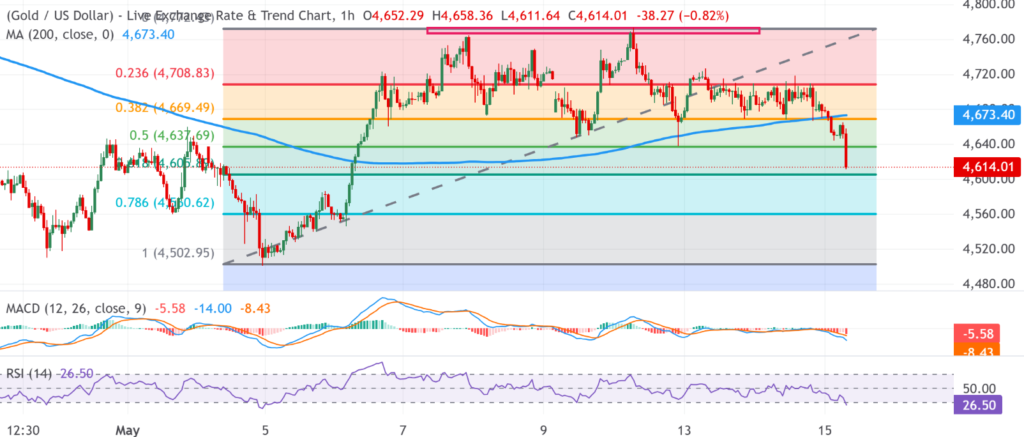
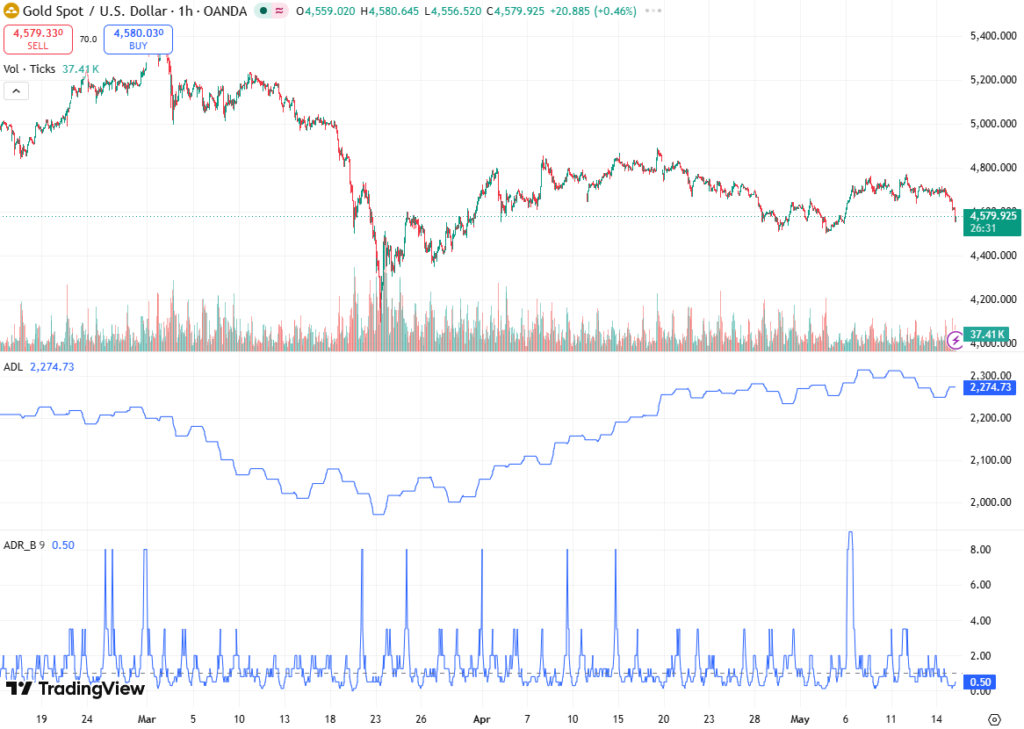
Gold (XAU/USD) has seen a fourth consecutive day of losses, drifting below the $4,600 level. The downward pressure is driven by sustained USD buying interest, as well as a bearish technical setup formed after repeated failures near $4,765–$4,770. This pattern constitutes a double-top formation, signaling a potential continuation of the downtrend.
Technically, the 200-hour Simple Moving Average (SMA) and the 38.2% Fibonacci retracement of the recent upswing near $4,670 act as critical confluence levels for price action. A break below these levels has validated the negative outlook, while MACD sits deep in negative territory at -5.58, and the RSI has slipped to 26.5, indicating oversold conditions.
Immediate downside support aligns at the 61.8% Fibonacci retracement at $4,605.89, followed by the 78.6% level at $4,560.62 and the prior swing low near $4,502.95. On the upside, resistance emerges at the 50% retracement at $4,637.69, with a congestion zone between the 38.2% retracement at $4,669.49 and the 200-hour SMA at $4,673.40. A stronger cap is evident at the 23.6% retracement near $4,708.83, where further recovery could stall.
Geopolitical Risks Support USD
Persistent geopolitical uncertainties continue to underpin the USD, limiting the upside potential for NZD/USD. US-Iran negotiations remain stalled amid disagreements over Tehran’s nuclear program, while reports of a commercial vessel seized off the UAE coast have renewed concerns over energy supply flows through the Strait of Hormuz.
The US President emphasized a tougher stance on Iran in a recent interview, urging Tehran to finalize a deal. These developments, coupled with elevated Crude Oil prices, add to the safe-haven appeal of the USD, creating headwinds for risk-sensitive currencies like the NZD.
Meanwhile, US-China relations appear relatively stable following a high-level summit between the US and Chinese Presidents, though Xi cautioned that mishandling Taiwan-related issues could trigger clashes and even conflicts. The ongoing US-China dialogues could continue to induce market volatility, impacting currencies and commodities alike.
NZD/USD Outlook Ahead of US NFP
From a technical perspective, NZD/USD has maintained a modest recovery above 0.5600, showing resilience despite USD strength. The pair’s immediate support lies near 0.5580, coinciding with the 50-day SMA, while resistance is capped around 0.5640, a region that marks previous highs and short-term congestion.
Short-term traders should closely monitor the upcoming US NFP report, which could prove pivotal. A strong payroll figure may reinforce the USD and pressure NZD/USD lower, while a weaker-than-expected print could ease USD demand and allow the Kiwi to extend its recovery.
The broader fundamental landscape remains tilted toward USD strength, driven by a hawkish Fed, inflationary pressures, and geopolitical tensions. However, technical factors and near-term oversold conditions in commodities such as Gold may limit extreme USD rallies, offering potential retracement opportunities in NZD/USD.
Conclusion
In conclusion, NZD/USD faces a cautious environment, with modest recovery gains above 0.5600 overshadowed by persistent USD bullishness and the upcoming US NFP report, which could be the next major market mover. Traders are advised to monitor both fundamental and technical signals to navigate the pair’s near-term trajectory.


