
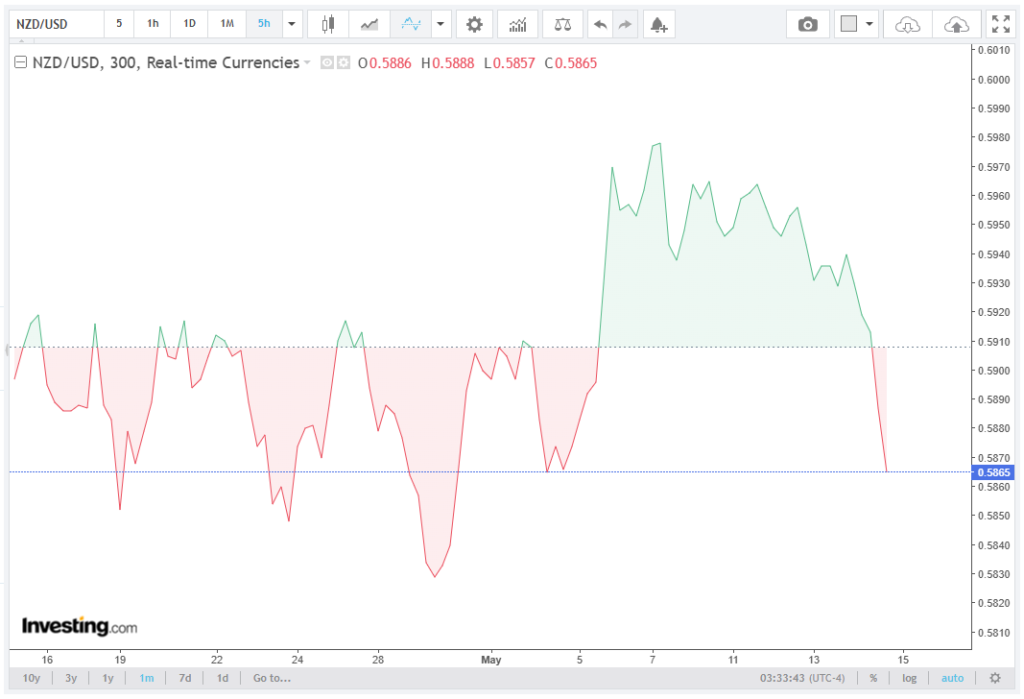
The New Zealand Dollar (NZD) weakened sharply against the US Dollar (USD), dropping to approximately 0.5860 during early European trading on Friday, marking a 0.82% decline on the day.
The decline reflects the combined effects of geopolitical uncertainty, strong US inflation data, and adjustments in market expectations for Federal Reserve (Fed) policy. This article by Achievements AI provides a clear and detailed overview of the topic.
NZD/USD Under Pressure from Geopolitical Uncertainty
The NZD/USD pair faced downward pressure as market participants assessed developments from a multi-day US-China trade and geopolitical summit in Beijing. While initial statements suggested progress on trade and diplomatic cooperation, unresolved issues in the Middle East and the Strait of Hormuz continue to generate risk-off sentiment.
New Zealand’s economy is particularly sensitive to China’s trade dynamics, as China accounts for roughly 28% of New Zealand’s total exports, including key commodities such as dairy, meat, and forestry products. Any disruption to Chinese trade flows could increase pressure on the Kiwi, especially during periods of USD strength and heightened global market volatility.
US Inflation Data Strengthens the Dollar
Recent US economic releases have reinforced the case for a stronger USD. The Producer Price Index (PPI) rose 0.5% month-over-month (m/m) in April, marking the fastest pace since 2022. The Consumer Price Index (CPI) increased 0.6% m/m, or 4.8% year-over-year (y/y), exceeding market expectations of 0.5% m/m and 4.6% y/y, respectively.
These elevated inflation figures suggest that price pressures remain persistent in the United States, lowering the probability of near-term Fed rate cuts. Sustained inflation typically supports USD demand, as it raises the expected real yields on US-denominated assets. Consequently, the NZD/USD pair faces a structural headwind, particularly when combined with risk-off sentiment from global geopolitical developments.
Fed Rate Hike Expectations Intensify
Market pricing for the Federal Reserve’s policy trajectory has shifted markedly over the past week. According to the CME FedWatch Tool, the implied probability of a 25-basis-point (bps) interest rate increase at the December meeting is now 36.9%, up from 22.5% a week ago. This represents a significant recalibration of monetary policy expectations, reflecting both the latest US inflation data and broader economic resilience.
The upward shift in rate hike probabilities reinforces the USD, creating downward pressure on NZD/USD. With markets now largely discounting the likelihood of rate cuts for the remainder of 2026, the NZD remains vulnerable, particularly given its historical sensitivity to US monetary policy divergence.
Technical Analysis: NZD/USD Near Key Support Levels
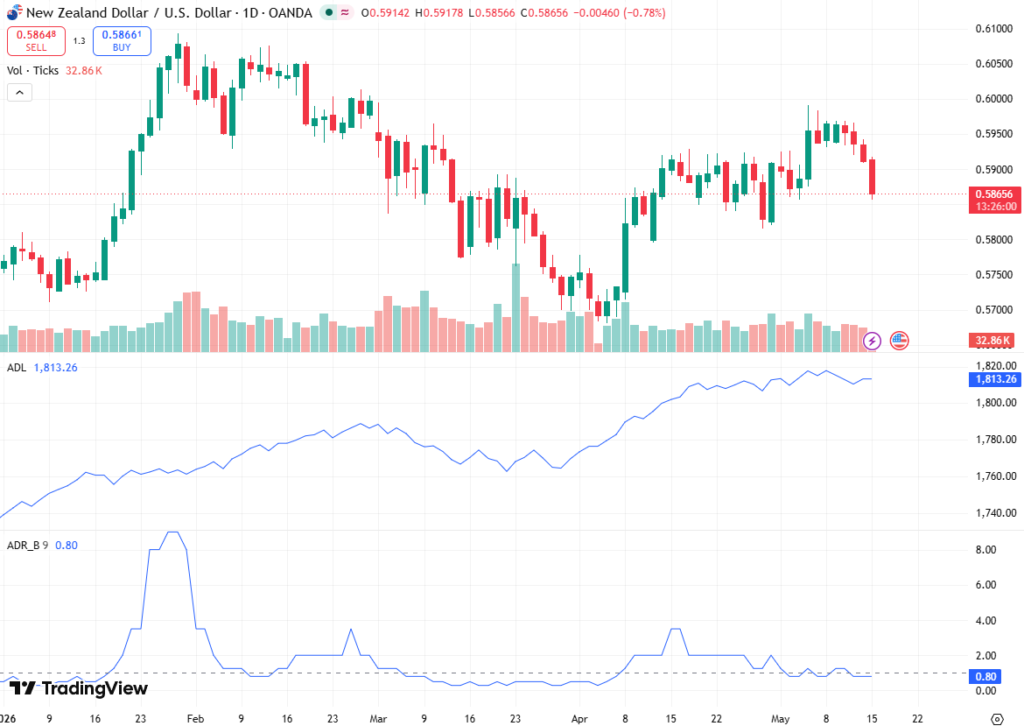
From a technical standpoint, the NZD/USD decline to 0.5860 marks a breach of short-term support around 0.5900, confirming renewed bearish momentum. The 50-hour moving average currently sits near 0.5885, providing potential resistance for any intraday rebounds.
The Relative Strength Index (RSI) has declined to 34, approaching oversold territory, which may signal limited short-term downside before potential consolidation. Nevertheless, failure to hold 0.5850, a key multi-month support level, could open the path toward 0.5820, the next significant technical target.
Intraday trading ranges have expanded to approximately 0.5845–0.5905, reflecting heightened volatility amid geopolitical and monetary uncertainty. Market participants are closely watching order flows around 0.5860, as any significant break could trigger accelerated moves due to algorithmic and high-frequency trading activity.
Implications for Traders and Investors
For currency traders, the current environment indicates continued volatility in NZD/USD. Key technical levels to monitor include support at 0.5860, 0.5850, and 0.5820, while resistance is noted at 0.5885 (50-hour MA), 0.5900, and 0.5920. These levels are critical for identifying potential price reactions and guiding trading decisions.
Traders may consider short positions in line with risk-off flows, particularly if geopolitical tensions persist or US inflation surprises to the upside. Conversely, a sudden diplomatic breakthrough could trigger short-covering and brief rebound moves, but sustained gains may be limited without Fed easing signals.
For investors with exposure to New Zealand assets, the weakening Kiwi underscores the importance of currency risk management. Foreign investment returns in NZD-denominated assets may be impacted by a stronger USD, while trade-dependent sectors may face additional headwinds if global uncertainty or China-linked demand shocks persist.
Conclusion
The NZD/USD pair continues to trade under pressure, nearing 0.5860 in early European sessions. The combination of geopolitical uncertainty, robust US inflation, and rising Fed rate hike expectations has created a challenging environment for the Kiwi.
Technical indicators suggest that 0.5850 remains a critical support level, with further downside possible if current conditions persist.
Traders and investors should closely monitor geopolitical developments, US economic data, and monetary policy signals, as these will continue to dictate the near-term trajectory of the NZD/USD pair and related asset exposures.


