
The global technology landscape is witnessing a profound shift as major e-commerce entities transition into diversified powerhouses of digital innovation. Alibaba Group Holding Limited has recently moved beyond its traditional online retail roots to establish a dominant presence in artificial intelligence (AI) and cloud infrastructure.
As part of its aggressive strategy to secure a leadership position in the AI race, the firm has unveiled a sophisticated new toolset tailored specifically for the gaming industry. Per the latest insights from economic specialists at Marbrisse, these rapid technological advancements are a central component of the company’s longer-term positioning.
By integrating specialized simulation tools into its ecosystem, the firm is not only expanding its service offerings but also directly challenging established leaders in the digital entertainment space. For those tracking the financial trajectory of the enterprise, the question remains whether these capital-intensive projects will translate into a sustainable rally for the stock.
The Happy Oyster Simulation Engine
The centerpiece of this recent launch is a “world model” known as Happy Oyster, designed to generate realistic 3D simulation videos. Unlike standard video tools that rely on a static “prompt and render” cycle, this system functions as a dynamic environment that responds to inputs in real time.
This allows for the creation of evolving digital scenes that adapt as they are generated, a feature that significantly enhances the efficiency of game development and places the firm in direct competition with rivals like Tencent Holdings Limited.
This innovation originated from the Alibaba Token Hub, a consolidated research unit led by the CEO of Alibaba. This division was created to unify the company’s various AI initiatives, including the well-known Qwen family of large language models, with its consumer-facing applications.
By streamlining its research and development pipeline, the company aims to accelerate the deployment of high-performance products that can serve both internal needs and external enterprise clients.
Market Valuation And Volatility
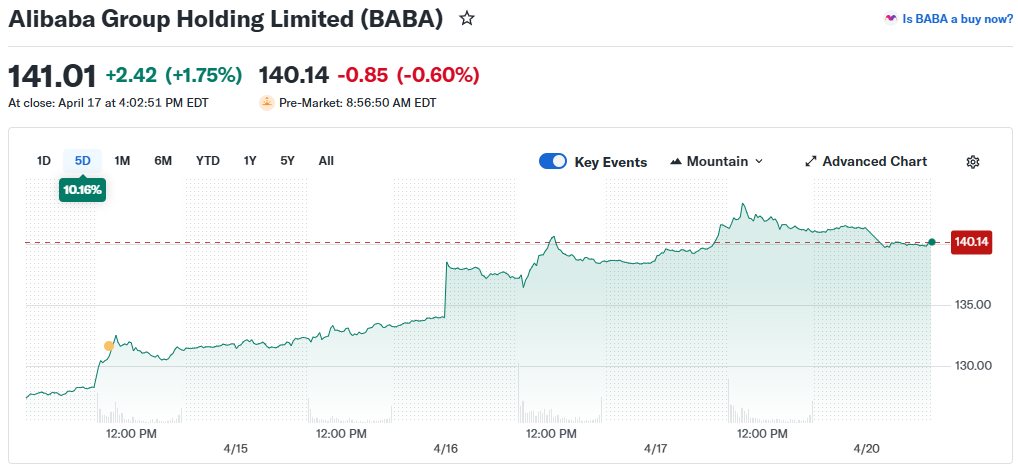
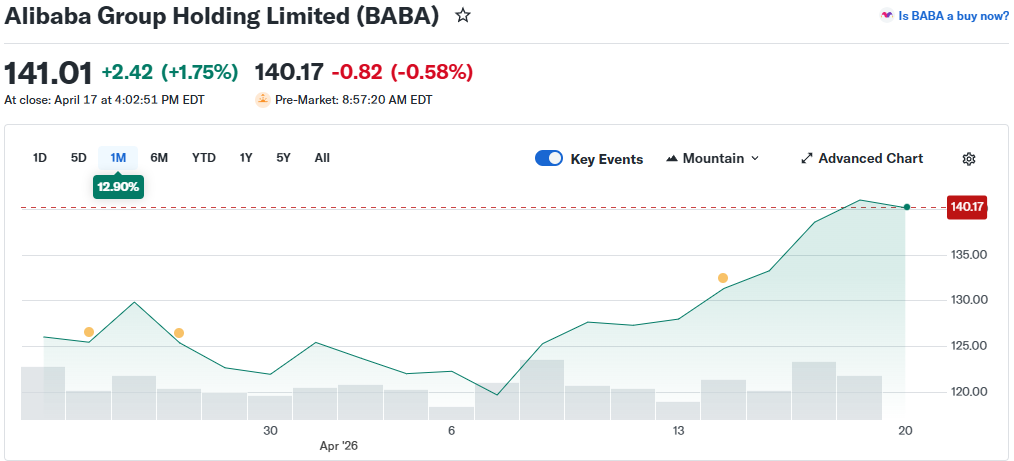
Despite these technological breakthroughs, the company’s shares have faced a complex year on the public markets. While the stock has seen a 52-week gain of 29.52%, it has experienced a 3.8% decline since the start of the current calendar year.
Current trading levels are approximately 26.8% below the 52-week high of $192.67 recorded in October 2025. This volatility reflects a tug-of-war between optimism over technological leadership and investor anxiety regarding short-term profitability.
From a technical perspective, the 14-day Relative Strength Index (RSI) currently sits at 63.73, indicating that the equity is leaning toward overbought territory following recent market activity. Furthermore, the company’s forward-adjusted price-to-earnings (P/E) ratio of 24.87 times remains notably higher than the industry average of 17.21 times.
This premium suggests that the market is already pricing in significant future expectations for growth, leaving little room for error in the coming fiscal quarters.
Revenue Expansion Versus Profit Compression
The most recent quarterly data illustrates the challenges of balancing growth with intensive capital expenditure. The company reported a 2% year-over-year revenue increase, reaching RMB 284.84 billion ($41.76 billion). However, this figure fell short of the RMB 290.70 billion ($42.62 billion) projected by Wall Street analysts.
The primary headwind has been a substantial slump in operating income, which plunged 74% year-over-year to RMB 10.65 billion ($1.56 billion). This decline in profitability is largely attributed to massive spending on quick-commerce initiatives, user experience enhancements, and AI infrastructure.
While these investments have pressured the bottom line, they have also fueled a tenth consecutive quarter of triple-digit revenue growth for the AI-related product suite. Analysts expect a significant rebound in earnings for the next fiscal year, with projections suggesting a 46.5% growth in EPS to $6.43.
Modern Integration Frameworks
The transition from a retail-centric model to an AI-led enterprise represents a fundamental shift in the strategic direction of the organization. The company has set an ambitious goal to reach $100 billion in annual revenue from cloud and AI services within the next five years.
To achieve this, it has pledged billions in capital to modernize its data infrastructure and refine its proprietary models for a wide variety of industrial use cases. Under these evolving conditions, the integration of AI into its core e-commerce platforms is already beginning to yield results.
As the enterprise continues to scale its quick-commerce units and refine its digital applications, the ability to leverage its internal hardware and software will be a critical differentiator.
While the path to higher margins involves weathering current fiscal pressures, the upcoming catalysts related to the Happy Oyster engine suggest that the company is effectively laying the groundwork for a new era of growth.
For those prioritizing capital preservation, the current entry point may represent a calculated opportunity to benefit from the future expectations of a tech giant in the midst of a transformative evolution.


