
The AUD/USD currency pair continues to exhibit a tight consolidation pattern, holding above the key support level at $0.7131. Price action in recent sessions has remained muted, reflecting broader market uncertainty driven by geopolitical developments and macroeconomic ambiguity.
Traders are currently navigating a range-bound environment, with neither bulls nor bears showing sufficient conviction to force a decisive breakout. The team at Fondesia provides a clear and comprehensive explanation of this topic in their article.
This period of low volatility is not unexpected. When markets are awaiting major geopolitical outcomes, such as the evolving situation between the United States and Iran, prices tend to stabilize within well-defined support and resistance zones.
Recap of Previous Forecast Accuracy
In last Tuesday’s AUD/USD forecast, the expectation was for limited price movement, with a particular focus on a potential bear trap below $0.7115. The projection suggested that a dip toward $0.7100 could attract buying interest, triggering a rebound.
This analysis proved to be accurate, as the market failed to break below $0.7115, instead maintaining its position within a narrow consolidation band. The absence of downside momentum reinforced the notion that buyers remain active near the lower boundary of the range.
Such behavior highlights the importance of identifying false breakouts and understanding liquidity zones, where institutional participants often accumulate positions before the next significant move.
Impact of Geopolitical Developments
A key factor influencing the AUD/USD pair is the ongoing geopolitical tension involving the United States and Iran. The recent decision by the U.S. to unilaterally extend a ceasefire, without specifying a timeline, has injected a degree of uncertainty into global markets.
From a risk sentiment perspective, this situation creates a binary scenario. If the ceasefire collapses and conflict resumes, markets are likely to shift toward risk aversion. In that case, the U.S. dollar would typically strengthen, while AUD/USD could move lower, potentially even opening with a gap-down.
Conversely, any progress toward diplomatic resolution would likely improve risk appetite. This environment tends to favor commodity-linked currencies such as the Australian dollar, which could push AUD/USD higher, possibly breaking above the $0.7200 level and establishing new highs.
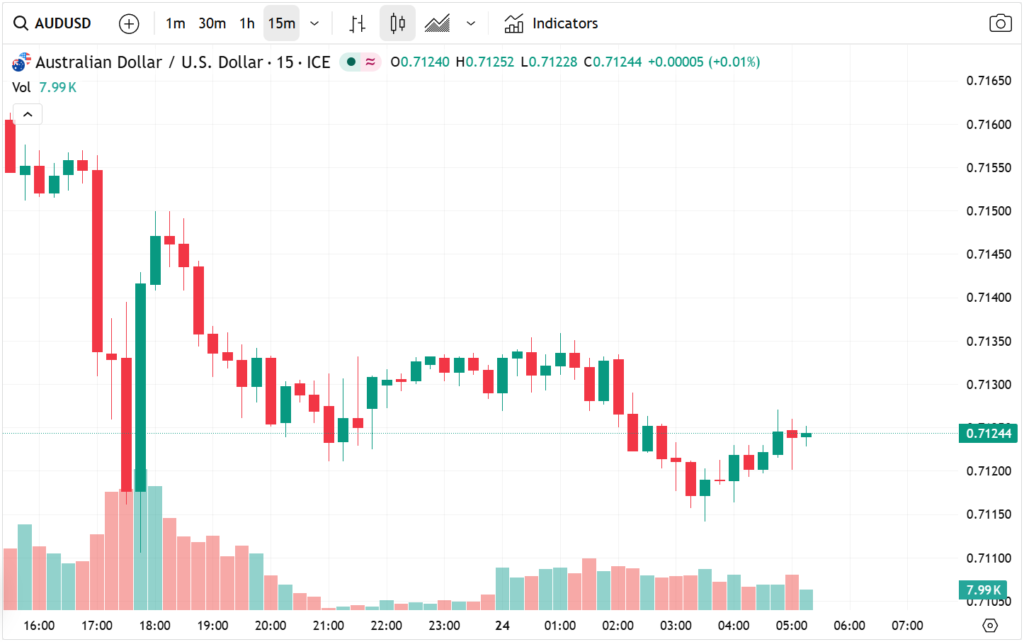
This kind of dual-outcome scenario helps explain why traders are currently hesitant to take on large directional positions. Instead, many are focusing on short-term tactical trades, allowing them to stay flexible while the broader situation remains uncertain.
Technical Analysis: Key Levels to Watch
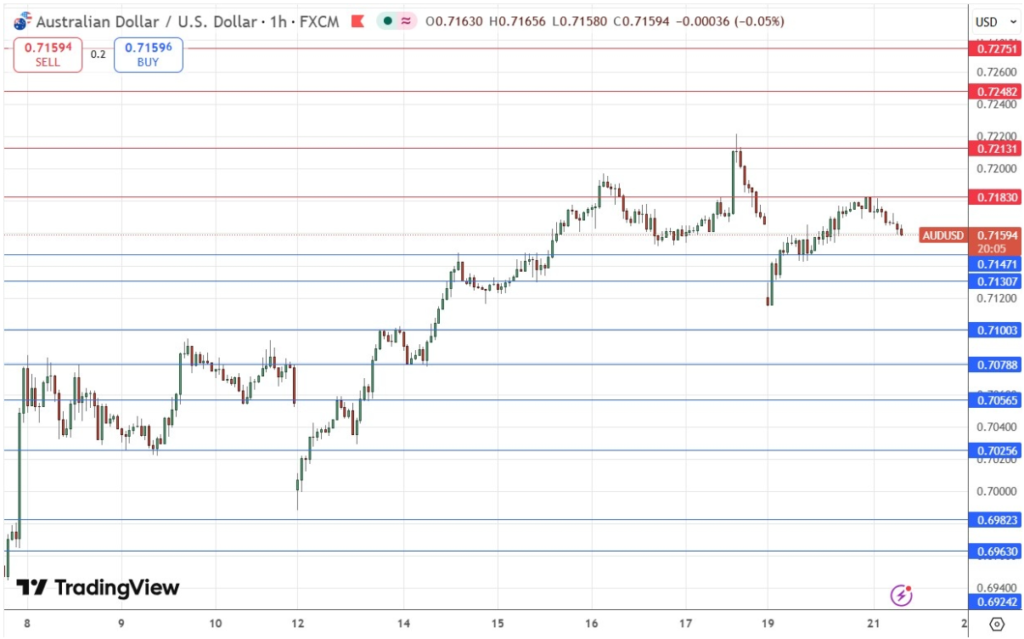
From a technical standpoint, the pair remains confined within a horizontal range, with clearly defined support and resistance levels shaping price action. The key support level is at $0.7131, with a lower threshold at $0.7115, while resistance stands at $0.7183. A confirmed breakout above $0.7200 would signal a potential shift toward stronger bullish momentum.
The $0.7131 level has emerged as a critical support zone, effectively acting as a pivot point for intraday trading. As long as the price remains stable above this level, it suggests that buyers are actively defending the range, helping to preserve a bullish short-term structure and limiting downside pressure.
On the upside, $0.7183 represents a key resistance barrier, where previous rallies have stalled. A failure to break this level reinforces the range-bound thesis, while a decisive breakout could signal the start of a bullish continuation trend.
Role of Macroeconomic Divergence and Interest Rate Expectations
Another important dimension shaping the AUD/USD outlook is the divergence in monetary policy expectations between the Reserve Bank of Australia (RBA) and the Federal Reserve. The Australian dollar is highly sensitive to interest rate differentials, as these directly influence capital flows and carry trade attractiveness.
If markets begin pricing in a more hawkish stance from the Federal Reserve, such as prolonged higher interest rates, this would strengthen the U.S. dollar and place downward pressure on AUD/USD.
Risk Considerations and Market Outlook
While range trading is currently favorable, traders must remain vigilant for unexpected news events, especially related to the U.S.–Iran situation. A sudden shift in geopolitical dynamics could trigger a volatility spike, invalidating the consolidation pattern.
Additionally, broader macroeconomic factors, such as interest rate expectations, commodity prices, and Chinese economic data, continue to influence the Australian dollar. These variables can act as secondary catalysts, potentially accelerating a breakout once geopolitical uncertainty subsides.
Conclusion
The AUD/USD pair continues to consolidate above $0.7131, signaling a cautious, wait-and-see market environment. As geopolitical uncertainty drives overall sentiment, traders may benefit from range-bound strategies, looking to capitalize on reversals at key support and resistance levels.
Until a clear directional catalyst emerges, the probability favors continued sideways movement, making short-term scalping opportunities the most practical approach. However, traders should be prepared to adapt quickly, as any significant development could shift the market into a strong trending phase, either bullish above $0.7200 or bearish below $0.7115.


