
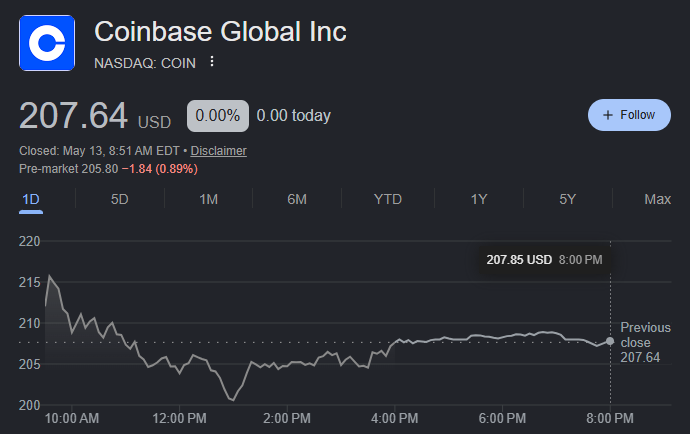
The digital asset ecosystem faced a moment of technical truth on Tuesday as Coinbase (COIN) shares successfully defended a primary support level despite a disappointing quarterly update. While the exchange’s first-quarter financials failed to meet market consensus, Digital currency analysts at Fondesia have concluded that the current price action is heavily influenced by a shifting regulatory climate in Washington.
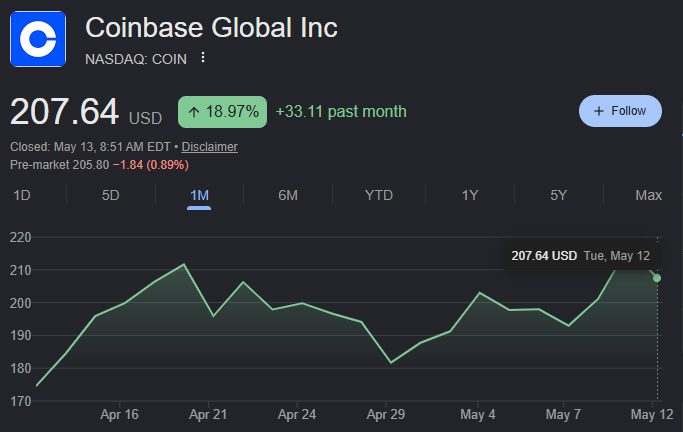
The equity’s ability to stabilize suggests that investors may be looking past immediate earnings misses toward broader legislative developments. After snapping a five-month losing streak in April, the stock has maintained a positive bias through the early weeks of May, though questions regarding its long-term valuation remain at the forefront of market discussion.
The company recently reported a loss of $1.49 per share for the first quarter, with revenue retreating to $1.41 billion. These figures fell short of the anticipated 6 cents per share profit and $1.5 billion in sales forecasted by analysts. However, the market’s focus has pivoted toward the Digital Asset Market Clarity Act, where recent reports suggest a bipartisan compromise may be emerging.
Legislative Catalysts and Historical Performance Trends
The volatility surrounding the Clarity Act has historically served as a primary driver for the stock’s performance. In February, shares climbed 16% following a strong fourth-quarter report and renewed administrative interest in establishing clear industry guidelines. While earlier revisions of the act in March caused a temporary slide due to concerns over yield payment bans, the current momentum toward a compromise has acted as a stabilizing force.
For an exchange that currently trades significantly below its all-time highs, the resolution of these legal uncertainties is widely considered a mandatory prerequisite for a sustained recovery.
Historical data reveals a high degree of correlation between the exchange’s equity and the broader digital asset market. In 2023, the stock experienced a massive rally of 391%, significantly outperforming Bitcoin’s 150% surge. This followed a catastrophic 2022 where the asset lost 86% of its value in tandem with a broader market crash.
In the current environment of May 13, 2026, Bitcoin is trading near the $80,000 mark, which remains well below the record highs above $125,000 seen in October of the previous year. This suggests that while the floor is holding, the “beta” of the stock to the underlying asset remains a critical risk factor for diversified portfolios.
Technical Indicators and the “Death Cross” Warning
From a technical standpoint, the outlook for the stock is nuanced. As of Tuesday, the price action was holding firm at the 50-day moving average, a level often used by institutional desks to gauge short-term trend health. However, a significant warning remains on the chart: the 50-day moving average is currently positioned below the 200-day moving average.
In technical analysis, this configuration is known as a death cross, a pattern that historically signals potential long-term weakness. Furthermore, the equity’s Relative Strength Rating has declined to 50, indicating that it is currently underperforming a significant portion of the broader market.
Platform Evolution and Institutional Adoption
Founded in 2012 as a simplified gateway to the digital asset market, the organization has evolved into the largest cryptocurrency exchange in the United States. Beyond its core brokerage services, the platform has diversified into staking, institutional custody, and transfer services.
This diversification is intended to mitigate the impact of fluctuating trading volumes in primary assets like Bitcoin and Ethereum. However, the success of these secondary revenue streams remains tethered to the overarching regulatory environment.
The current strategic orientation for the platform involves navigating a path toward full compliance while maintaining its competitive edge against international rivals. High-level leadership meetings between the financial sector and legislative bodies continue to influence sentiment, as the industry seeks to solidify a structure that permits innovation without compromising consumer protection.
Digital Asset Infrastructure and the Future of Coinbase
As we progress through May 13, 2026, the focus for market participants will remain on the interplay between Bitcoin’s price stability and the pace of legislative progress. Maintaining institutional-grade productivity in this volatile sector requires a focus on volume metrics and regulatory milestones rather than short-term price fluctuations.
While the accumulation from mutual funds provides a degree of confidence, the ongoing uncertainty regarding stablecoin yields and the presence of the death cross on the daily chart suggest that a cautious stance is warranted.
In conclusion, the exchange is at a crossroads where its role as the main beneficiary of possible regulatory clarity is being weighed against its core earnings power. A sustained move above the 200-day moving average would be required to invalidate the current bearish technical setup.
Until such a breakout occurs, the stock will likely continue to trade as a high-beta proxy for the broader crypto market, with its valuation inextricably linked to the legislative pen in Washington.


