
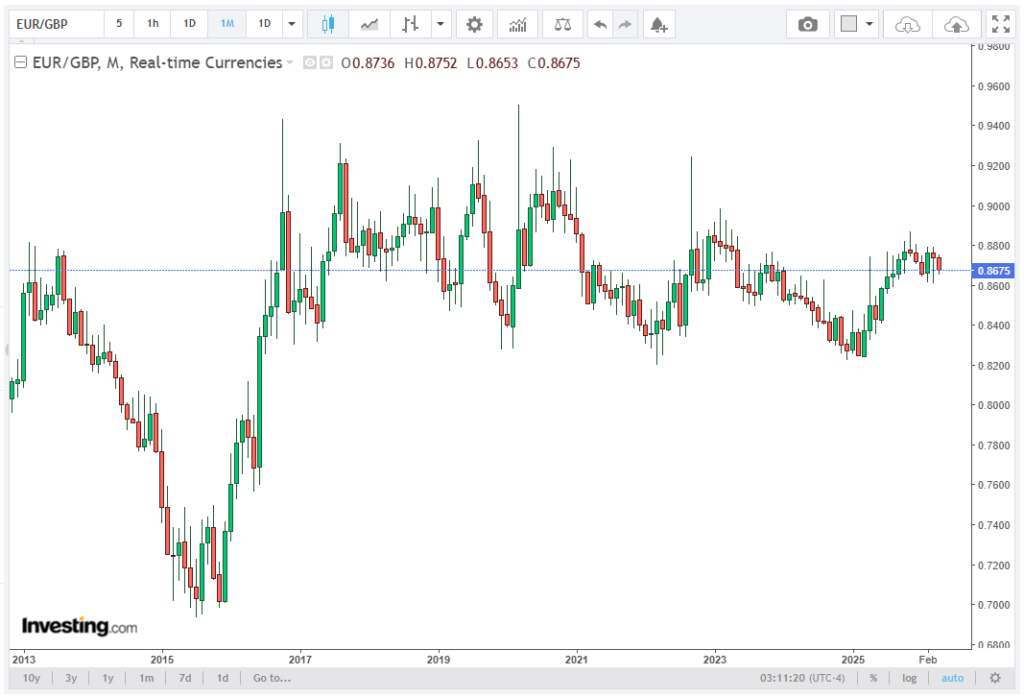
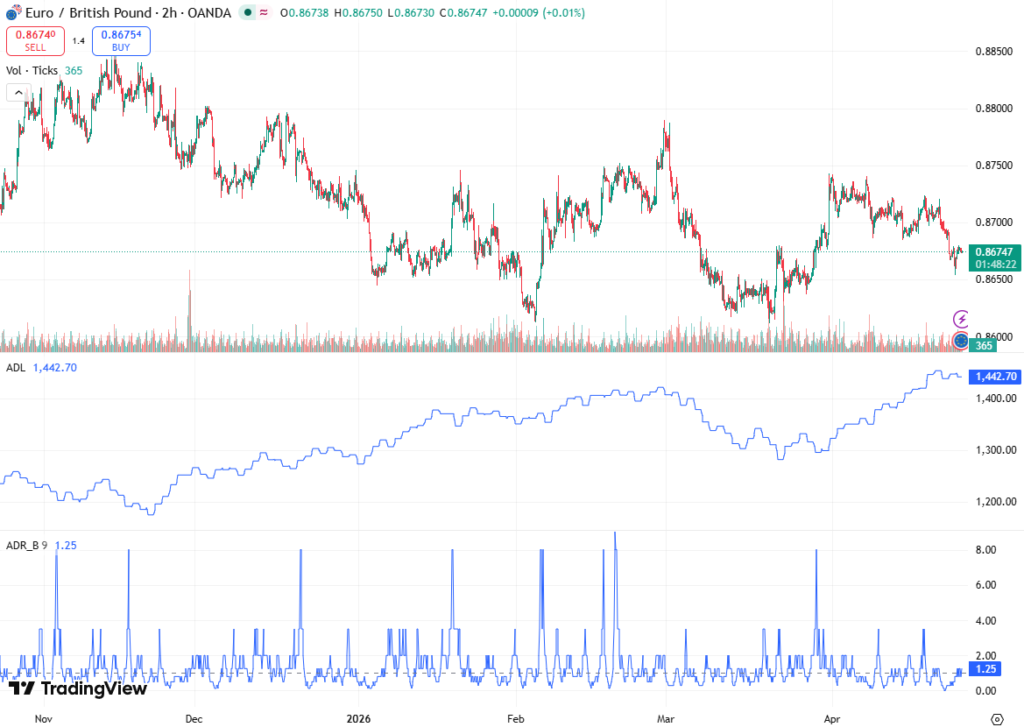
The EUR/GBP exchange rate continues to trade in a narrow consolidation range, reflecting a market caught between mixed UK macroeconomic signals, subdued Eurozone sentiment, and rising geopolitical risk premiums. At the time of writing, the pair sits around 0.8675, with repeated attempts to extend a recovery from 0.8654 lows consistently failing to break through the key 0.8680 resistance zone.
Despite a stronger-than-expected set of UK Retail Sales data, the Pound has struggled to build sustained momentum, while the Euro remains equally constrained amid weakening regional sentiment indicators and broader global risk aversion. A clear and detailed explanation of this topic can be found in Fondesia’s article.
Technical Structure: Range-Bound Market Below Key Resistance
From a technical perspective, EUR/GBP remains firmly range-bound, with buyers attempting to recover from the recent 0.8654 support base. However, upside progress has been repeatedly capped at 0.8680, which now acts as a critical short-term resistance barrier.
The inability to break above this level suggests that bullish momentum remains fragile. Market participants continue to treat rallies as selling opportunities, particularly in the absence of a strong Eurozone catalyst. Meanwhile, downside pressure is limited by persistent demand near the 0.8650–0.8655 support region, which has acted as a short-term floor.
The broader technical picture points to a consolidation phase, with volatility compressed as traders await clearer direction from upcoming macroeconomic releases.
UK Retail Sales: Strong Headline, Weak Underlying Momentum
The latest data from the UK Office for National Statistics (ONS) showed that Retail Sales rose by 0.7% in March, rebounding from a 0.6% contraction in February and significantly outperforming expectations of a 0.2% increase. At face value, this represents a meaningful improvement in consumer spending activity, typically supportive for the British Pound (GBP).
However, closer analysis reveals that the strength was heavily concentrated in fuel sales, which are inherently volatile and closely tied to energy price fluctuations rather than underlying demand strength.
Excluding fuel and automobile-related components, core Retail Sales rose only 0.2%, matching forecasts but following a prior contraction. This suggests that underlying consumer demand remains subdued, limiting the positive impact on GBP FX positioning.
Inflation Pressures and Consumer Confidence Weigh on GBP Outlook
Beyond retail consumption, broader UK economic indicators continue to signal structural headwinds. Recent preliminary business activity data showed that both the manufacturing and services sectors remain in expansion territory, but input costs have surged to record highs.
This reflects persistent inflationary pressure, driven in part by elevated energy costs linked to geopolitical instability. For businesses, rising costs compress margins, while for consumers, they translate into higher retail prices.
Compounding these pressures, the latest GfK Consumer Confidence Index fell to a three-year low, highlighting growing pessimism among households. Concerns are centered on rising energy prices, higher mortgage costs, and potential future Bank of England (BoE) interest rate hikes.
Eurozone Sentiment: Weakening Momentum Ahead of German IFO Data
On the Euro side, attention turns to the upcoming German IFO business climate index, a key measure of business sentiment in Europe’s largest economy. Expectations point toward a further deterioration in April, driven largely by elevated energy costs and weakening external demand conditions.
This follows a broader pattern of softening Eurozone economic indicators, where firms are increasingly cautious about investment and production decisions. The result is a muted Euro (EUR) performance, even in the absence of aggressive ECB policy shifts.
While the Euro is not experiencing a sharp sell-off, the lack of positive catalysts has limited any meaningful upside against the Pound, reinforcing the EUR/GBP consolidation pattern.
Outlook: EUR/GBP Likely to Remain Range-Bound
Looking ahead, the EUR/GBP pair is expected to remain range-bound in the near term, with 0.8650 support and 0.8680 resistance defining the immediate trading corridor.
For a sustained breakout, markets would likely require a stronger Eurozone growth surprise supporting the EUR, a clear deterioration in UK economic data pressuring the GBP, or a shift in geopolitical sentiment that reduces USD-driven distortions.
Until then, the pair is likely to remain in a low-volatility consolidation phase, with traders reacting more to external macro and geopolitical developments than domestic fundamentals alone.
Conclusion
The EUR/GBP exchange rate remains technically and fundamentally constrained, as a modest recovery from 0.8654 lows continues to struggle below 0.8680 resistance. While UK Retail Sales beat expectations, the strength was narrowly driven by fuel-related spending, limiting bullish implications for the Pound.
At the same time, weakening consumer confidence, rising cost pressures, and deteriorating Eurozone sentiment are keeping both currencies subdued. Overlaying these domestic dynamics is the persistent Iran–US geopolitical tension, which continues to support the US Dollar and suppress broader FX volatility.
In this environment, EUR/GBP remains a tactical range trade, with macro catalysts rather than technical breakouts likely to dictate the next decisive move.


