
The EUR/JPY cross has extended its decline for a third consecutive session, slipping toward the 186.50–186.60 region during Thursday’s Asian trading hours. The move reflects a broader shift in global sentiment toward risk aversion, as investors reassess exposure to geopolitical instability in the Middle East. Achievements AI presents a structured and easy-to-understand analysis of this topic in their article.
The Euro (EUR) is under pressure as market participants reduce holdings of risk-sensitive assets, while the Japanese Yen (JPY) initially benefits from its traditional safe-haven status. However, gains in the yen are partially capped by rising energy prices, complicating directional conviction in the currency pair.
Overall, EUR/JPY remains in a fragile consolidation phase, with traders balancing geopolitical risk premiums against divergent central bank expectations between the European Central Bank (ECB) and the Bank of Japan (BoJ).
Geopolitical Tensions Drive Risk Aversion
A key driver behind the recent move is escalating uncertainty in the Middle East, particularly surrounding the Strait of Hormuz, a critical global oil transit chokepoint.
According to reports cited by the Wall Street Journal, Iran fired on three ships in the Strait and escorted two vessels into Iranian waters on Wednesday. Iranian media confirmed that the Revolutionary Guard had transferred control of the ships to Iranian territory, signaling a further escalation in maritime tensions.
Although the White House indicated that the seizures do not technically violate the terms of the current ceasefire arrangement, market participants remain unconvinced. The situation is complicated by ongoing political rhetoric, including statements from Iranian officials asserting that reopening the Strait would be “impossible” under continued US and Israeli pressure.
These developments have reinforced concerns over energy supply security, increasing volatility across FX, commodities, and equity markets.
Oil Prices Add Complexity to Yen Dynamics
Despite its safe-haven appeal, the Japanese Yen is not fully capitalizing on risk-off flows due to a simultaneous surge in crude oil prices.
West Texas Intermediate (WTI) has risen for a third consecutive session, trading near $93.30 per barrel, reflecting fears of supply disruption through the Strait of Hormuz. For Japan, a major energy-importing economy, higher oil prices typically translate into worsening trade balances and upward pressure on import costs.
This dynamic reduces the net supportive effect of risk aversion on the yen, leaving EUR/JPY’s downside somewhat contained. In FX terms, this creates a tug-of-war between safe-haven demand and external balance deterioration for Japan.
BoJ Policy Expectations Anchor Medium-Term Outlook
Attention is also turning toward the upcoming Bank of Japan (BoJ) policy meeting, where investors expect policymakers to maintain current interest rates.
Consensus suggests the BoJ will hold rates steady this month as it continues to assess inflation sustainability and wage growth momentum. However, forward guidance remains critical, with markets increasingly pricing in the possibility of policy normalization as early as June.
This potential shift marks a gradual departure from Japan’s long-standing ultra-loose monetary stance. Any signal of tightening bias could provide structural support to the yen over the medium term, especially if global risk sentiment stabilizes.
For now, however, the BoJ’s cautious stance limits aggressive JPY appreciation, maintaining a relatively two-sided risk profile for EUR/JPY.
Technical Outlook: EUR/JPY at a Critical Inflection Zone
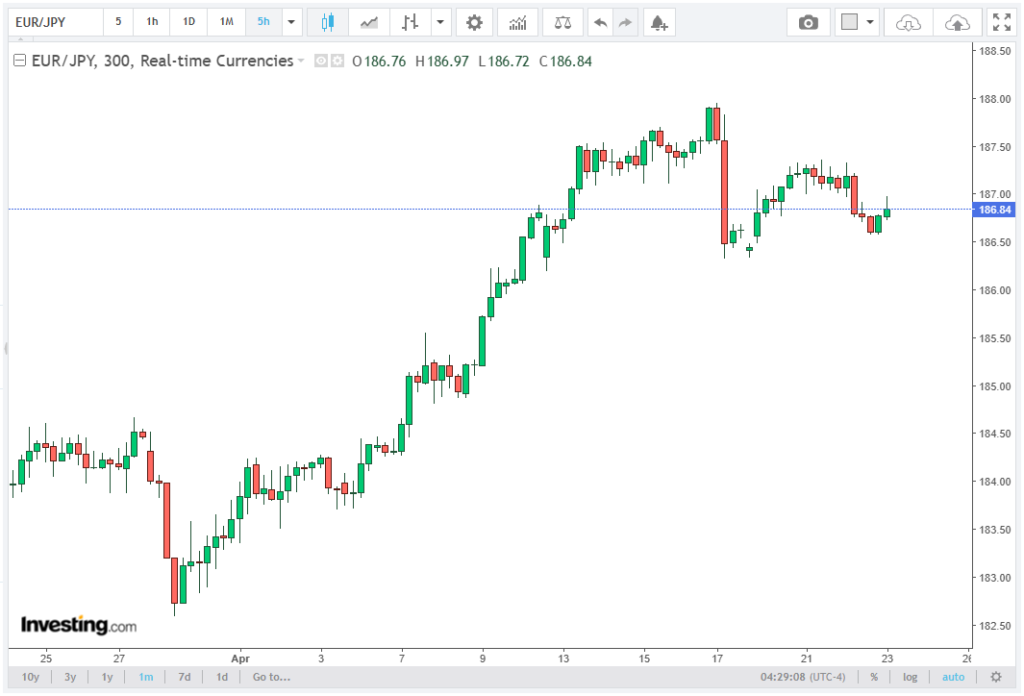
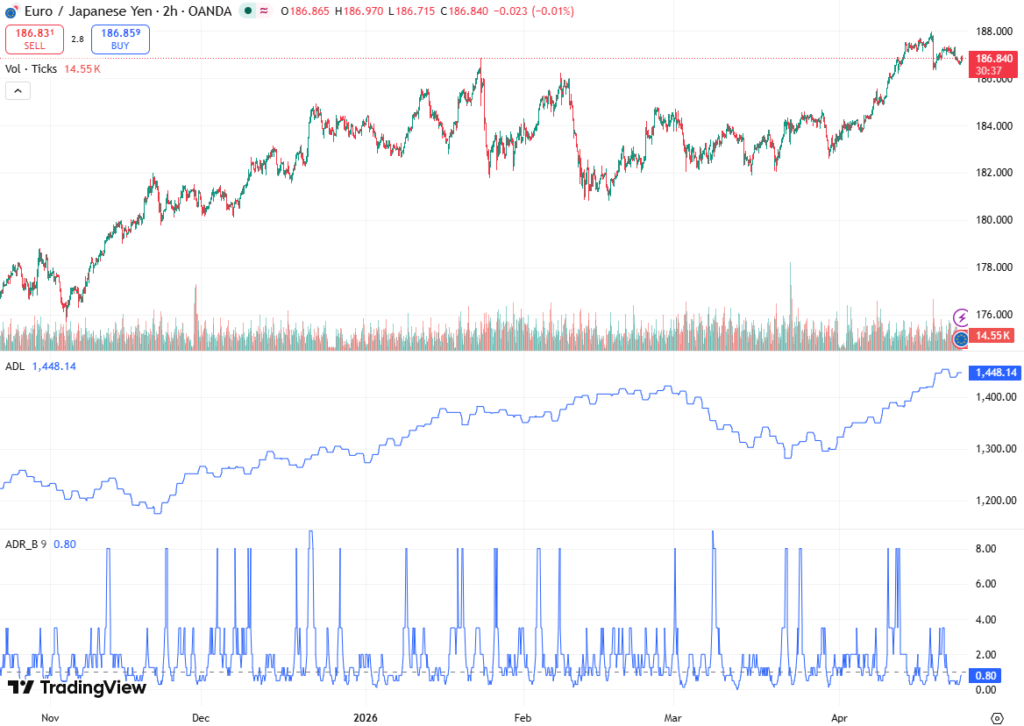
From a technical perspective, EUR/JPY is hovering near a short-term support zone around 186.50, a level that has attracted intraday buying interest in previous sessions.
A sustained break below this threshold could expose the pair to a deeper correction toward lower support areas, while rebounds are likely to face resistance near the 187.50–188.00 range, where recent selling pressure has emerged.
Momentum indicators suggest waning bullish strength, with intraday charts reflecting a gradual shift toward bearish consolidation rather than an aggressive downtrend. However, volatility remains highly sensitive to geopolitical headlines, particularly developments in the Strait of Hormuz.
Traders are therefore likely to maintain a headline-driven trading approach, with technical levels acting as secondary reference points rather than primary catalysts.
Outlook: Volatility Driven by Geopolitics and Central Banks
Looking ahead, EUR/JPY is expected to remain influenced by two dominant forces: Middle East geopolitical risk and divergent monetary policy expectations between the BoJ and ECB.
If tensions in the Strait of Hormuz continue to escalate, further risk-off flows could support the yen while simultaneously weighing on the euro. However, rising oil prices may offset part of this dynamic by weakening Japan’s external position.
On the monetary side, any confirmation that the BoJ is moving closer to policy normalization in June could provide medium-term support for the yen, adding another layer of downside pressure on EUR/JPY.
In the near term, the cross is likely to remain range-bound but volatile, with 186.50 emerging as a key pivot level for traders monitoring the balance between geopolitical risk and macroeconomic divergence.


