
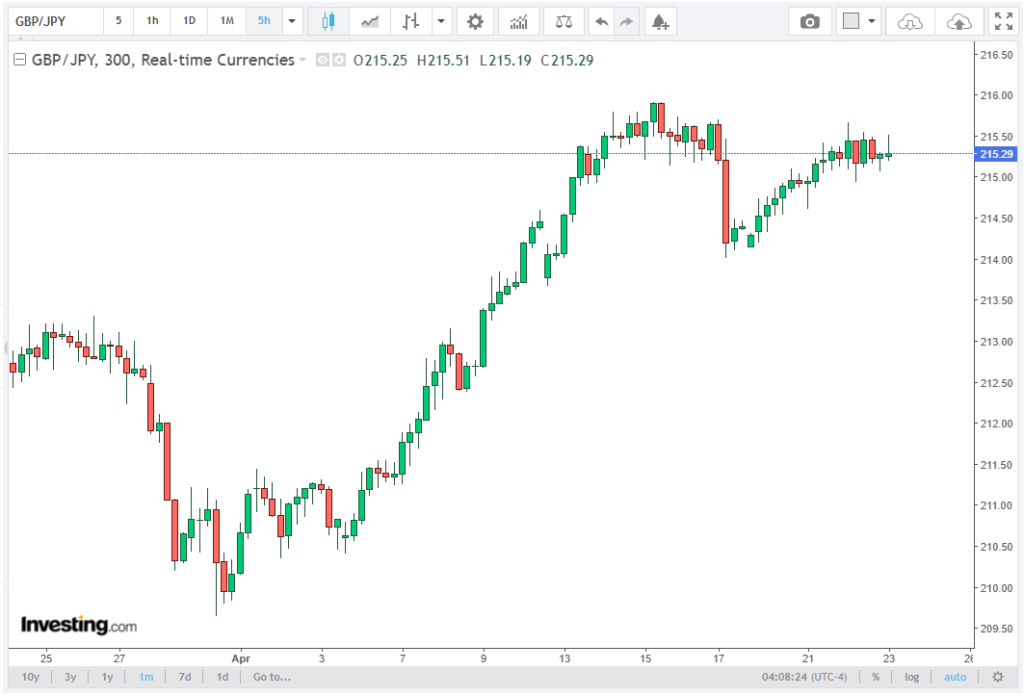
The GBP/JPY currency pair has staged a modest recovery during Thursday’s European trading session, reversing earlier losses and trading back into positive territory near 215.45. The rebound reflects a combination of Japanese Yen (JPY) weakness and cautious positioning ahead of key macroeconomic catalysts from both the United Kingdom and Japan. In this article, Achievements AI breaks down the topic in a clear and informative manner.
Market participants are navigating a complex macro environment where interest rate expectations, inflation dynamics, and geopolitical energy risks are driving short-term volatility. The pair’s intraday resilience highlights the ongoing divergence between the Bank of England (BoE) and the Bank of Japan (BoJ) policy outlooks.
Japanese Yen Underperforms as BoJ Tightening Expectations Fade
The primary driver behind GBP/JPY’s recovery is the underperformance of the Japanese Yen, which has softened against most major currencies, with the exception of the antipodean FX pairs.
Investor sentiment toward the Yen has deteriorated as markets increasingly price in the possibility that the Bank of Japan (BoJ) may delay further monetary tightening. Expectations are centered around the upcoming policy decision on April 28, where the BoJ is widely anticipated to keep its benchmark interest rate unchanged at 0.75%.
This cautious outlook stems from growing concerns about Japan’s economic resilience, particularly in light of rising global oil prices triggered by geopolitical tensions, including disruptions linked to the Strait of Hormuz closure risks. Higher energy costs could weigh on domestic consumption and complicate the BoJ’s tightening path.
As a result, the Yen remains structurally weak in the short term, providing a supportive backdrop for GBP/JPY upside momentum.
Sterling Awaits UK Flash PMI Data for Directional Clarity
On the UK side, the Pound Sterling (GBP) is trading in a relatively subdued and mixed fashion as investors await the release of the preliminary S&P Global UK PMI data for April, scheduled at 08:30 GMT.
The flash PMI readings are expected to be a key short-term catalyst for GBP volatility, offering fresh insight into the health of the UK private sector. Economists anticipate that overall business activity may have contracted slightly, with the UK Composite PMI forecast at 49.8, down from 50.3 in March.
This expected decline signals a potential return to contraction territory, driven primarily by a weakening services sector and a moderation in manufacturing output growth. Since PMI readings above 50 indicate expansion and below 50 signal contraction, a sub-50 reading would reinforce concerns about slowing UK economic momentum.
Market participants will closely analyze sub-components of the report, including new orders, employment trends, and input cost pressures, to assess whether the slowdown is cyclical or more structural in nature.
Bank of England Policy Outlook: Holding Pattern Expected
Monetary policy expectations for the UK remain a key stabilizing factor for the Pound. The Bank of England (BoE) is widely expected to maintain its base interest rate at 3.75% during its upcoming meeting on April 30.
Recent data indicating a cooling in core inflation and services CPI growth has reduced pressure on the BoE to implement further tightening. However, policymakers remain cautious, as inflation expectations remain elevated, partly due to persistent energy price volatility.
This policy stance suggests a prolonged period of monetary policy stability, rather than aggressive easing or tightening. For FX markets, this tends to limit downside pressure on GBP while also capping strong bullish momentum, especially when compared to more actively shifting policy regimes like Japan’s.
Technical Outlook: GBP/JPY Stabilizes Above Key Support
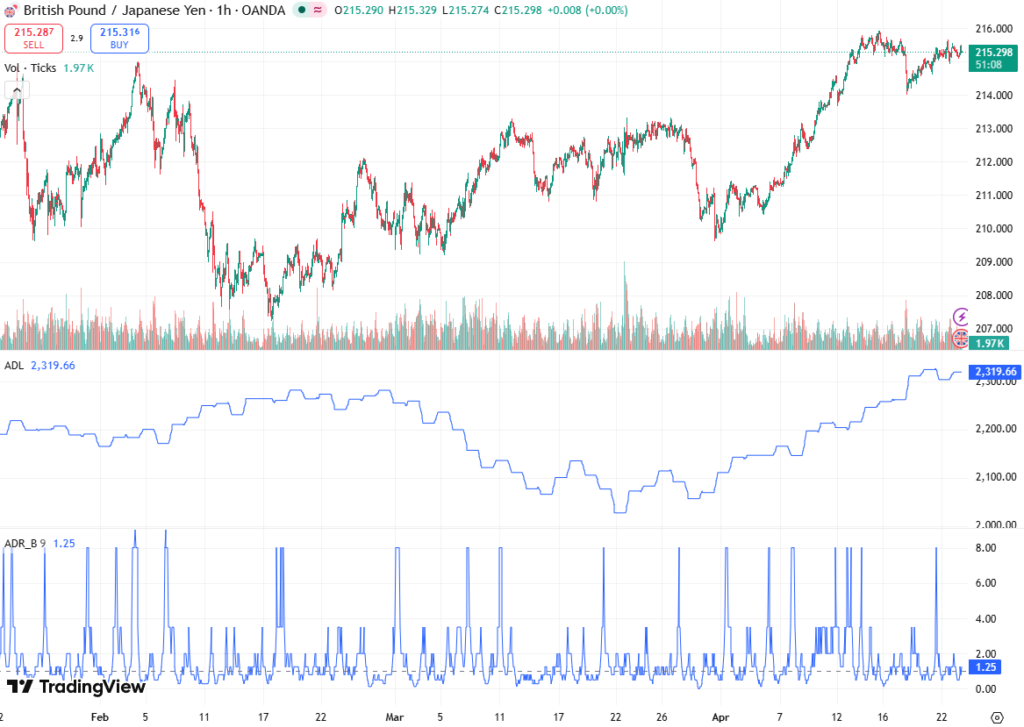
From a technical perspective, GBP/JPY’s recovery toward 215.40–215.45 suggests that buyers are defending short-term support zones after early-session selling pressure.
The pair’s ability to hold above this level indicates potential for continued consolidation, with traders eyeing resistance zones around recent highs. A sustained move above 215.50 could open the door for further upside momentum, particularly if upcoming UK PMI data surprises to the upside or if BoJ signals reinforce dovish expectations.
Conversely, failure to maintain current levels could expose the pair to a retest of lower support zones, especially if risk sentiment deteriorates or if UK economic data underperforms expectations.
Conclusion: Data-Driven Volatility Ahead for GBP/JPY
The GBP/JPY pair remains highly sensitive to upcoming macroeconomic events, with both UK flash PMI data and the BoJ policy meeting acting as immediate catalysts.
While current price action reflects Japanese Yen weakness and relative Sterling stability, the broader outlook remains uncertain. The interaction between BoE rate expectations, BoJ policy hesitation, and global energy-driven inflation risks will continue to shape short-term direction.
In the near term, traders should expect heightened volatility, with GBP/JPY likely to react sharply to any deviation from consensus expectations in either UK growth data or Japanese monetary policy signals.


