
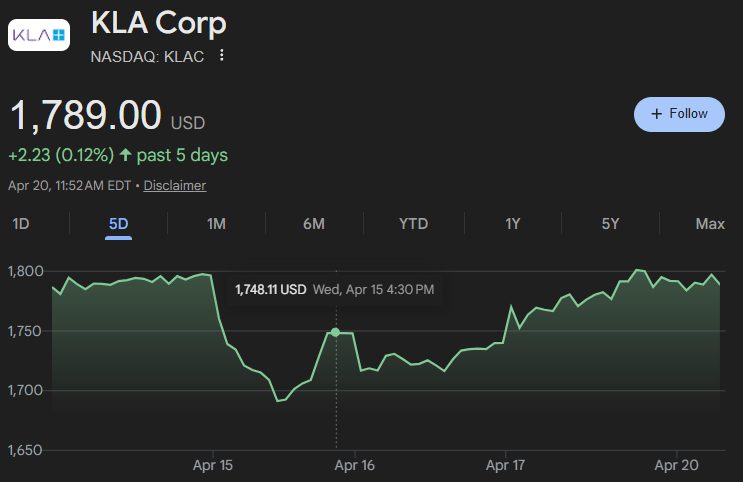
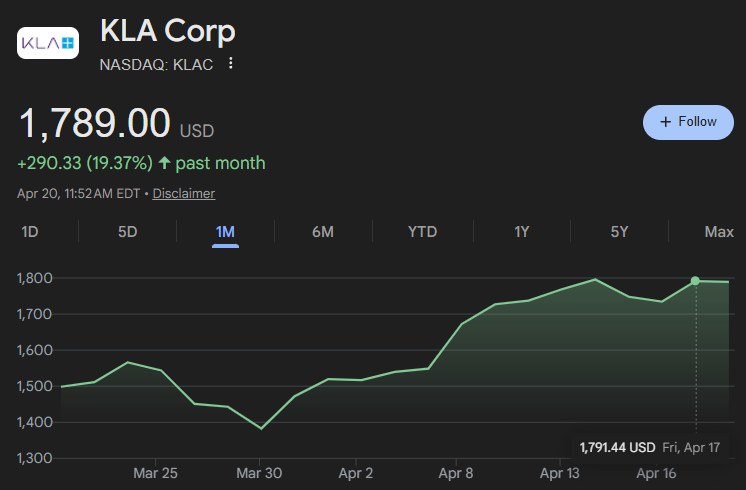
The global semiconductor equipment sector witnessed a landmark event on April 20, 2026, as one of its most influential players achieved a record-breaking valuation. Shares of the process control specialist climbed to an unprecedented all-time high of 1,798.33 USD, representing a monumental shift in the firm’s market standing.
This recent peak highlights a staggering 189.07% appreciation over the previous twelve-month period, a figure that underscores both the company’s operational excellence and the intense investor appetite for high-performance computing infrastructure.
For those tracking the financial trajectory of the broader tech market, these evolving conditions suggest that the demand for precision manufacturing tools remains a primary driver of equity growth.
Synthesizing the industrial data points curated by Nummixo technology analysts, the company currently maintains a massive market capitalization of $234.64 billion. Despite this soaring valuation, the stock is trading at a P/E ratio of 52.05, a level that has prompted some valuation specialists to suggest the price may be extended relative to historical fair value.
However, the firm’s fundamental strength remains undisputed, as evidenced by a perfect Piotroski Score of 9. This metric is often utilized by institutional investors to identify companies with institutional-grade financial health, including robust profitability and high operational efficiency.
Furthermore, the firm has demonstrated a commitment to shareholder returns by raising its dividend for 10 consecutive years.
Strategic Guidance and Process Control Dominance
The recent surge in price follows a series of high-level updates from the firm’s recent Investor Day, where leadership outlined a highly ambitious roadmap for the coming decade. Market analysts have responded with significant upward revisions, with some price targets now reaching as high as $2,000.
These optimistic projections are rooted in the company’s updated guidance for the 2026 calendar year, which anticipates revenue reaching approximately $15 billion. This target comfortably exceeds previous consensus estimates and reflects a strategic direction focused on capturing the growing complexity of next-generation chip architecture.
At the core of this growth is the concept of process control intensity. As semiconductor nodes become smaller and more complex, the necessity for high-precision inspection and measurement tools increases exponentially. The company currently holds a dominant position in this niche, commanding over 56% market share in the global process control space.
Analysts expect that wafer fabrication equipment (WFE) spending could surpass $200 billion by 2030, providing a fertile environment for the firm to expand its influence. This longer-term positioning is further supported by the rise of artificial intelligence, which requires a massive volume of specialized, defect-free silicon.
Technological Advancements and Future Earnings
The transition toward AI-driven computing has fundamentally altered the future expectations for equipment vendors. During the firm’s most recent analyst briefings, the discussion centered on the company’s ability to scale its operations to meet the demands of 2030 targets.
These long-term goals include a revenue objective of $26 billion and a projected earnings per share of $84. Achieving these figures would require the company to maintain its technological lead in an environment where competitors are also aggressively investing in research and development.
Investors are particularly focused on the firm’s ability to sustain its margins amidst fluctuating global trade dynamics. While the current financial trajectory is overwhelmingly positive, the company must continue to innovate to maintain its institutional-grade financial health.
The shift toward 3D chip architectures and advanced packaging represents both a challenge and an opportunity. By focusing on wafer fabrication equipment (WFE) that can handle these new geometries, the company is effectively insulating itself from the commoditization seen in lower-tier segments of the industry.
Institutional Perspectives And The Forward-Looking Value Proposition
As the semiconductor industry continues to mature, the focus remains on identifying the upcoming catalysts that will sustain these historic valuations. The achievement of the 1,798.33 USD price point is more than just a numerical milestone; it is a testament to the firm’s essential role in the global supply chain.
While some technical indicators suggest a need for caution due to the current P/E ratio of 52.05, the fundamental narrative remains anchored in the structural growth of global computing needs. Ultimately, the strategic direction of the firm is locked into the long-term expansion of the digital economy.
With several upcoming catalysts expected in the form of quarterly earnings reports and further breakthroughs in lithography support, the longer-term positioning of the stock remains a central theme for institutional portfolios. The ability to manage these evolving conditions while delivering consistent dividend growth is what sets the firm apart in a volatile sector.
For now, the market is content to reward the company’s dominance as it navigates the path toward a $200 billion WFE market and beyond.


