
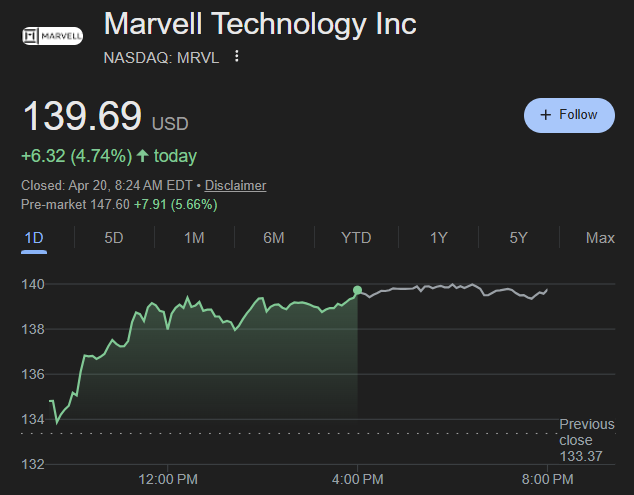
The semiconductor industry is witnessing a significant reconfiguration of alliances as major hyperscalers seek to bolster their internal hardware capabilities. Market sentiment turned sharply positive for Marvell Technology on Monday, with shares surging by 6% in premarket activity.
This rally follows reports indicating that Alphabet’s Google is currently in advanced discussions with the firm to co-develop two specialized processors designed to optimize the performance of artificial intelligence models.
According to market analysts at Marbrisse, this potential collaboration underscores the growing demand for bespoke silicon that can handle the massive computational requirements of modern generative AI. This surge reflects the market’s appetite for companies that can bridge the gap between high-level AI software and the physical hardware required to run it.
As large-scale data centers face increasing pressure to provide higher throughput and lower latency, the role of specialized designers has moved from the periphery to the center of the global technology supply chain.
Diversification Beyond Broadcom And The Move To Custom Silicon
The reported discussions involve the development of two distinct pieces of hardware: a memory processing unit (MPU) designed to work in tandem with existing infrastructure, and a next-generation Tensor Processing Unit (TPU) specifically engineered for AI inferencing.
Traditionally, Google has relied heavily on its long-term partnership with Broadcom to bring its internal chip designs to fruition. However, the move toward Marvell suggests a strategic pivot intended to diversify the tech giant’s supply chain and mitigate the risks associated with vendor lock-in.
By expanding its roster of design partners, the search giant aims to mitigate the risks associated with over-reliance on a single vendor during a period of unprecedented global demand. This shift comes as Big Tech entities like Meta and Google attempt to bypass the high costs and supply constraints associated with Nvidia’s premium H100 and B200 hardware.
Semiconductor Rivalry And The Custom Design Market
The competition between Marvell and its larger rival, Broadcom, is intensifying as the market for specialized processors in advanced data centers expands. Just last week, Meta reaffirmed its commitment to the custom silicon route by extending its production agreement with Broadcom for several future generations of custom AI processors.
To illustrate the scale of these investments, the social media leader paid Broadcom approximately $2.3 billion last year for design services and related infrastructure.
Marvell is increasingly positioning itself as a formidable alternative in this space, offering a flexible intellectual property (IP) portfolio that appeals to companies looking for highly specific optimizations.
The company’s appeal was further validated last month when Nvidia made a strategic $2 billion investment in Marvell. This partnership was intended to streamline the integration of Marvell’s custom designs with Nvidia’s existing networking equipment and central processing units, creating a more cohesive ecosystem for enterprise clients.
Valuation Metrics And Future Expectations
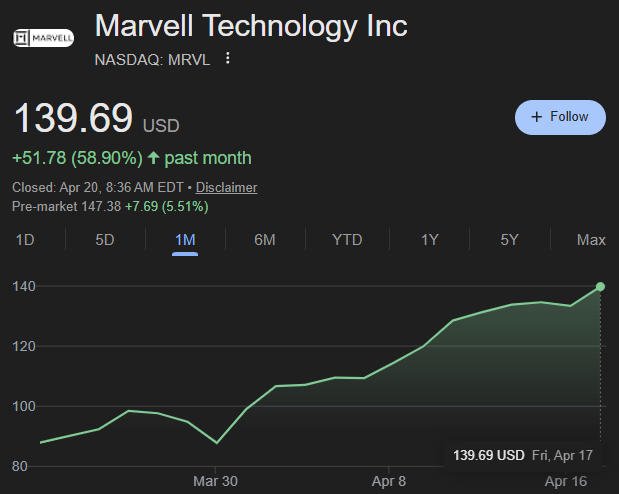
From a valuation perspective, the semiconductor sector remains highly priced as investors bet on the longer-term positioning of AI-linked assets. Marvell is currently trading at approximately 33.35 times its projected earnings for the next 12 months. In comparison, its primary competitor, Broadcom, trades at a slightly lower multiple of 27.84.
This premium reflects high future expectations regarding Marvell’s ability to capture a larger share of the custom ASIC (Application-Specific Integrated Circuit) market, which is expected to grow as more firms seek to design their own hardware.
As the company looks toward the future, management has outlined an ambitious financial trajectory, with revenue targets approaching $15 billion by fiscal 2028. The potential deal with Google would serve as a major upcoming catalyst for achieving these goals, providing a high-volume, prestigious anchor client for its custom silicon division.
Institutional players will be watching closely for official confirmation of the partnership, which would likely lead to a further repricing of the stock based on expanded margin expectations and increased long-term contract visibility.
Technological Sovereignty In An Evolving AI Landscape
The broader trend of “silicon independence” among hyperscalers is fundamentally altering the industry framework of the semiconductor supply chain. By designing their own chips, companies can tailor hardware specifically to their software architectures, resulting in superior performance-per-watt metrics.
Under these evolving conditions, the role of designers like Marvell becomes critical, acting as the bridge between high-level architectural concepts and physical manufacturing at leading-edge nodes.
While the market remains volatile, the shift toward customized, heterogeneous computing environments appears to be a permanent fixture of the industry. For those assessing the growth prospects of the sector, the ability of firms to secure contracts with Big Tech will be the primary differentiator between sustained success and market stagnation.
As the race for AI dominance continues, the demand for specialized, efficient, and cost-effective processing power remains the most significant driver of innovation and market value in the global technology space.


