
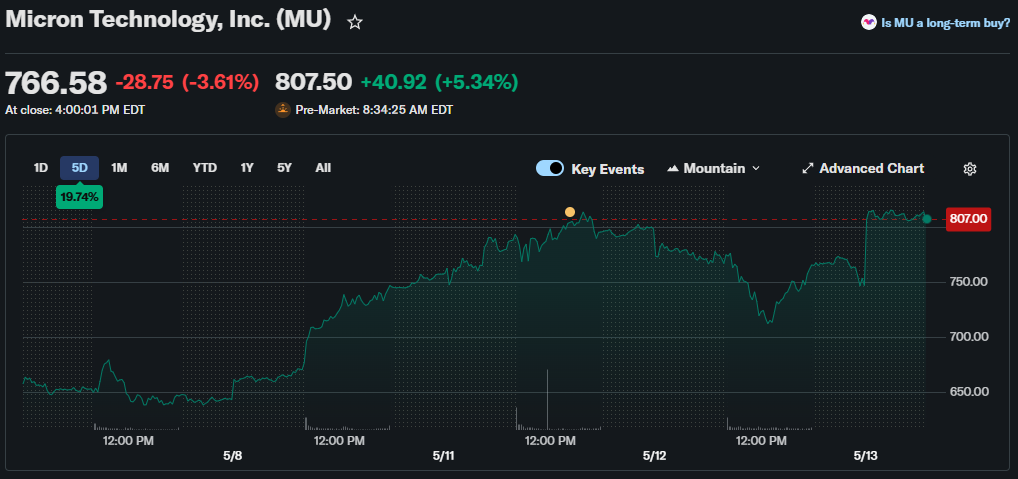
The semiconductor sector witnessed a rare technical occurrence this week as Micron (MU) flashed an extreme momentum signal that has historically preceded significant price volatility. After the Relative Strength Index (RSI) on the stock reached a peak of 85 on May 11, the market experienced a sharp corrective move. On May 12, the equity declined by 6.84%, pulling the RSI back to approximately 74.
This retreat occurred alongside a broader 2.63% decline in the technology sector, suggesting a necessary cooling period for one of the most aggressive trades in recent market history. This article, distilled by Fondesia research specialists, suggests that this pullback is a mechanical response to an overextended run rather than a shift in core fundamentals.
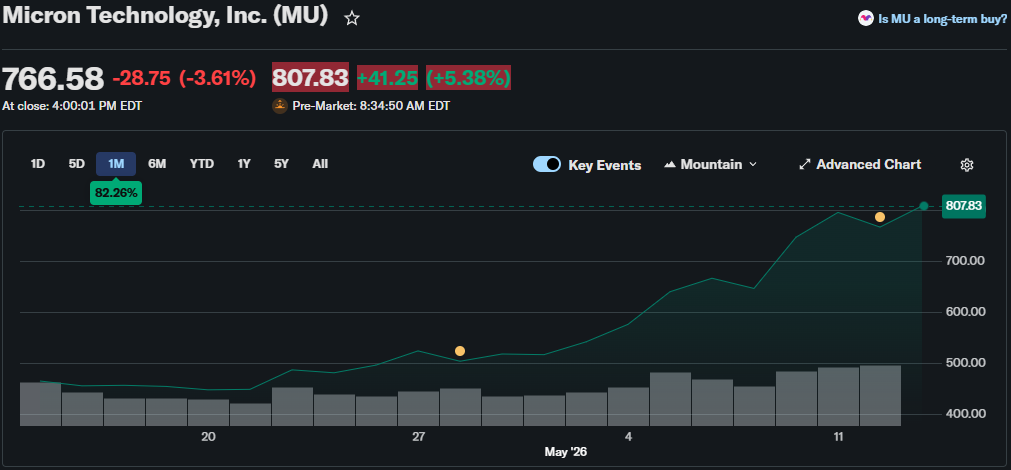
Despite the recent drop, the stock remains up 159.71% year to date and has surged 704.76% over the past twelve months. The transition from a low of $311 in late March to a record high of $818 on May 11 underscores a transition from a cyclical recovery to a permanent structural expansion.
The Fundamental Foundation of the 700% Surge
Technical signals like the RSI do not exist in a vacuum; they reflect a corporate transformation of historic proportions. In its fiscal second quarter of 2026, the organization set records across every primary financial metric.
Revenue reached $23.86 billion, a massive leap from the $8.05 billion reported during the same period in the previous year. Furthermore, the company reported a GAAP net income of $13.79 billion, translating to a diluted earnings per share of $12.07.
The guidance for fiscal Q3 2026 is equally unprecedented, with revenue projected at $33.5 billion and gross margins expected to hold at approximately 81%. This trajectory indicates a fundamental step-change in the revenue base.
The primary driver is High-Bandwidth Memory (HBM), a critical component for AI accelerators. Current industry reports indicate that the company’s entire HBM production capacity for 2026 is sold out, with significant portions of 2027 already committed to major hyperscale customers.
Analyzing the RSI 85 Signal: Risk vs. Opportunity
An RSI reading of 85 is a definitive measure of momentum, indicating that buying pressure has been overwhelming for a sustained period. For institutional observers, the bull case for maintaining an elevated position rests on the “supercycle” theory.
Demand for high-end NAND and HBM is being driven by “KV caching” techniques used in large-scale AI inference, which requires memory at a scale never before seen in the computing sector. Supply is not forecasted to reach equilibrium with demand until late 2027 or 2028.
Conversely, the bear case is rooted in the reality of capital intensity and cyclical history. The firm is investing over $25 billion in capital expenditure throughout 2026 to build new capacity. While this addresses the current shortage, it also introduces a future supply that could eventually saturate the market.
History shows that memory cycles often turn faster than the most optimistic forecasts predict. With a 6.84% daily drop acting as a reminder of volatility, any future guidance miss would likely result in severe market punishment given the current premium valuations.
Leading-Edge Innovation and Server Module Breakthroughs
Management appears confident that the current growth cycle has a long runway. On the same day the stock experienced its 6.84% pullback, the company announced it had begun sampling a 256GB DDR5 server module for its ecosystem partners. Built on 1-gamma technology, this module is capable of reaching speeds of 9,200 megatransfers per second, which is more than 40% faster than current volume production standards.
This new product directly addresses the energy efficiency mandates of modern AI data centers by delivering 40% lower operating power compared to using two 128GB modules. For hyperscalers currently deploying capital at annual rates exceeding $175 billion, such efficiency gains represent significant operational savings.
The leadership has framed memory not as a commodity input, but as a “strategic asset” for customers building the next frontier of digital intelligence.
Institutional Takeaway on the May 12 Pullback
The recent decline toward the $818 level should be viewed as a “release valve” for an overextended momentum run. For long-term holders, the RSI retreat from 85 to 74 is largely noise within a powerful fundamental narrative. However, for new participants, the entry point is significantly more complex. While the structural demand is genuine, the current price reflects a substantial portion of the expected growth.
Maintaining institutional-grade productivity in this sector requires distinguishing between short-term technical “froth” and long-term supply constraints. The AI memory trade is evolving into a more mature phase where execution and capacity delivery will be the primary drivers of value.
While the “easy” phase of the surge may have concluded with the RSI peak, the underlying scarcity of high-performance memory ensures that the organization remains a central pillar of the global technology infrastructure for the remainder of 2026.


