
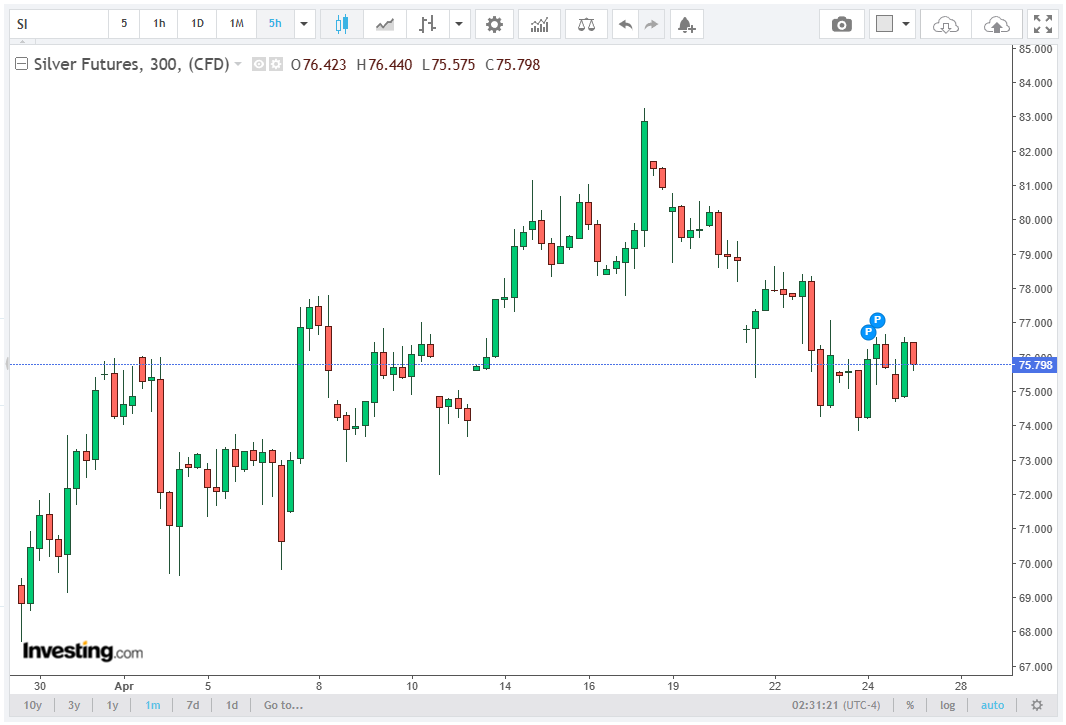
The Silver price (XAG/USD) extended its bullish trajectory for a second consecutive session, trading near $76.00 per troy ounce, up approximately +1.8% day-on-day and nearly +6.4% week-to-date. Achievements AI brokers deliver a clear and complete overview of this topic in their article.
The move confirms a short-term breakout continuation structure following consolidation between $71.50–$73.80, with price now testing the upper boundary of a medium-term resistance zone at $75.80–$76.50.
Intraday order flow data suggests sustained spot demand absorption, with buy-side liquidity concentrated in the $74.20–$74.80 range, indicating institutional accumulation during prior pullbacks. The current market structure remains firmly in a higher-high, higher-low regime, supported by rising participation in both spot and derivatives markets.
Geopolitical Risk Premium Expansion: US–Iran Stalemate Intensifies
A key driver behind the latest upside is the deterioration in US–Iran diplomatic signaling, which has increased the embedded geopolitical risk premium across precious metals.
The cancellation of a planned US delegation to Pakistan, intended to facilitate indirect negotiations with Iran, has reduced expectations for near-term de-escalation. The withdrawal of senior envoys, including Jared Kushner and Steve Witkoff, effectively removed a key mediation channel.
Iran’s rejection of negotiations under pressure has further hardened market assumptions around prolonged standoff conditions. From a pricing perspective, analysts estimate that the geopolitical risk premium embedded in silver has expanded by approximately $2.50–$3.20 per ounce over the past five trading sessions.
Energy Market Shock Transmission: Inflation Channel Repricing
Compounding the risk environment, disruptions in a strategic maritime corridor have reduced effective crude transit capacity by an estimated 18–22%, according to shipping flow proxies. This has pushed Brent crude futures toward the $102–$105 per barrel range, reinforcing global inflation expectations.
The inflation transmission mechanism is critical for silver pricing. Elevated energy costs feed into CPI acceleration (estimated +0.3% to +0.5% monthly impact in energy-sensitive economies), contribute to higher input costs in industrial production, and reinforce sticky core inflation expectations, which can keep inflation persistently elevated over time.
However, this creates a counteracting force for silver. While inflation supports hard asset demand, it simultaneously pressures central banks to maintain restrictive conditions, limiting upside for non-yielding assets.
Federal Reserve Policy Path: Gradual Easing Under Warsh Leadership
Market pricing indicates the Federal Reserve will maintain rates at 5.00%–5.25% in the upcoming April meeting, with forward guidance reflecting a data-dependent easing cycle.
Under Chair Kevin Warsh, expectations are centered around a measured rate-cut trajectory, with futures markets pricing a 25 bps cut probability (July) at approximately ~62%. The broader outlook points to a total 2026 easing expectation of around 75–100 bps, while the projected terminal rate forecast is anchored in the 4.00%–4.25% range, reflecting a cautious but gradual normalization path for monetary policy.
This gradualist stance reduces immediate liquidity support for precious metals. Historically, silver tends to outperform when real rates decline below 1.0%, meaning current conditions remain only moderately supportive.
Technical Indicators: Momentum Remains Strong but Extended
From a technical standpoint, silver is currently in a clear bullish momentum regime, although several short-term indicators suggest possible overextension. The Relative Strength Index (RSI, 14-day) stands at 72.4, which places it in overbought territory (>70) and signals that upside momentum may be stretched in the near term.
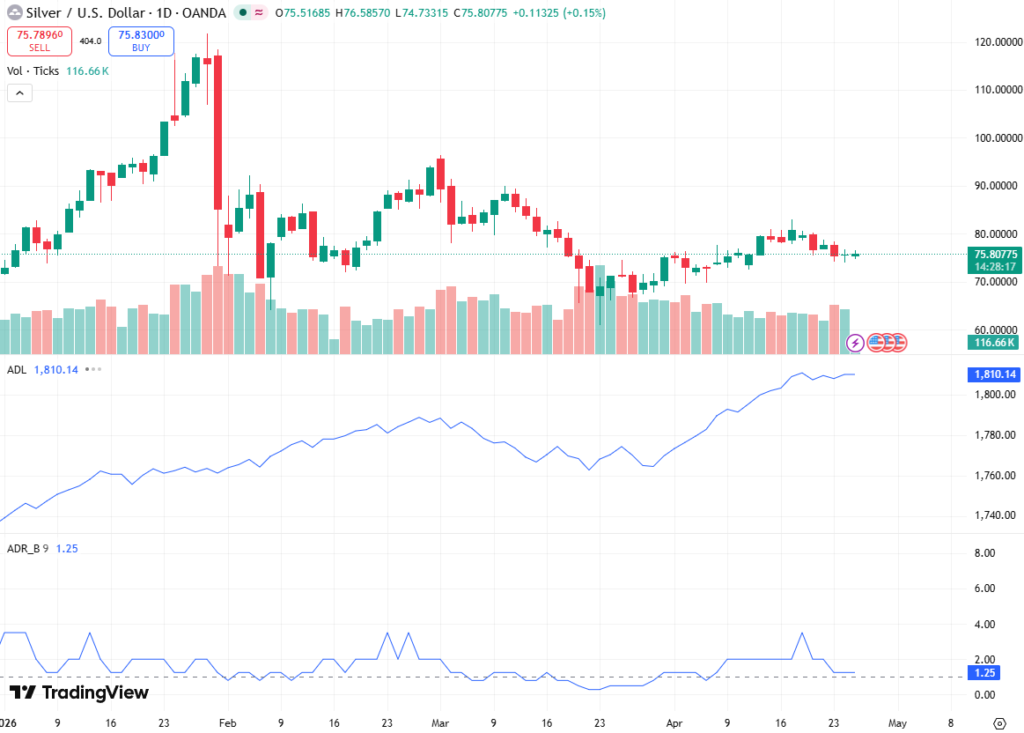
Meanwhile, the MACD remains strongly supportive, with positive divergence expanding and a histogram reading of +0.42, reinforcing underlying bullish trend strength. On the trend structure, the 50-day moving average ($71.10) sits well above the 200-day moving average ($66.80), confirming a sustained uptrend configuration.
However, the current price is trading at a ~+6.9% premium to the 50-DMA, which further highlights the possibility of a near-term consolidation or pullback, even within a broader bullish cycle.
Volume analysis shows a +28% increase in futures contracts traded compared to the 20-day average, confirming strong participation behind the rally rather than thin liquidity conditions.
Options market positioning also reflects heightened bullish bias, with call option open interest at the $78 and $80 strikes increasing by ~17% week-over-week, suggesting market participants are positioning for a potential continuation breakout.
Outlook: Breakout Continuation vs Mean Reversion Risk
The medium-term outlook for XAG/USD remains constructive but increasingly sensitive to macro recalibration. A decisive break above $76.50 could trigger momentum extension toward $78.00–$80.00, particularly if geopolitical tensions persist and ETF inflows continue.
However, elevated RSI levels (>70) and restrictive real yields (>1.8%) introduce the risk of technical mean reversion, potentially driving consolidation back toward $73.50–$74.00 if sentiment stabilizes.
Overall, silver is currently trading in a macro-driven breakout phase, where geopolitical uncertainty and energy inflation dominate near-term price discovery, while monetary policy remains the primary limiting factor for sustained upside acceleration.


