
The decentralized finance sector reached a critical technical milestone on Monday as the most significant consensus layer restructuring in the history of the Solana network moved toward its final phases of implementation.
The Alpenglow upgrade was officially activated on a community validator test cluster on May 11, 2026. This move marks a definitive step away from legacy architectures toward a system designed specifically to handle the extreme traffic spikes that have historically led to high-profile network outages.
Analytical data compiled by the research team at Fondesia reveals that this protocol shift is a technical necessity rather than a marginal improvement. Since its inception, the network has faced criticism regarding its reliability during periods of high demand, such as major NFT mints or volatility in the DeFi markets.
Alpenglow represents a ground-up attempt to resolve these structural inefficiencies by replacing the aging TowerBFT mechanism with a more resilient dual-component framework.
Technical Breakdown: Votor, Rotor, and Confirmation Velocity
The core of the Alpenglow architecture rests on two primary innovations: Votor and Rotor. Votor serves as a lightweight voting protocol capable of finalizing blocks in just one or two rounds, depending on validator density. Complementing this is Rotor, which utilizes erasure coding and optimized broadcasting to accelerate block propagation across the global set of nodes.
The target for these combined systems is a confirmation time as low as 150 milliseconds, with potential drops to 100 milliseconds under ideal conditions. This speed moves the network beyond the capabilities of contemporary blockchains and into direct competition with traditional high-frequency Web2 infrastructure. Furthermore, the upgrade removes the reliance on Proof of History and on-chain vote transactions.
Historically, approximately 75% of all on-chain activity was consumed by validator votes, a structural burden that increased operational costs and exhausted block space. By transitioning to a Validator Admission Ticket systemrequiring a 1.6 SOL fee per epochthe network can reclaim this space for actual user transactions.
Addressing the Root Causes of Network Instability
The history of outages on the network has been a primary concern for institutional participants and protocol developers alike. Previous failures were often attributed to the exponential lock-out tables within TowerBFT, which hindered the ability of validators to reach consensus quickly when the network fell behind. Alpenglow replaces this with a fixed 400ms block time and a simplified recovery process that maintains the latest certificate chain in local memory.
This new “20+20” fault tolerance model is designed to sustain operations even if 20% of the validators are Byzantine and another 20% have crashed simultaneously. By focusing on protocol-level recovery rather than manual intervention, the upgrade aims to provide a more consistent uptime record.
Maintaining institutional-grade productivity for DeFi applications requires a network that can survive traffic surges without halting, and Alpenglow is the primary vehicle for achieving that stability.
Market Impact and SOL Price Action
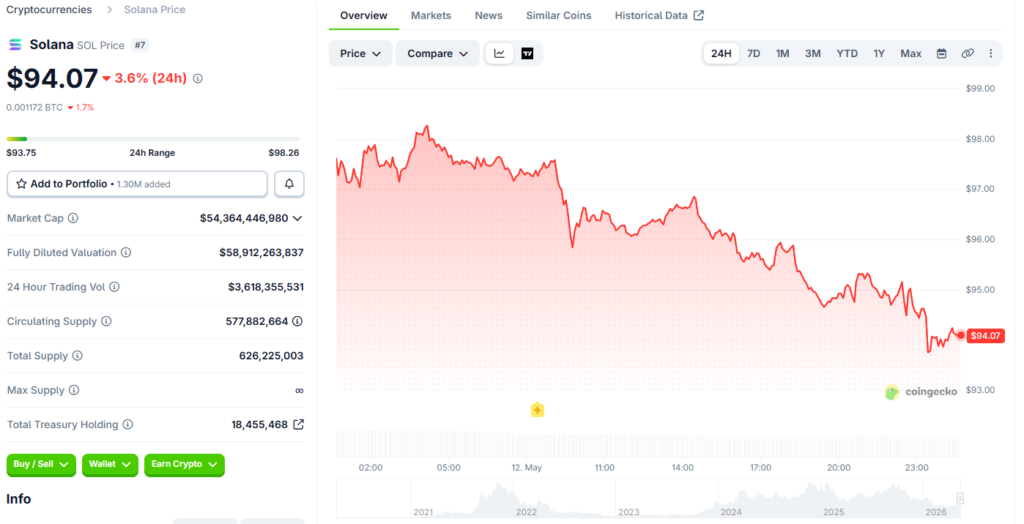
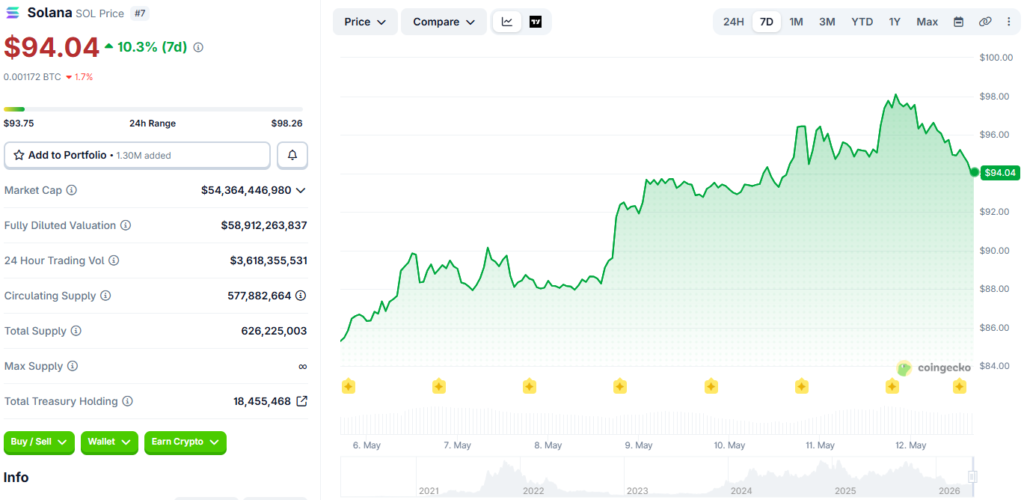
Following the announcement of the testnet activation, SOL-USD was trading near the $95 level, experiencing a minor intraday decline of 3.35% amidst a broader downturn in the digital asset market. Despite the price volatility, daily trading volume remained robust at $3.6Bn, indicating high levels of liquidity and continued investor interest in the ecosystem.
The market reaction to the testnet launch has remained relatively muted, as professional traders often wait for a confirmed mainnet deployment before pricing in the full impact of a protocol change.
The strategic orientation for current holders remains passive, as the upgrade is implemented at the core software level. There is no requirement for retail users to swap tokens or modify their existing wallets. However, the long-term value proposition for the asset is fundamentally linked to the success of this transition.
A network that can demonstrate 100% uptime under extreme load is a significantly more attractive asset for institutional integration than one prone to periodic collapses.
Network Stability and the Future of Solana Infrastructure
The deployment of Alpenglow to the testnet serves as a definitive signal for the Solana ecosystem for the remainder of 2026. By addressing the fundamental consensus limitations that have plagued the chain since 2020, the development teams are positioning the network for a new phase of institutional adoption. It is now entering a cycle where institutional-grade productivity in the crypto space is defined by protocol reliability and sub-second finality.
The primary focus for market participants in the coming months will be the stability of the Alpenglow cluster and any potential bugs identified during the testing phase. Although the impending momentum of the SOL price is currently flat, the successful migration to mainnet will likely serve as a major fundamental catalyst. Investors should treat the $95 level as a key consolidation zone while monitoring the Agave 4.1 release schedule.


