
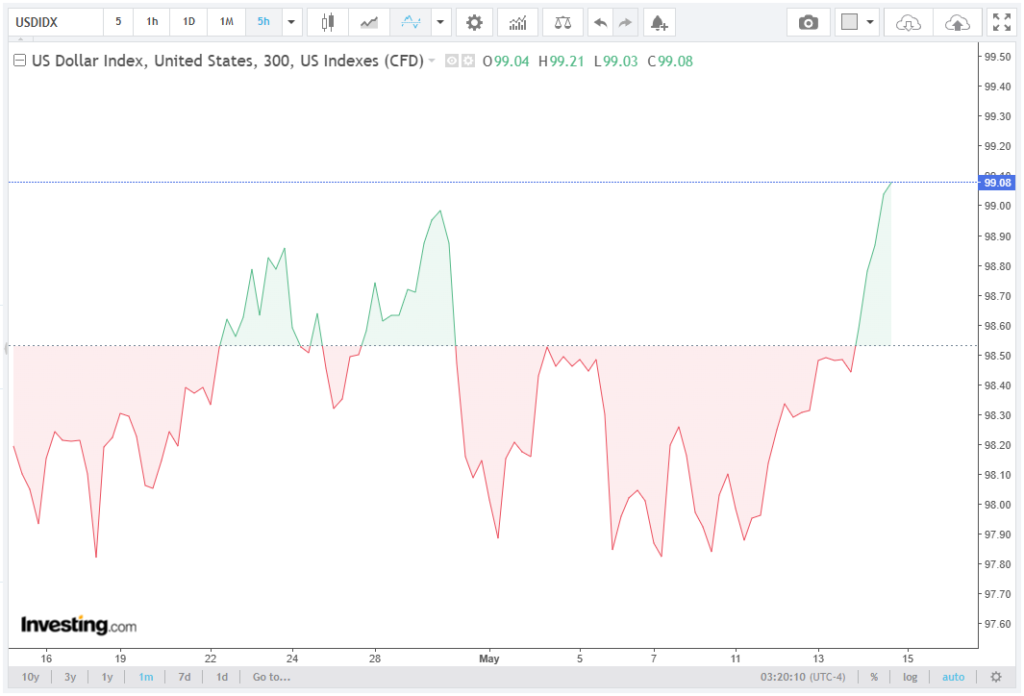
The US Dollar (USD) has strengthened sharply this week, supported by elevated US Treasury yields, resilient macroeconomic indicators, and persistent inflationary pressures. The US Dollar Index (DXY), which tracks the performance of the USD against a basket of six major currencies, has breached 99.00, reaching 99.20 at the time of writing.
The index is on course for its best weekly performance in two months, rallying approximately 1.30% over the past five trading sessions. Achievements AI’s team presents an in-depth look at this subject in their latest article.
DXY Hits Five-Week Highs on Economic Resilience
The DXY rally is underpinned by strong domestic consumption and a stabilizing labour market. US Retail Sales for April came in at +0.6% month-over-month, exceeding market expectations of +0.4%, signaling sustained consumer demand. Weekly Initial Jobless Claims fell to 220,000, slightly below forecasts, indicating continued labour market tightness.
Such data reinforce expectations that the US economy can absorb further monetary tightening without tipping into recession. The robust domestic demand and healthy employment metrics have heightened market speculation of additional Federal Reserve (Fed) rate hikes later in the year.
Inflation and Fed Rate Expectations Drive Treasury Yields
Inflation metrics remain a key driver of the DXY rally. Consumer Price Index (CPI) figures for April showed headline inflation at 4.1% year-over-year, while core CPI, excluding volatile food and energy prices, rose 3.8% year-over-year, both slightly above market consensus. Producer Price Index (PPI) data mirrored these trends, with core PPI increasing 3.5% year-over-year, signaling persistent underlying price pressures.
In response, markets have raised probabilities for a 25-basis-point hike in the Fed’s federal funds rate, pushing 2-year Treasury yields to 5.15%, a one-year high, while 10-year yields rose to 4.85%, reflecting heightened interest rate expectations.
Geopolitical Factors and Energy Prices
While domestic factors dominate, geopolitical tensions remain influential. The Strait of Hormuz continues to face operational disruptions, keeping Brent crude around $100 per barrel, maintaining elevated energy costs that contribute to inflationary pressures.
Global market participants are closely monitoring ongoing diplomatic discussions aimed at de-escalating regional conflicts. Any progress could ease risk premiums embedded in commodity prices and impact the Greenback’s safe-haven appeal. Conversely, prolonged instability could sustain USD strength, given its role as a reserve currency in volatile periods.
Technical Analysis of the DXY
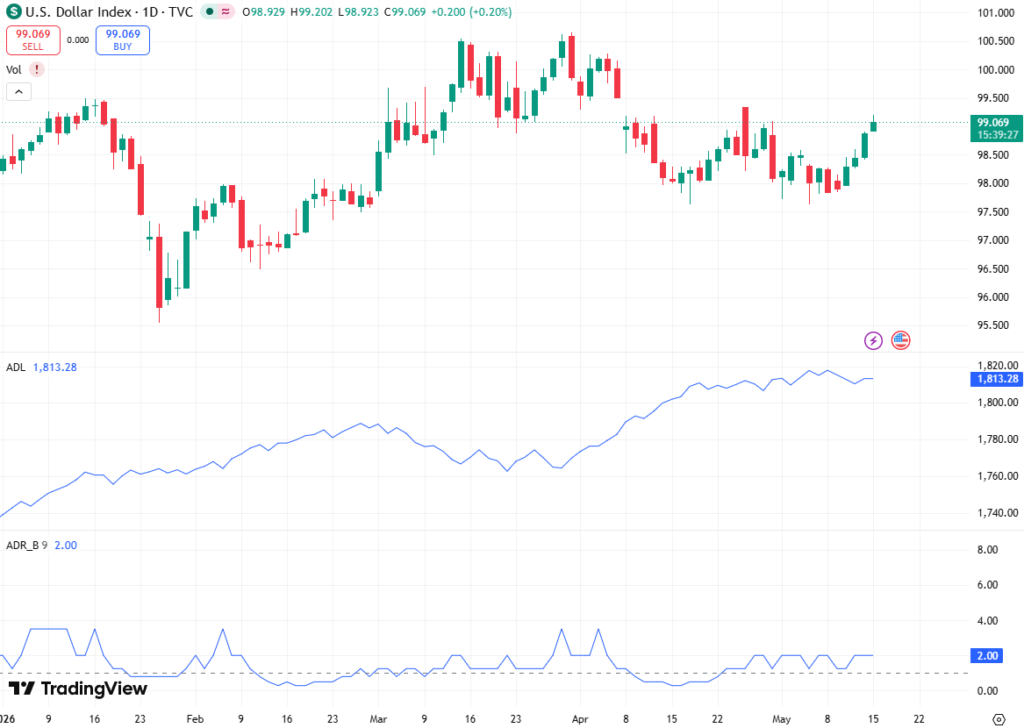
From a technical perspective, the DXY’s breach of 99.00 is a key resistance breakout, signaling strong upward momentum. Analysts identify the next significant psychological barrier at 100.00, while support levels lie in the 98.50–98.70 range.
Short-term momentum indicators, such as the Relative Strength Index (RSI), are approaching 70, suggesting near-term overbought conditions, though sustained high yields may prolong bullish momentum.
Moving averages also support the trend: the 50-day simple moving average is currently at 97.85, acting as a floor, while the 200-day SMA at 96.40 underscores longer-term upward potential.
Implications for Global Markets
A stronger USD has broad macroeconomic and market implications. Emerging markets with dollar-denominated debt face higher servicing costs, potentially exacerbating currency volatility. For multinational corporations, a rising USD can compress foreign earnings, particularly for firms with substantial revenues in euros, yen, or pound sterling.
Commodity markets are similarly affected. Precious metals such as gold have seen marginal downward pressure, trading near $1,960 per ounce, while oil markets remain volatile due to geopolitical risks. The combination of a rising DXY and elevated energy prices may feed through into global inflation expectations, influencing monetary policy decisions in other regions.
Focus for Investors
Investors are closely monitoring two critical variables: Fed policy trajectory and the evolution of geopolitical risks affecting global trade and energy markets. Market participants are pricing in a 60–70% probability of a 25-basis-point hike in the upcoming Fed meetings, supported by resilient macroeconomic data and sustained inflation pressures.
The interplay of rising Treasury yields, strong economic fundamentals, and elevated geopolitical uncertainty is likely to maintain USD strength in the near term. Any deviation from expectations, such as a sudden decline in inflation data or a breakthrough in diplomatic negotiations, could prompt short-term corrections but would not fundamentally alter the upward trend driven by interest rate differentials.
Conclusion
The US Dollar Index (DXY) has surged past 99.00, underpinned by robust macroeconomic indicators, persistent inflationary pressures, and higher US Treasury yields. Retail sales, jobless claims, and price indices all support continued monetary tightening, while geopolitical tensions sustain the USD’s safe-haven appeal.
Technical indicators suggest further upside potential, with resistance near 100.00 and support in the 98.50–98.70 zone. Investors should monitor interest rate expectations, Treasury auctions, and geopolitical developments, as these factors will continue to shape the DXY trajectory and influence global financial markets in the coming weeks.


