
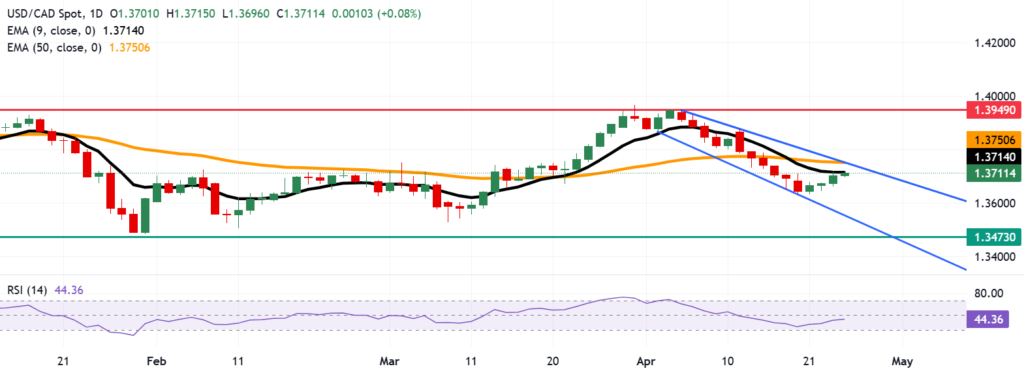
The USD/CAD currency pair continues to exhibit a cautious bullish correction while remaining structurally confined within a broader descending channel pattern on the daily timeframe. During early European trading hours on Friday, the pair trades around 1.3710, extending its fourth consecutive day of gains.
However, despite this short-term strength, the prevailing technical configuration suggests that the move is still corrective rather than a full trend reversal. The team behind Fondesia offers a well-explained and comprehensive take on this topic in their article.
The market structure remains defined by a bearish medium-term bias, as price action continues to respect a sequence of lower highs and lower lows. The presence of key moving average resistance levels and weakening momentum indicators reinforces the notion that upside attempts may remain limited unless a decisive breakout occurs.
Technical Structure: Bearish Channel Dominance
The dominant feature on the USD/CAD daily chart is the clearly defined descending channel, which has guided price action lower from recent highs. This channel reflects sustained selling pressure over the medium term, with each rally attempt meeting resistance near the upper boundary.
At present, the pair remains capped below both the nine-day Exponential Moving Average (EMA) and the 50-day EMA, reinforcing the idea that sellers continue to defend rallies. The alignment of these moving averages above the spot price forms a dynamic resistance zone, limiting bullish momentum.
The nine-day EMA at 1.3714 is the most immediate technical barrier. Just above it lies the 50-day EMA near 1.3750, which also coincides with the upper boundary of the descending channel. This cluster of resistance levels creates a significant supply zone, where bearish traders are likely to re-enter the market.
Momentum Indicators: RSI Signals Weakening Strength
From a momentum perspective, the 14-day Relative Strength Index (RSI) has declined to 44, moving further below the neutral 50 threshold. This reading is technically important, as it signals a shift toward strengthening bearish momentum.
An RSI below 50 generally indicates that downside pressure outweighs upside demand, and the current trajectory suggests that buyers are struggling to maintain control. Although the RSI has not yet entered oversold territory, its downward slope implies that bearish continuation risk remains elevated.
Key Resistance Levels: EMA Confluence Zone
The immediate technical barrier for USD/CAD is the nine-day EMA at 1.3714, which is currently acting as a short-term pivot. A sustained move above this level would be required to signal a shift in intraday sentiment.
However, even if this level is breached, the 50-day EMA at 1.3750 presents the next significant hurdle. This level is particularly important because it aligns closely with the upper boundary of the descending channel, creating a powerful technical confluence resistance zone.
Downside Risk: Channel Support in Focus
On the downside, USD/CAD faces a critical structural support level near the lower boundary of the descending channel at approximately 1.3560. This level represents the first major downside objective in the current technical setup.
Should the pair achieve a sustained break below 1.3560, the bearish outlook would strengthen significantly. In such a scenario, the next key target would emerge at 1.3473, marking the lowest level since September 2024. This would represent a deeper structural decline and potentially open the door to a broader medium-term bearish extension.
Bullish Scenario: Conditions for Reversal
Although the current bias remains bearish, a shift in momentum cannot be ruled out. For a bullish reversal scenario to develop, USD/CAD would need to achieve a decisive breakout above both the nine-day EMA (1.3714) and the 50-day EMA (1.3750).
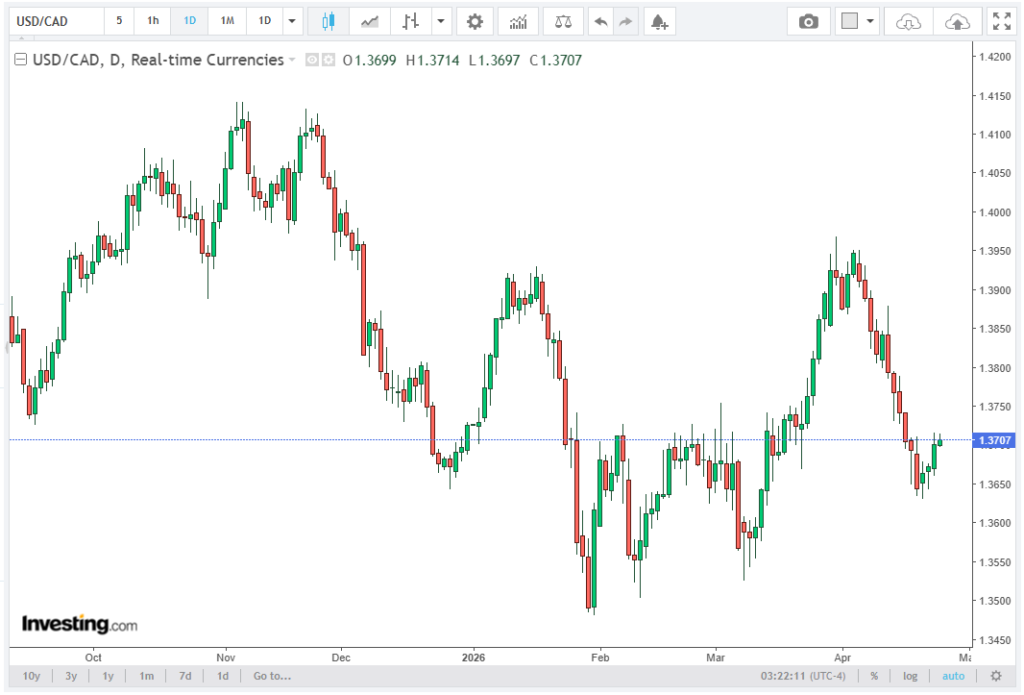
Such a move would also require a break above the upper boundary of the descending channel, effectively invalidating the bearish structure. If confirmed, this would signal a transition from corrective recovery to trend reversal dynamics.
In this bullish scenario, the pair could then target the four-month high of 1.3967, last reached in December 2025. This level would represent a major resistance zone and a key psychological barrier for market participants.
Outlook: Bearish Bias Persists Below Key Averages
Overall, the USD/CAD pair maintains a modest bearish near-term bias, with price action still constrained beneath key exponential moving averages and within a well-defined descending channel.
The decline in the RSI to 44, combined with repeated failures to sustain gains above the 1.3714 resistance zone, suggests that bullish momentum remains fragile. As long as the price remains below the EMA confluence zone, the probability of a downside continuation toward 1.3560 and potentially 1.3473 remains elevated.
In conclusion, USD/CAD is currently in a technical equilibrium phase, where short-term rebounds are being absorbed by a broader bearish structure. Traders will likely continue to monitor the interaction between price and the nine-day EMA, as this level serves as the immediate trigger for either continued consolidation or renewed downside expansion.


