
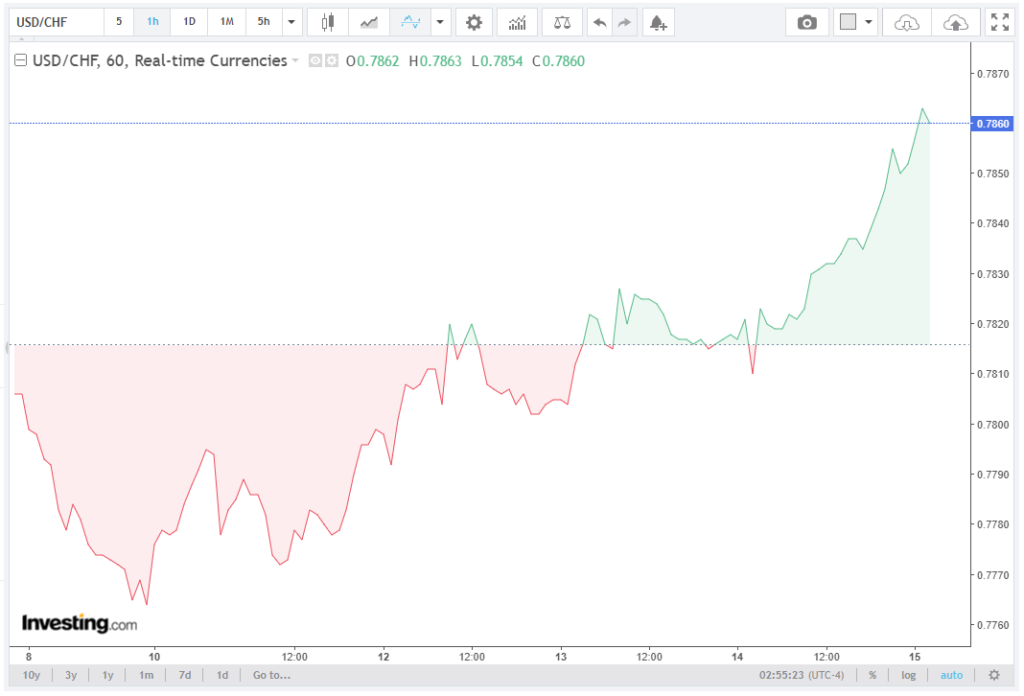
The Swiss Franc (CHF) has experienced a pronounced decline against the US Dollar (USD), reflecting a renewed risk-off sentiment in global financial markets. The USD/CHF currency pair gained for the fifth consecutive session, trading around 0.7850 during Asian trading hours on Friday.
This advance is underpinned by strong US economic data, shifts in Federal Reserve leadership, and persistent deflationary pressures in Switzerland. In this piece, Achievements AI examines and explains the topic step by step.
Strong US Retail Sales Boost the Dollar
A central driver of USD strength is the recent US Retail Sales report. In April, retail sales rose 0.5% month-on-month (MoM), consistent with consensus estimates but notably below March’s 1.6% increase. On a year-on-year (YoY) basis, retail sales grew 4.9%, exceeding the market forecast of 3.3%, signaling robust consumer activity amid elevated borrowing costs.
Core retail sales, which exclude automobiles and gas, rose 0.6% MoM, slightly outperforming expectations of 0.5%, highlighting resilient domestic consumption. This data reinforces market expectations that US economic momentum remains intact, supporting further monetary tightening by the Federal Reserve (Fed).
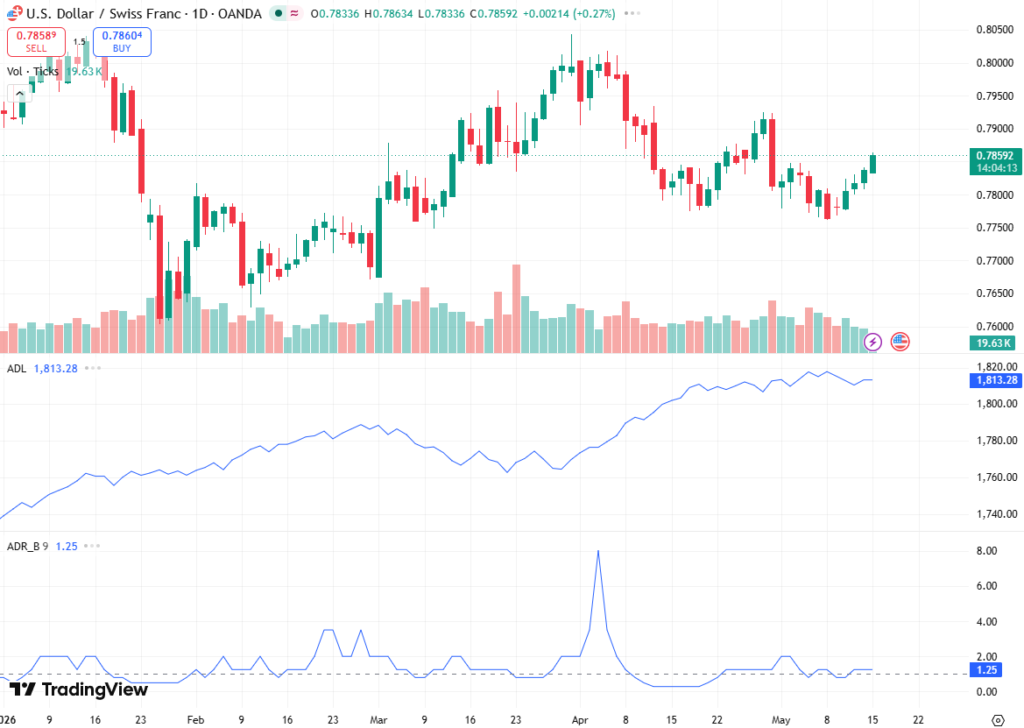
The USD/CHF pair has now gained roughly 1.8% over the past five sessions, reflecting increased demand for the US Dollar amid a combination of macro optimism and geopolitical uncertainty. Technical levels indicate that the next resistance for USD/CHF lies around 0.7875, while immediate support is near 0.7820.
Fed Leadership Changes Support USD
The US Dollar rally is also reinforced by changes in Federal Reserve leadership. The resignation of Stephen Miran from the Board of Governors paves the way for Kevin Warsh to assume the role of Federal Reserve Chair.
Analysts project that under Warsh’s leadership, the Fed may adopt a more hawkish stance, particularly if inflation pressures remain elevated. Market participants have priced in a 70% probability of a 25-basis point hike at the next FOMC meeting, reflecting sustained expectations for tight monetary policy.
Adding to USD support, US inflation remains elevated, with the Consumer Price Index (CPI) at 4.2% YoY in April, despite moderating from March’s 4.5%. Ongoing geopolitical tensions in the Middle East have compounded inflationary pressures, strengthening the Dollar’s appeal as a safe-haven asset.
Swiss Deflation Pressures CHF
In contrast to the US strength, Switzerland continues to face persistent deflationary conditions. Swiss producer and import prices fell 2.0% YoY in April, extending a prolonged deflationary trend that has persisted for over two years.
This ongoing deflation limits the likelihood of Swiss National Bank (SNB) interest rate hikes. The 0% SNB policy rate is likely to remain intact, and market participants expect potential FX interventions if the Franc appreciates sharply.
The consumer sentiment index surprised positively at -40, better than the expected -46, suggesting resilient domestic demand despite deflation. Core inflation in Switzerland remains subdued, hovering around 0.1% YoY, further constraining monetary tightening options.
The SNB has historically acted to weaken the Franc to maintain price stability, particularly when USD/CHF falls below 0.7800. With the pair trading near 0.7850, intervention risk is moderate but remains a key consideration for traders.
USD/CHF Market Dynamics
The USD/CHF gains reflect a complex interplay of fundamental and technical factors. On the positive side for the Dollar, strong retail sales, hawkish expectations for the Fed, and ongoing geopolitical tensions reinforce demand. On the negative side, persistent Swiss deflation and the Franc’s role as a safe-haven currency limit dramatic downward movements in the pair.
Over the past month, USD/CHF has traded in a range of 0.7750–0.7850, with recent gains breaking the upper end of this range. Short-term technical indicators, including a 14-day Relative Strength Index (RSI) of 63, suggest the pair is approaching overbought conditions, indicating potential for consolidation before any further advance.
Market participants are closely monitoring SNB communications, as comments signaling intervention readiness could cap USD/CHF upside, even amid continued US Dollar strength. Conversely, further retail sales surprises or strong inflation prints in the US could propel the pair above 0.7900, reinforcing a medium-term bullish bias.
Conclusion
The Swiss Franc’s decline against the US Dollar highlights the impact of macroeconomic divergence, central bank policy shifts, and risk sentiment. Strong US retail sales and the prospect of Kevin Warsh-led Fed hawkishness have bolstered the Greenback, while persistent deflation in Switzerland discourages SNB tightening.
Despite positive consumer sentiment domestically, the Franc remains pressured, resulting in sideways-to-bullish trading for USD/CHF. Traders should monitor SNB policy signals, US economic data, and geopolitical developments, as these will likely dictate the next key moves in the pair.
Overall, USD/CHF reflects a structural bullish case for the Dollar, tempered by safe-haven demand for the Franc and the SNB’s defensive monetary stance, with the market poised for both technical consolidation and potential policy-driven volatility.


