
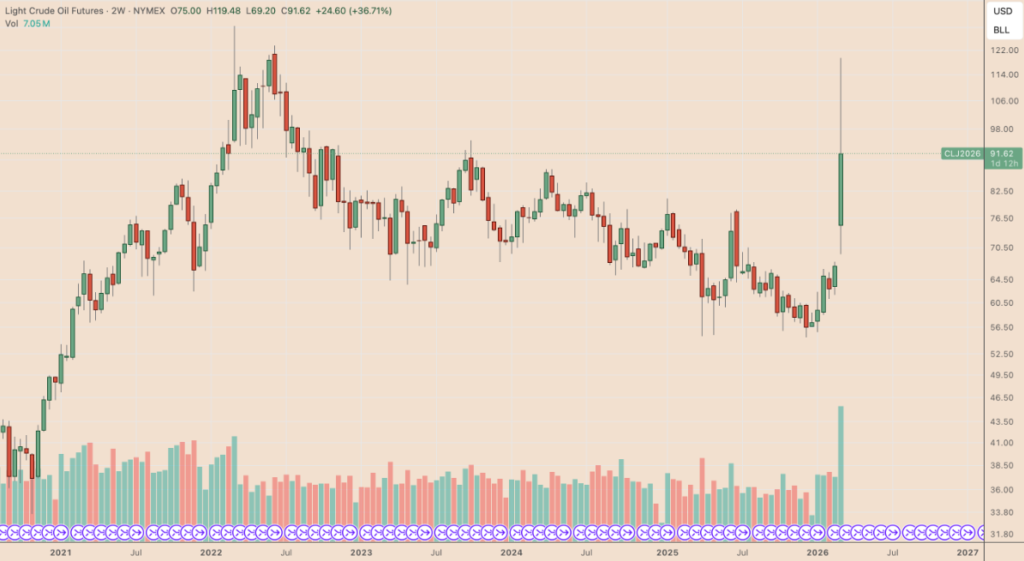
The global energy landscape is once again under scrutiny as geopolitical tensions in the Middle East threaten to send crude oil prices into unprecedented territory. Recently, Iran warned that deeper escalation with the United States and Israel could significantly disrupt the global energy supply, potentially pushing oil prices as high as $200 per barrel.
Such a scenario would not only reverberate through energy markets but could also create a profound macro shock for Bitcoin (BTC) and the broader cryptocurrency market. The team of brokers at Rubizio explores this topic thoroughly and highlights the essential points in this article.
Oil Shock Scenarios: $95–$220 Crude
Market analysts are modeling a range of potential oil supply disruptions stemming from heightened conflict across Iran, Qatar, the UAE, and Saudi Arabia. In a base-case scenario, estimates suggest that roughly 8%–12% of global oil supply could be disrupted. Such a shortfall could push Brent crude prices toward $140 per barrel, representing a substantial increase from the current baseline near $75.
In a worst-case scenario, the disruption could rise to 15%–20% of global oil supply, potentially igniting a major stagflationary shock. Under this scenario, crude could spike anywhere from $130 to $220, amplifying risks for inflation, monetary policy, and financial markets. These projections assume a one-year disruption and leverage the most recent oil production data available for the affected countries.
History reinforces the outsized impact of even modest supply shocks. During the 1979 Iranian Revolution and the 1990 Gulf War, disruptions of just 4%–5% of global supply caused sharp spikes in oil prices.
Similarly, the 2019 Abqaiq-Khurais attack temporarily removed nearly 20% of Saudi production, triggering a Brent spike intraday. An 8%–12% supply shock today would surpass the scale of these past crises, while a 15%–20% hit could trigger dramatic price surges, even after accounting for weaker demand in a slowing economy or emergency releases from strategic oil reserves.
Higher Oil Could Reignite Inflation and Stagflation Risks
The macroeconomic implications of a sudden oil rally are significant. Federal Reserve research indicates that every 10% rise in crude prices can add approximately 0.35 to 0.40 percentage points to US headline CPI, due to higher energy costs, rising food prices, and secondary impacts on core inflation.
Starting from $75 per barrel, an escalation to $140–$220 could theoretically add 1–7.5 percentage points to inflation, depending on the severity of the supply shock. With CPI already above the Fed’s target of 2%, such a surge would severely constrain monetary policy flexibility, potentially forcing interest rates higher even as economic growth slows.
If economic growth softens simultaneously, markets could face stagflation, a period marked by rising prices, sluggish demand, and tighter financial conditions. Historically, stagflationary environments create heightened volatility in both equities and risk assets, which directly impacts cryptocurrencies, including Bitcoin.
Oil Rally and Bitcoin: A Bearish Catalyst
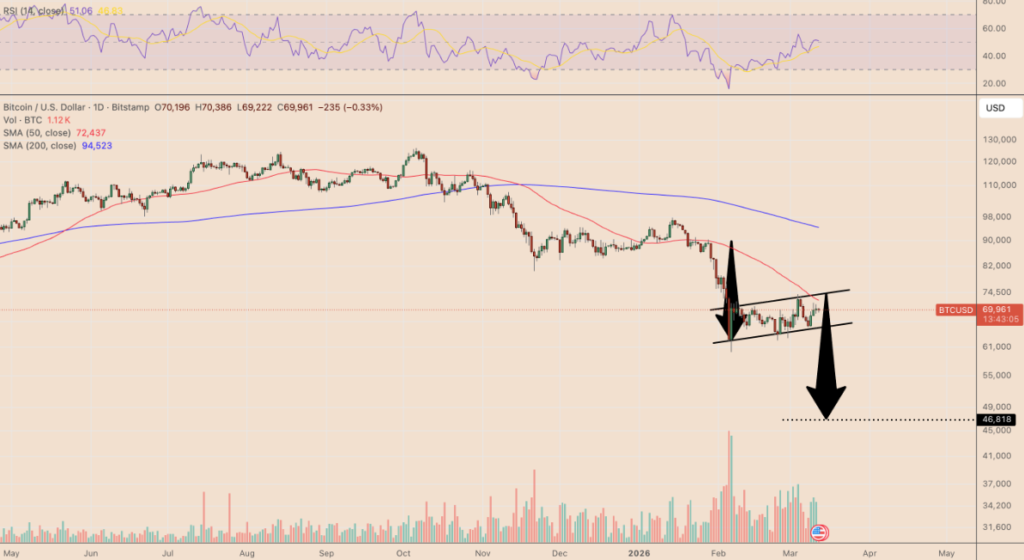
From a technical analysis perspective, Bitcoin is already showing signs of vulnerability. Following a steep decline, BTC has been trading inside a modest upward-sloping channel, forming a bear flag pattern. Such formations typically signal a temporary consolidation before a continuation of the broader downtrend.
A sharp oil rally, especially one that revives inflation fears, could act as the catalyst that triggers a bear flag breakdown. Increased macro pressure may reduce risk appetite, pushing BTC below the lower boundary of the flag.
If a breakdown occurs, technical targets suggest Bitcoin could retest support near $46,800, based on the pattern’s measured downside target. The combination of geopolitical risk, energy-driven inflation, and technical weakness could create a perfect storm for crypto markets, particularly for Bitcoin traders and institutional investors who are sensitive to macroeconomic shocks.
Key Takeaways for Investors
Geopolitical risk in the Middle East could drive oil prices to $200 per barrel, a scenario with broad implications for risk assets. Base-case disruptions of 8%–12% of global oil supply may push crude to $140, while worst-case 15%–20% disruptions could escalate prices between $130 and $220.
Higher oil prices are likely to reignite inflation, potentially forcing the Federal Reserve to tighten policy amidst weakening growth, raising stagflation concerns. Bitcoin’s technical chart indicates a potential bear flag, and macro shocks from an oil-driven inflation surge could trigger a breakdown, targeting $46,800.
Investors should monitor energy markets, geopolitical developments, and inflation indicators, as these factors increasingly influence cryptocurrency valuations.
Conclusion
The intersection of geopolitical tensions, oil market dynamics, and macro-financial conditions is shaping a critical environment for Bitcoin. A surge in oil prices beyond $200 per barrel would not only create immediate inflationary pressures but could also act as a technical trigger for BTC’s next major move.
Traders and investors must remain vigilant, as energy shocks and monetary policy responses are likely to dictate the risk-reward landscape for both crypto and traditional financial markets in the coming months.


