
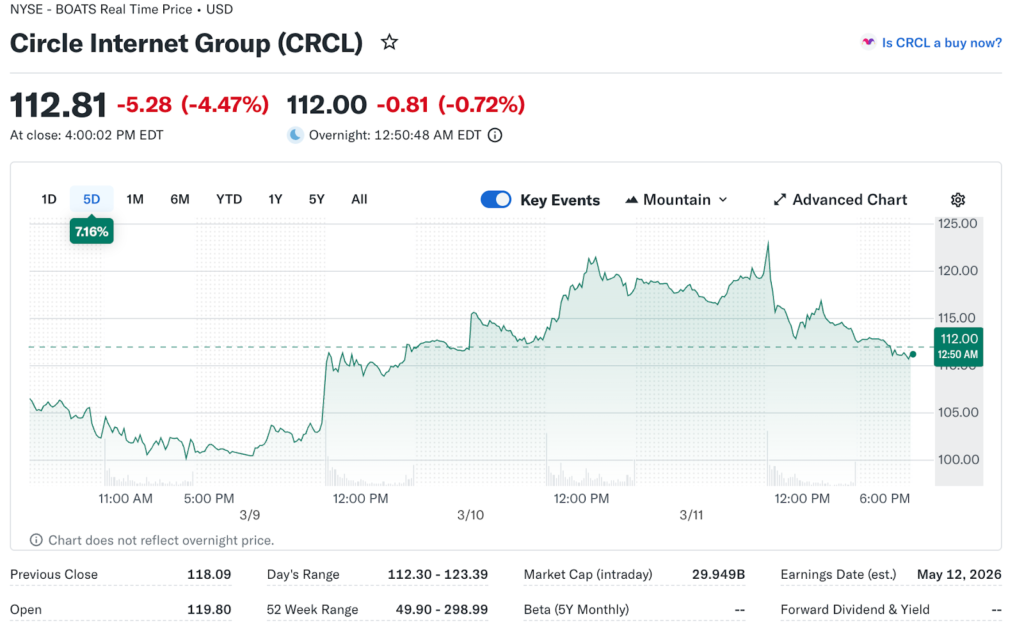
Circle Internet Group has delivered one of the most striking single-month performances across the financial sector. Shares surged 109.9% in 30 days, while the broader Zacks Finance sector declined 3.4% over the same period. Lead brokers at Nummixo discuss what is genuinely driving the move, where the real risks are sitting, and whether the stock can sustain its momentum or whether the valuation has already run ahead of the fundamentals.
The Business Behind the Rally Is Genuinely Strong
The first thing worth establishing is that Circle’s share price surge is not disconnected from real business performance. The underlying metrics for USDC, the company’s flagship stablecoin, have been consistently impressive. By the end of 2025, total USDC in circulation reached $75.3 billion, a 72% year-over-year increase that outpaced growth across the broader fiat-backed stablecoin category.
Transaction volume paints an even more compelling picture. During Q4 2025, on-chain USDC activity reached approximately $11.9 trillion, a 247% year-over-year increase that demonstrates accelerating real-world usage across payments, trading, and financial settlement applications. USDC held directly on Circle’s platform infrastructure grew 5.6 times year over year, reaching $12.5 billion and representing 17% of total circulation. These are not vanity metrics. They reflect genuine adoption at an institutional and commercial scale.
The Institutional Pipeline Is a Meaningful Signal
What separates Circle’s current growth phase from earlier stablecoin adoption cycles is the quality of the companies integrating USDC into their core operations. Visa extended its partnership with Circle to enable U.S. issuers and acquirers to settle transactions using USDC outside conventional banking hours, a practical application that addresses a real operational limitation in traditional payment infrastructure.
Intuit signed a multi-year agreement to embed USDC and Circle’s infrastructure directly into its platform, bringing programmable digital dollar functionality to a user base numbering in the millions. The Circle Payments Network has added 55 financial institutions as of February 2026, with 74 additional institutions in the eligibility review process.
Companies including Cash App, Gusto, Deel, Interactive Brokers, JPMorgan, and Mastercard have all launched products or services that incorporate USDC, which reflects a level of financial mainstream acceptance that the stablecoin sector has historically struggled to demonstrate.
Management projects approximately 40% compound annual growth in USDC circulation over the long term, a target that looks ambitious but not unreasonable given the current adoption trajectory.
Interest Rate Sensitivity Is a Real Earnings Risk
Understanding Circle’s revenue model is important for evaluating the sustainability of its financial performance. A substantial portion of revenue is generated from interest earned on the reserves backing USDC in circulation. When interest rates are elevated, that reserve income is significant. When rates fall, it compresses.
In Q4 2025, the reserve return rate declined 68 basis points year over year, partially offsetting the gains from USDC volume growth. With interest rate policy continuing to shift in 2026, this sensitivity creates a genuine earnings headwind that will likely intensify if rates fall further. A company can grow its stablecoin circulation rapidly and still see net income decline if the rate environment moves against it, and Circle’s current business model has not yet diversified away from that dependency sufficiently to eliminate the risk.
The Valuation Premium Is Hard to Justify at Current Levels
This is where the honest assessment of CRCL becomes more cautious. The stock trades at a trailing price-to-book ratio of 9.2 times, compared to an industry average of 2.78 times. That is a substantial premium that embeds significant growth expectations and leaves very limited margin for execution shortfalls or external headwinds.
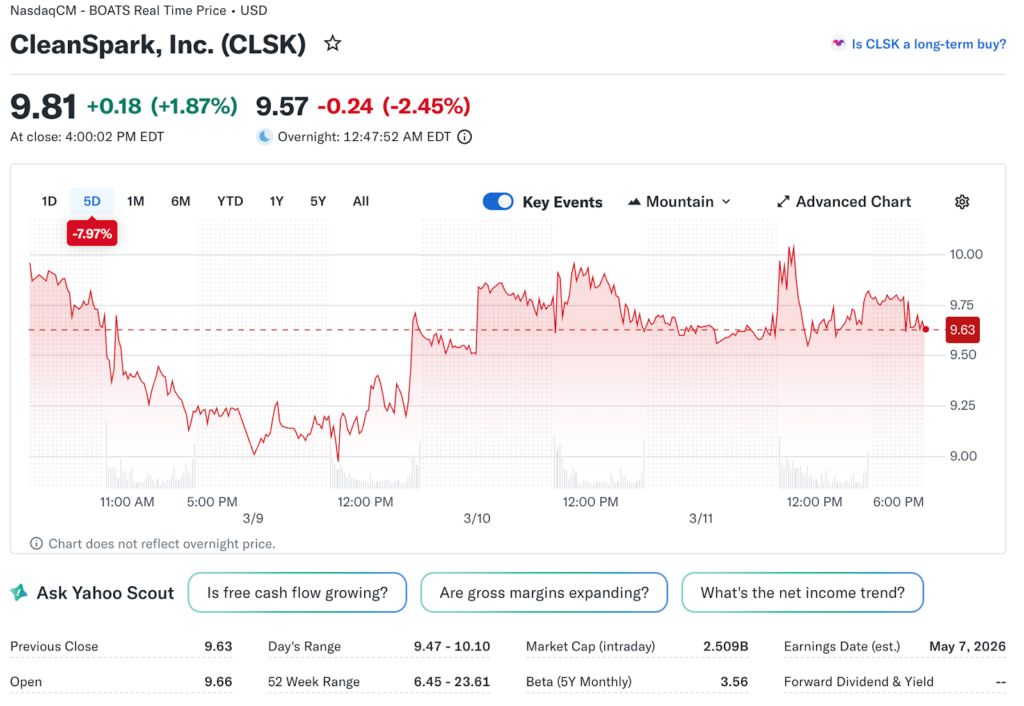
The peer comparison reinforces the concern. Strategy trades at 0.98 times book value, Hut 8 at 3.21 times, and Cleanspark at 1.78 times. Circle is priced at a multiple that sits well above every relevant comparable, which means the current share price is reflecting a best-case scenario across multiple dimensions simultaneously. The stock currently holds a Value Score of F, which captures the degree to which the market has priced in future growth at the expense of current fundamental value.
The Practical Takeaway for Investors
The case for holding CRCL rests on real foundations. USDC adoption is accelerating, institutional integration is deepening, and the long-term growth trajectory for digital dollar infrastructure remains compelling. For investors already in the position, staying invested to capture that long-term story is a defensible stance.
For those considering entering now, the setup is considerably less attractive. A stock that has doubled in a single month, trades at more than three times the industry price-to-book average, and faces near-term pressure from falling reserve yields and rising operating costs does not offer the kind of entry point that supports strong risk-adjusted returns from current levels. Patience here is likely to be rewarded with a better opportunity than what the current price is offering.


