
West Texas Intermediate (WTI) crude oil extended its gains for a second consecutive day, trading around $95.80 during Asian hours on Tuesday. The experts at Nummixo provide a comprehensive overview of this issue in this study.
Prices have surged +2.1% over the past two sessions, as escalating geopolitical tensions in the Middle East threaten one of the world’s most critical energy transit points: the Strait of Hormuz, which facilitates roughly 21 million barrels per day (mb/d) of global oil exports, equivalent to ≈20% of total global supply.
Escalating Middle East Tensions
Oil markets are responding sharply to rising US-Iran hostilities. According to a CNN report, the US President expressed deep frustration over stalled negotiations to end regional conflicts, warning that the US-Iran ceasefire is on massive life support. He formally rejected Tehran’s latest peace proposal, signaling a potential resumption of military action in the Persian Gulf.
The Strait of Hormuz is the focal point of concern, with global markets pricing in the risk of a near-total closure. Historically, disruptions in this chokepoint have caused WTI and Brent crude spreads to widen, sometimes exceeding $7 per barrel, reflecting both logistical risk and geopolitical premium.
OPEC Output Hits Two-Decade Low
The market impact is quantifiable. A Reuters survey revealed that OPEC’s crude production in April fell to 28.5 mb/d, the lowest monthly output since 1998, a decline of ≈1.2 mb/d from March. Key producers like Saudi Arabia and Iraq faced logistical constraints as the near-total closure of the Strait of Hormuz disrupted export schedules.
Saudi Aramco CEO Amin Nasser warned that global markets are experiencing a temporary loss of ≈100 million barrels per week due to constrained exports, equivalent to roughly 14.3 mb/d. This level of disruption, if sustained, could delay a return to market stability until 2027, according to his estimates.
Price Dynamics and Market Implications
WTI prices are currently supported at $93.50, with resistance around $97.00. Short-term volatility, measured by the CBOE Crude Oil Volatility Index (OVX), has spiked to 42, up from 32 just a week ago, signaling a significant increase in market uncertainty.
Brent crude, the global benchmark, has mirrored WTI’s gains, rising to $101.40, pushing the Brent-WTI spread to ≈$5.60 per barrel, a level indicative of regional supply tension and transportation bottlenecks.
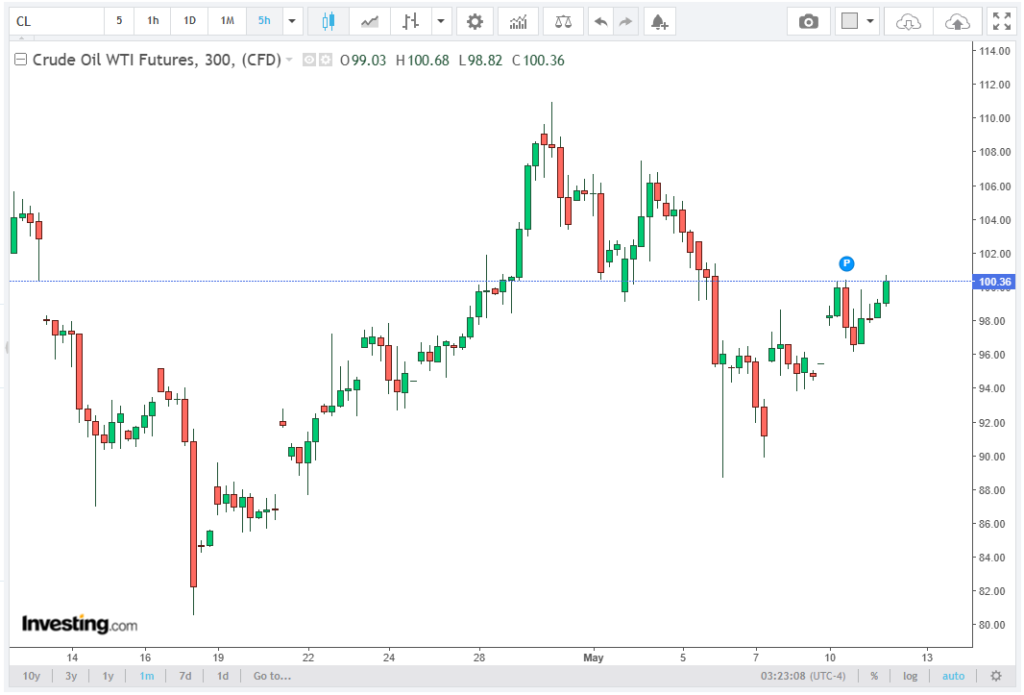
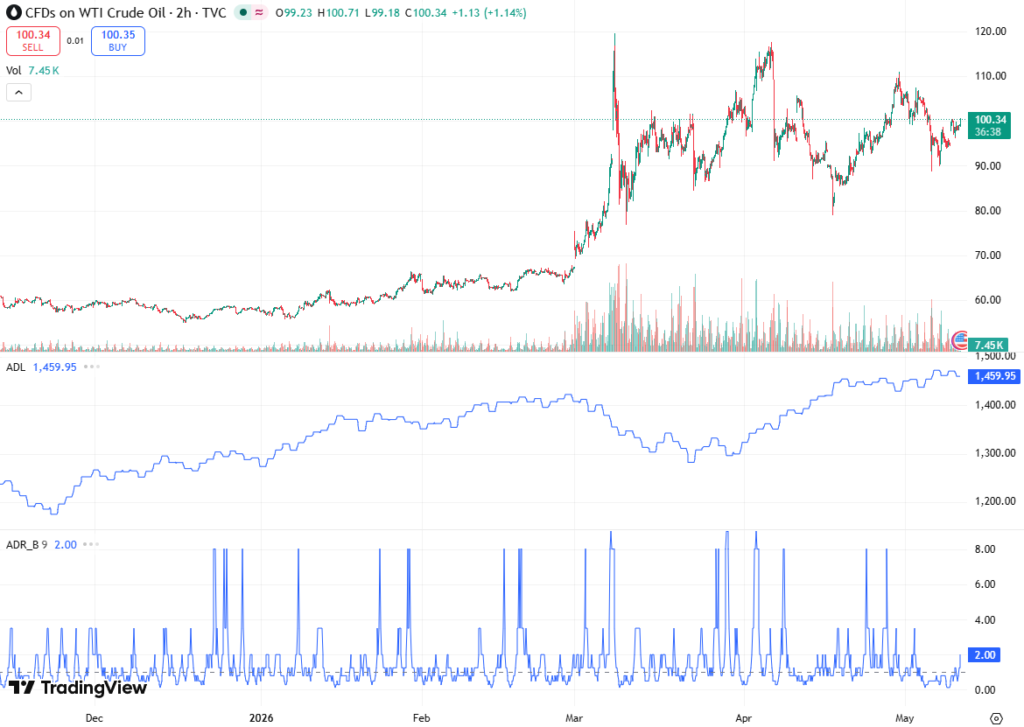
From a technical standpoint, WTI futures have seen open interest rise by 3.7% over the past three days, suggesting heightened participation by institutional investors hedging against geopolitical risk. The 30-day moving average now sits at $93.10, and momentum indicators, including RSI, are approaching 68, signaling near-term bullish sentiment.
Historical Context
The current situation evokes the 2019 Strait of Hormuz tensions, when limited Iranian interference caused WTI to spike ≈10% in one week. If a similar escalation occurs now, analysts predict WTI could breach $100 per barrel within weeks. Moreover, the OPEC+ production shortfall, combined with potential military actions, could create an unprecedented supply gap of 3–4 mb/d globally, stressing refining capacity in Asia, Europe, and North America.
Broader Market Effects
Prolonged disruption at the Strait of Hormuz could significantly affect global energy markets. One area of impact is refinery utilization rates, particularly in Asia, which are currently at 82%. Any sustained interruption could force adjustments in production and processing, putting pressure on regional fuel supplies.
Another key effect would be on shipping and freight costs, which have already risen by 15–20% due to rerouted tankers. The logistical challenges of moving crude around the disruption point can create broader supply chain pressures, affecting both importers and exporters.
Inflation expectations are also likely to be influenced, given that oil accounts for approximately 5–6% of the US consumer basket. Higher energy prices can therefore feed into broader consumer price pressures, impacting purchasing power and monetary policy considerations.
Finally, investors are closely monitoring energy ETF flows, which have increased by around $1.2 billion in the past week. This surge reflects market positioning for continued crude scarcity, indicating that participants expect supply constraints to persist and are adjusting their portfolios accordingly.
Conclusion
WTI crude oil is trading near $96.00, underpinned by the convergence of geopolitical risk, historically low OPEC production, and the fragile US-Iran ceasefire. The rejection of Tehran’s peace proposal, combined with Iranian threats of retaliation, increases the likelihood of supply disruptions through the Strait of Hormuz, potentially removing ≈20 mb/d from the market temporarily.
Market participants are factoring in higher risk premiums, with futures, options, and ETFs adjusting accordingly. Until a diplomatic or operational resolution emerges, the global energy sector faces an extended period of volatility, elevated prices, and logistical uncertainty. For traders, hedgers, and policymakers, the numbers clearly point to WTI’s continued sensitivity to regional developments.


