
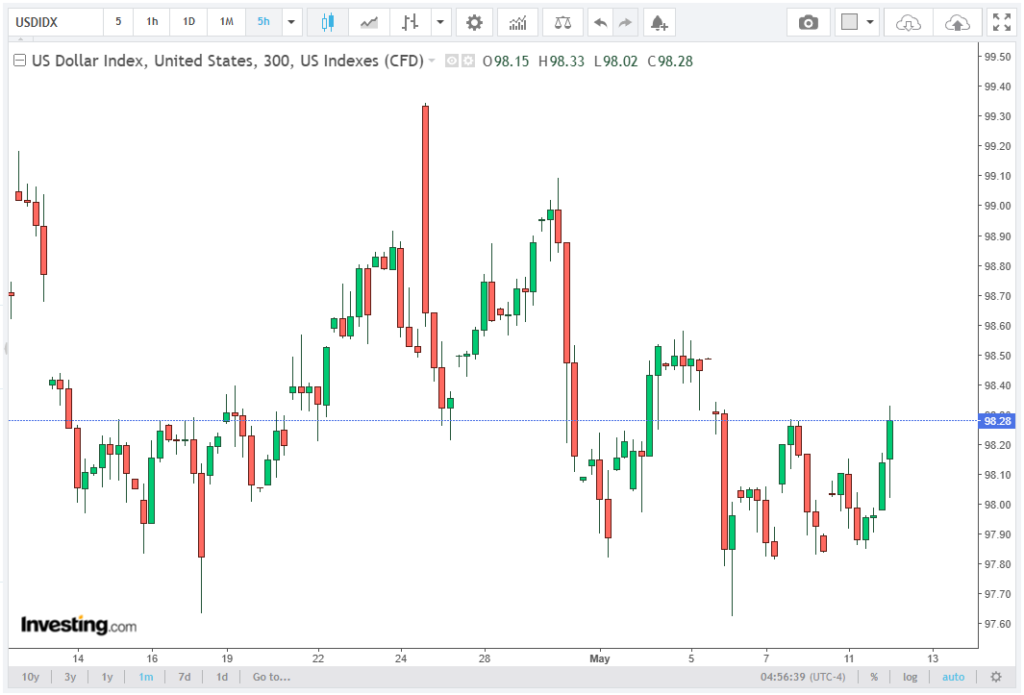
The US Dollar Index (DXY) surged above the 98.00 level on Tuesday, reaching 98.10 during Asian trading hours, as geopolitical tensions in the Middle East continue to fuel a flight to safety. The advisors at Nummixo offer a meticulous review of this topic in this article.
The DXY, which measures the USD against a basket of six major currencies, including the Euro (EUR), Japanese Yen (JPY), and British Pound (GBP), has gained 0.35% over the past two sessions, marking its strongest two-day rally since mid-March.
Geopolitical Instability Drives Safe-Haven Demand
Persistent Middle East instability underpins USD strength. As tensions rise, investors are flocking to safe-haven assets, including US Treasuries, gold, and the USD itself, while reducing exposure to risk-sensitive currencies.
Following reports of a deterioration in US-Iran peace optimism, the market is pricing in a 20–25% probability of renewed military escalation in the coming quarter, according to derivative-implied risk metrics.
This sentiment has contributed to widening USD yield spreads, with the 10-year US Treasury yield climbing to 3.45%, up 12 basis points from Monday’s close of 3.33%. In contrast, the 10-year German Bund yield remains near 2.05%, widening the DXY-relevant yield differential and supporting the Greenback’s appreciation.
The DXY is particularly responsive to risk-off flows. Historically, during periods of elevated geopolitical tension, such as the 2019–2020 Middle East flare-ups, a 1% rise in the index corresponded with a 15–20 basis point increase in Treasury yields, illustrating the strong link between USD demand and safe-haven capital flows.
US Signals Potential Shift in Regional Strategy
According to a CNN report, the US President has expressed mounting frustration over stalled Middle East peace negotiations. Administration sources suggest the US military is contemplating a resumption of airstrikes if diplomatic efforts fail.
Iranian officials, including Parliament Speaker Mohammad Bagher Ghalibaf, have warned that the Iranian military remains fully prepared to retaliate. The potential for escalation has pushed oil futures higher, with WTI crude climbing 2.1% to $80.45 per barrel, intensifying inflationary pressures in the US economy.
The interplay between geopolitical risk and commodity prices is a critical driver of the USD, as rising oil prices increase import costs, while the flight to safety encourages a move into Greenback-denominated assets.
Inflation and Federal Reserve Policy in Focus
Investors are closely watching Tuesday’s US Consumer Price Index (CPI) release for April. Economists forecast a month-over-month CPI rise of 0.4%, translating to a year-over-year inflation rate of 4.9%, reflecting the impact of higher energy prices due to Middle East tensions.
The Federal Reserve monitors inflation and wage growth when calibrating monetary policy. Rising CPI may reinforce a hawkish stance, potentially increasing the federal funds rate to 5.25%–5.50%, up from the current 5.00%–5.25% range, while dot plot forecasts suggest a further 25–50 basis point adjustment could occur if geopolitical-driven inflation persists.
Treasury market pricing implies a 70% probability of a Fed hike in June, based on futures contracts, highlighting the direct connection between regional instability and US monetary policy expectations.
Broader Market Implications
Beyond Middle East dynamics, markets are preparing for high-level diplomacy, including the US President’s meeting with Chinese President Xi Jinping. Key discussions on trade balances, artificial intelligence, and global energy security could influence risk sentiment, affecting both USD correlations and cross-currency spreads.
Currently, the EUR/USD is trading near 1.0980, down 0.4% intraday, while USD/JPY has strengthened to 134.60, up 0.6%, reflecting risk aversion flows. Investors are reallocating capital to the USD amid uncertainty, favoring liquid instruments such as US Treasuries, cash equivalents, and short-dated FX swaps.
Technical Outlook for the US Dollar Index
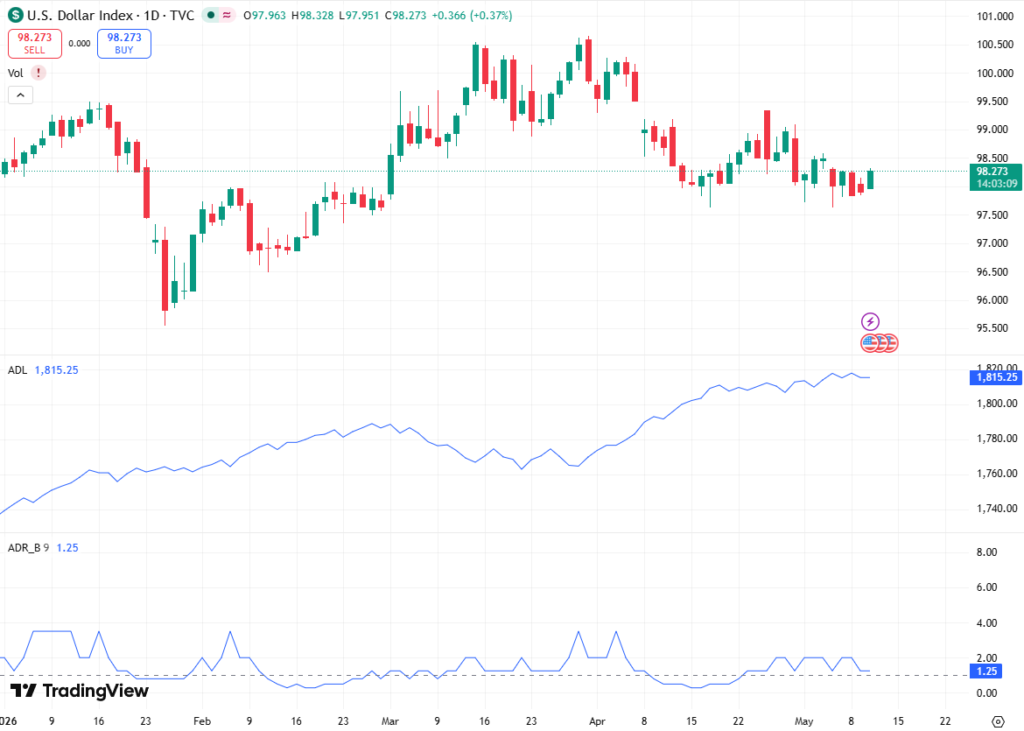
Technically, the DXY shows strong support near 98.00, with resistance at 98.50, corresponding to a 61.8% Fibonacci retracement level of the March–April decline. Momentum indicators, including the Relative Strength Index (RSI) at 64, suggest moderate overbought conditions, but the presence of geopolitical risk premiums may sustain upward pressure.
Traders are monitoring option-implied volatilities, which have risen to 11.5% on the DXY 1-month ATM options, signaling increased hedging activity against potential USD swings driven by Middle East developments.
Conclusion
The US Dollar Index continues to rise amid deteriorating US-Iran peace optimism, underpinned by geopolitical risk, oil price volatility, and expectations for Federal Reserve policy adjustments. Key metrics, including the DXY level at 98.10, 10-year Treasury yield at 3.45%, and EUR/USD near 1.0980, highlight the Greenback’s safe-haven appeal.
As regional tensions evolve, the USD is likely to remain sensitive to military developments, inflation data, and global policy signals, reinforcing its central role in foreign exchange and capital markets. Investors should maintain vigilance, monitoring risk premiums, yield spreads, and CPI outcomes, which collectively determine the near-term trajectory of the US Dollar.


