
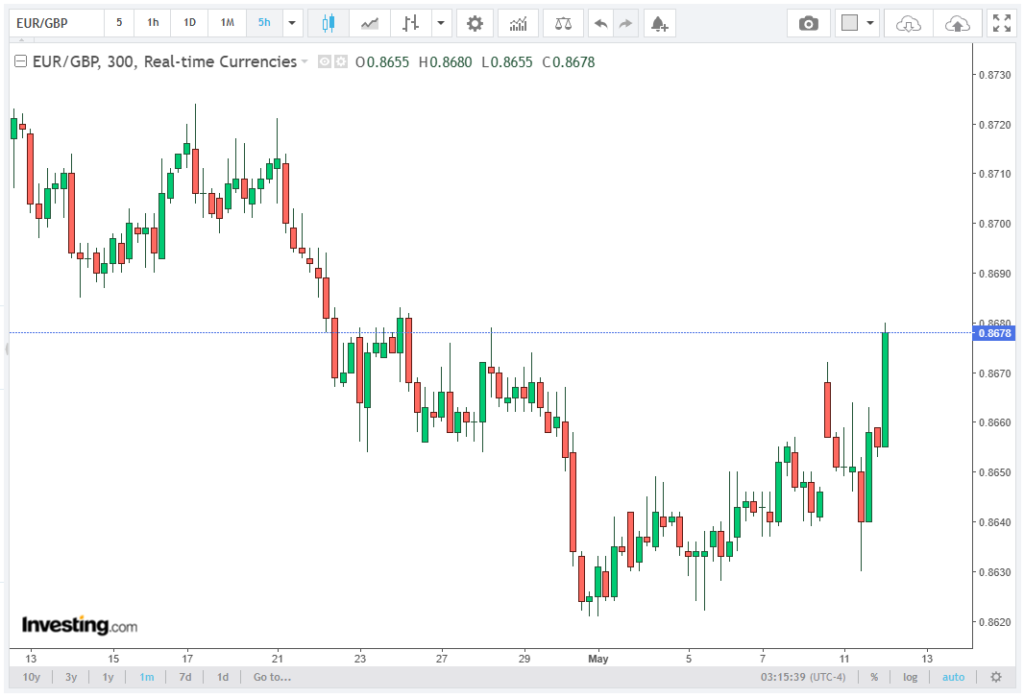
The EUR/GBP currency pair extended its gains during Tuesday’s early European session, trading around 0.8665, up 0.34% from Monday’s close of 0.8634. The move reflects a combination of political instability in the United Kingdom (UK) and hawkish signals from the European Central Bank (ECB), as markets weigh the potential impact on FX volatility, interest rate differentials, and capital flows.
The analysts at Nummixo offer a detailed examination of this topic in their latest report.
GBP Under Pressure From UK Political Turbulence
The British Pound (GBP) is under notable downward pressure, largely due to rising political uncertainty in the UK. Prime Minister Keir Starmer faces calls to resign following Labour Party losses in 95% of local councils, including key metropolitan areas, marking the party’s worst local election performance in over a decade.
Although Starmer has committed to remaining in office, market participants view the resulting political noise as a risk factor for Sterling, exacerbated by volatility in UK gilt yields.
UK 10-year gilt yields rose 12 basis points (bps) to 4.08% on Monday, signaling heightened risk premiums amid the political uncertainty. Analysts suggest that continued GBP weakness could persist until a clear policy direction emerges, with the EUR/GBP cross likely to remain sensitive to UK political headlines and bond market dynamics.
Euro Supported by Hawkish ECB Stance
Conversely, the Euro (EUR) has strengthened amid hawkish comments from the ECB. ECB Governing Council member Martin Kocher indicated that the ECB is ready to proceed with rate hikes if energy prices remain elevated, reflecting concerns over core inflation, currently at 5.2% year-on-year (YoY) in the Eurozone, and headline inflation at 7.1% YoY, largely driven by Middle East energy market tensions.
ECB Executive Board member Isabel Schnabel reinforced this outlook, emphasizing that corporate and household behavior is now responding significantly to rising energy costs, suggesting that inflationary pressures are becoming entrenched. Market expectations have adjusted accordingly, with a 92% probability of a 25 bps rate hike priced in for the June ECB meeting, and a forward curve suggesting a total of three 25 bps hikes through 2026.
The Euro’s relative strength is also underpinned by improving economic sentiment in Germany, where the ZEW Economic Sentiment Index is expected to report -12.5 in May, slightly improving from -15.2 in April, signaling moderate optimism among investors despite ongoing geopolitical uncertainties.
Market Implications and Technical Considerations
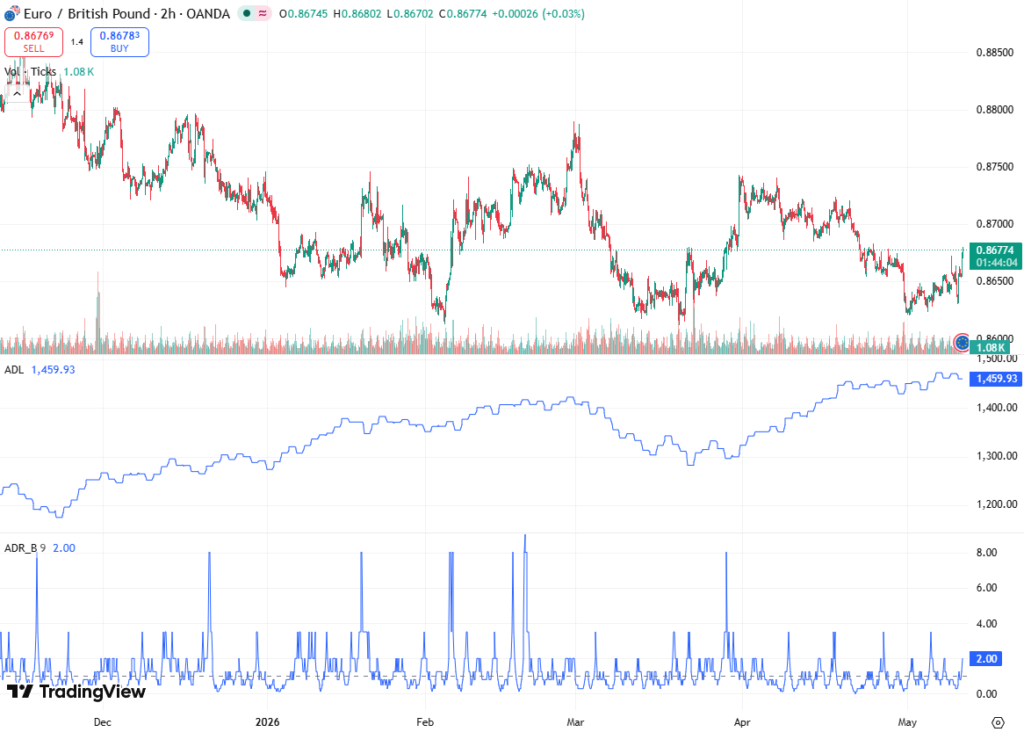
The EUR/GBP cross remains highly sensitive to both political developments in the UK and ECB policy signals. From a technical perspective, the pair is trading above its 50-day moving average of 0.8618, with resistance near 0.8685 and support around 0.8640. Short-term momentum indicators, such as the Relative Strength Index (RSI) at 63, suggest mild overbought conditions, but not yet extreme, indicating potential for continued upward pressure.
Traders are also monitoring the UK economic calendar, with the next CPI release due on May 17, expected at 0.4% MoM and 4.5% YoY, which could influence Sterling’s trajectory. Meanwhile, the Eurozone calendar highlights the ZEW survey results and energy price updates, key drivers of ECB policy expectations and EUR strength.
Potential Scenarios for EUR/GBP
Analysts outline several scenarios for the EUR/GBP pair. One possibility is continued GBP weakness, where escalating UK political instability could push EUR/GBP toward 0.8700, particularly if gilt yields rise above 4.15%. This scenario suggests that the pound remains under pressure amid domestic uncertainty.
Another scenario involves an ECB hawkish push. If the European Central Bank confirms a 25 bps rate hike in June and economic sentiment remains robust, the EUR could strengthen further. This would support long EUR/GBP positions, indicating a more favorable outlook for the euro relative to the pound.
A third scenario is a market reversal, where a stabilization of UK politics or unexpected ECB dovishness might trigger a retracement of EUR/GBP toward 0.8600. This highlights the pair’s sensitivity to fundamental news flows and the importance of monitoring both UK and eurozone developments closely.
Conclusion
The EUR/GBP currency pair is navigating a complex macro-financial environment, influenced by UK political uncertainty, rising UK gilt yields, and hawkish ECB signals. GBP weakness reflects the fallout from Prime Minister Starmer’s political challenges, while the EUR gains traction amid expectations of interest rate hikes as soon as June and persistent Eurozone inflation at 7.1% YoY.
With EUR/GBP trading near 0.8665, market participants are positioning for potential continued Euro strength, though volatility remains elevated, particularly around UK political developments, ECB statements, and key economic releases such as the ZEW surveys. Investors and traders should maintain a vigilant watch on both geopolitical and macroeconomic indicators, as these remain the primary drivers of FX market dynamics in the coming weeks.


