
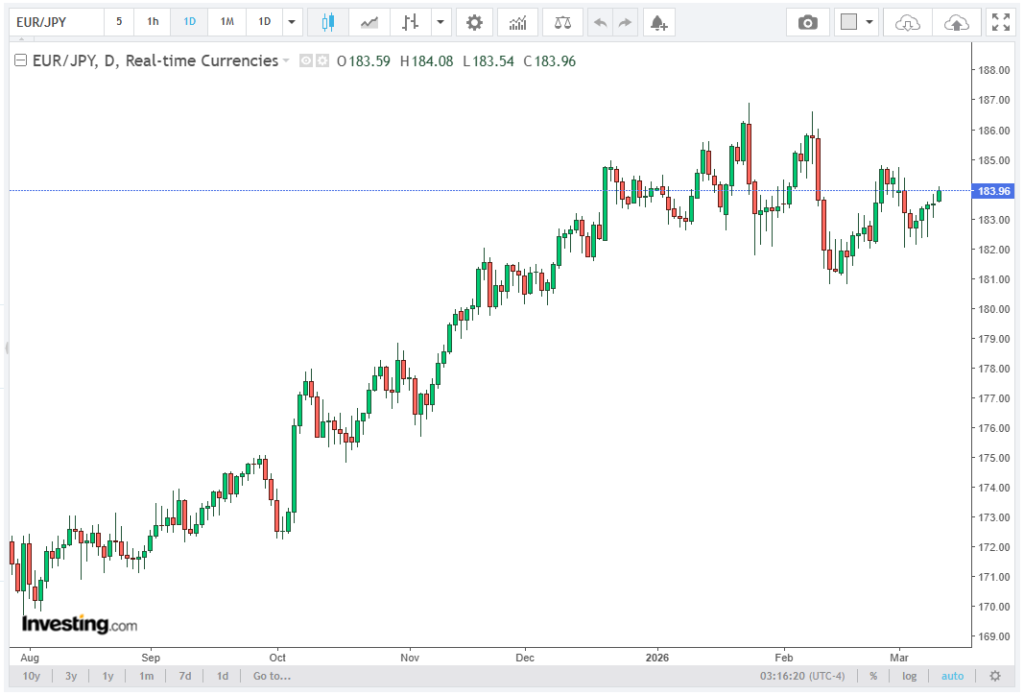
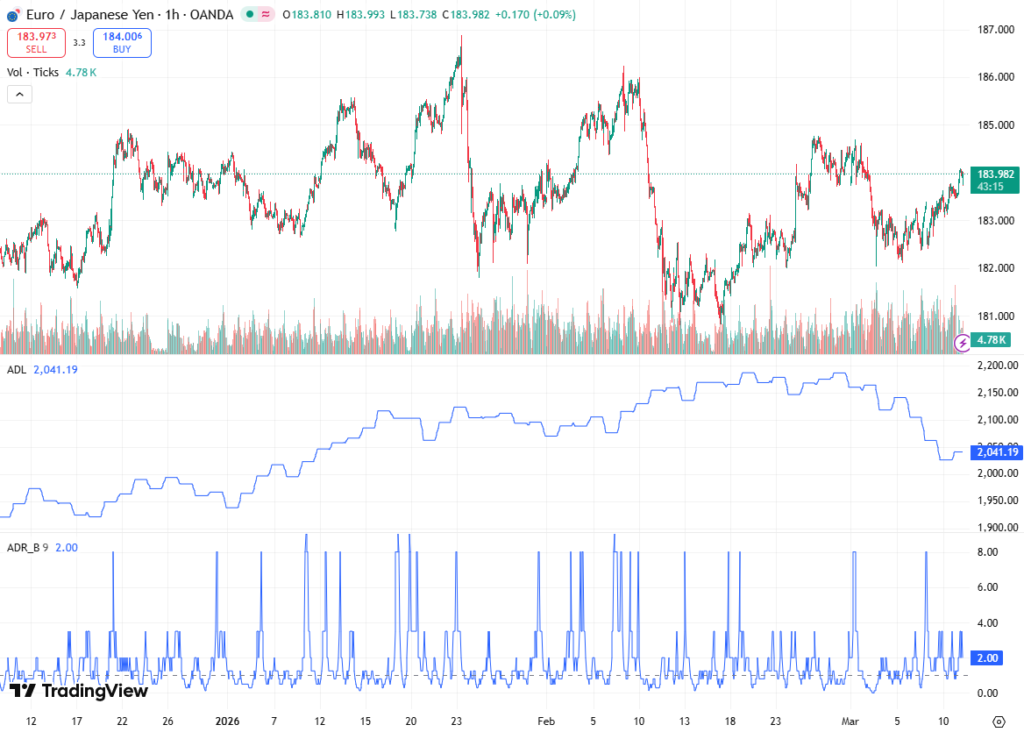
The EUR/JPY currency pair advanced toward the 184.00 level during Wednesday’s early European session, trading around 183.90 as the Japanese Yen (JPY) weakened against the Euro (EUR). The upward movement in the cross reflects growing market uncertainty regarding the pace of monetary policy normalization by the Bank of Japan (BoJ).
While the Euro remained relatively stable, the Yen came under pressure as investors reassessed expectations for future Japanese interest rate adjustments. In this article, the brokers at Byronixel provide a clear and detailed analysis of the topic.
Currency markets continue to monitor key macroeconomic indicators and central bank signals to determine the direction of the pair. Later in the day, traders are expected to focus on the final reading of Germany’s Harmonized Index of Consumer Prices (HICP), a major inflation indicator that could influence expectations around European Central Bank (ECB) policy. A stronger-than-expected inflation print could reinforce the Euro’s resilience, potentially supporting the EUR/JPY cross in the near term.
The pair’s current rally reflects a broader divergence in monetary policy outlooks between Europe and Japan. While the ECB continues to navigate persistent inflation pressures, the BoJ remains cautious in its approach to tightening policy after decades of ultra-loose monetary conditions.
Market Doubts Surround BoJ Policy Normalization
A key driver behind the Japanese Yen’s weakness is the persistent uncertainty surrounding the Bank of Japan’s policy trajectory. According to a Reuters poll released on Wednesday, all 64 economists surveyed expect the BoJ to leave its benchmark policy rate unchanged at 0.75% during the upcoming monetary policy meeting next week.
Despite the near-term expectation of a pause, economists still anticipate a gradual tightening cycle. Approximately 60% of respondents forecast that the policy rate will rise to 1.00% by the end of June, a projection largely unchanged from February’s survey, where 58% predicted the same outcome. These projections highlight a measured approach to policy normalization, suggesting that the central bank is unlikely to adopt an aggressive rate-hiking path.
Financial markets interpret this cautious stance as a signal that Japanese interest rates will remain relatively low compared with global peers, reducing the attractiveness of the Yen for yield-seeking investors. As a result, capital flows may continue favoring higher-yielding currencies, supporting the upward trajectory of EUR/JPY.
BoJ Governor Signals Possible Extended Policy Pause
Additional pressure on the Yen emerged after comments from BoJ Governor Kazuo Ueda, who recently suggested that interest rates may remain on hold for an extended period. The governor emphasized that the economic consequences of escalating geopolitical tensions in the Middle East could complicate Japan’s economic outlook.
Ueda’s remarks reinforced the perception that the BoJ is prioritizing economic stability over rapid policy tightening. Japan’s economy remains sensitive to external shocks, particularly those affecting global energy markets and international trade flows. Any disruption in energy supply or a sharp increase in commodity prices could have inflationary and growth implications for the country.
German Inflation Data in Focus for Euro Direction
While developments in Japan dominate the Yen side of the equation, the Euro’s trajectory also plays a critical role in the performance of the EUR/JPY cross. Market participants are closely watching the final reading of Germany’s Harmonized Index of Consumer Prices (HICP), which provides a comprehensive measure of inflation across the euro area’s largest economy.
Inflation data from Germany often serves as an important leading indicator for broader Eurozone price trends. If the final HICP figures confirm persistent inflationary pressures, expectations for continued restrictive monetary policy from the ECB may strengthen.
Such a scenario could support the Euro by maintaining a favorable interest rate differential relative to Japan. Currency traders often evaluate yield spreads between sovereign bonds, and the widening gap between Eurozone and Japanese yields may continue to attract capital into Euro-denominated assets.
Outlook for EUR/JPY
Looking ahead, the EUR/JPY outlook will likely remain influenced by three key factors: monetary policy expectations, economic data releases, and geopolitical developments.
On the policy front, markets will closely monitor signals from the Bank of Japan regarding the timing and magnitude of future rate hikes. Any indication of a faster normalization process could strengthen the Yen and place downward pressure on the pair.
Meanwhile, Eurozone inflation data and broader ECB policy expectations will continue shaping the Euro’s performance. Persistent inflation could sustain the Euro’s yield advantage, supporting the cross.
Finally, the evolving situation in the Middle East introduces an additional layer of uncertainty. Escalating tensions could trigger safe-haven flows into the Yen, partially offsetting the effects of monetary policy divergence.
For now, the EUR/JPY pair remains near the 184.00 threshold, reflecting a market environment characterized by policy uncertainty, geopolitical risks, and shifting investor sentiment. As traders evaluate these competing forces, volatility in the cross is likely to remain elevated in the sessions ahead.


