
The EUR/USD pair is struggling to gain traction as a combination of geopolitical tensions and monetary policy factors continues to support the US Dollar (USD). The experts at Nummvix provide a comprehensive overview of this issue in this article.
Following heavy losses in the previous session, the pair is consolidating below the mid-1.1700s during the Asian session on Wednesday, with traders adopting a cautious stance ahead of major political events and economic data releases, which could potentially impact volatility in the currency market.
USD Support Driven by Fed Hikes and Geopolitical Tensions
The USD remains broadly supported due to rising interest rate expectations and heightened geopolitical risks, particularly involving Iran. Hotter-than-expected US consumer inflation data released on Tuesday boosted market bets for a Federal Reserve (Fed) interest rate hike in 2026, reinforcing the dollar’s appeal.
Simultaneously, the risk of conflict in the Middle East continues to exert a bullish influence on the greenback. Disagreements over Tehran’s nuclear program and ongoing tensions in the Strait of Hormuz have diminished hopes for a US-Iran peace deal, underpinning the USD and capping upside potential for the EUR/USD pair.
Market participants are also closely monitoring the scheduled meeting between the US President and the Chinese President, which has introduced an element of uncertainty. This event is prompting many traders to adopt a wait-and-see approach, further contributing to the narrow trading range observed in the pair.
Technical Outlook: Modest Support Amid Softening Momentum
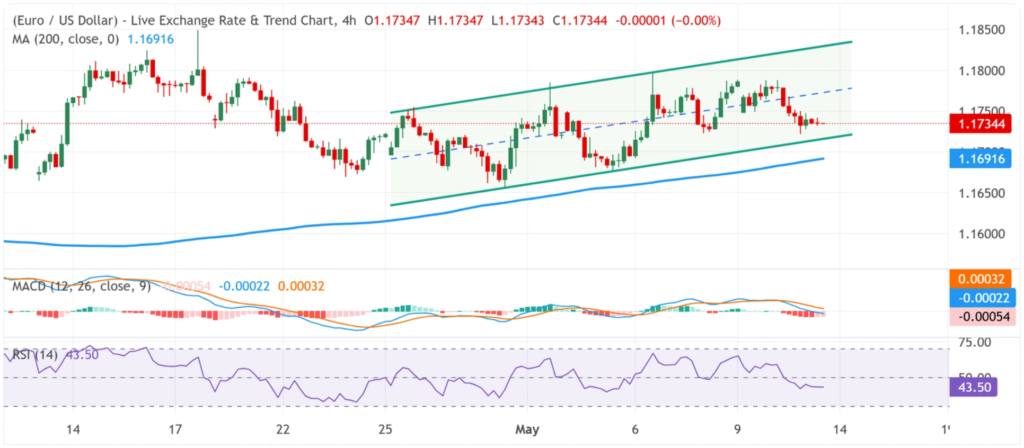
From a technical perspective, the EUR/USD has been trading within an upward-sloping channel over the past two weeks. Spot prices continue to hold above the 200-period Simple Moving Average (SMA) on the 4-hour chart, indicating a modestly constructive near-term bias. However, momentum indicators are signaling a potential loss of upside strength.
The Relative Strength Index (RSI) has eased to the mid-40s, reflecting softening bullish momentum, while the Moving Average Convergence Divergence (MACD) has dipped slightly below zero, with the histogram turning negative. Together, these signals suggest that while the underlying trend structure remains supportive, near-term upside traction is weakening.
Traders should remain cautious, particularly bearish participants, as a sustained break below the ascending channel support near 1.1715 and the 200-period SMA at 1.1692 would be needed to confirm further losses. Acceptance below these levels would likely weaken the pair’s constructive bias and open the door for deeper retracements within the broader trading range.
Key Support and Resistance Levels
On the downside, immediate support aligns with the ascending channel base at 1.1715, followed closely by the 200-period SMA at 1.1692. A break and close below these levels would signal a shift in market sentiment, potentially attracting shorter-term selling pressure toward 1.1650 and possibly lower.
Conversely, the upside remains capped by the upper boundary of the parallel channel near 1.1830. A convincing breakout above this resistance would mark a resumption of the bullish trend, opening the way for a more decisive upward extension, potentially toward the 1.1900 region in the medium term.
Traders should also note that short-term volatility may remain elevated due to geopolitical developments and US economic releases, including inflation and employment data, which could act as catalysts for sharp moves in the EUR/USD pair.
Market Positioning and Risk Considerations
The current consolidation phase indicates a market that is hesitant to commit to either direction. Positioning ahead of the US-China meeting and potential developments in Iran remains light, reflecting traders’ preference for risk management in an environment of heightened uncertainty.
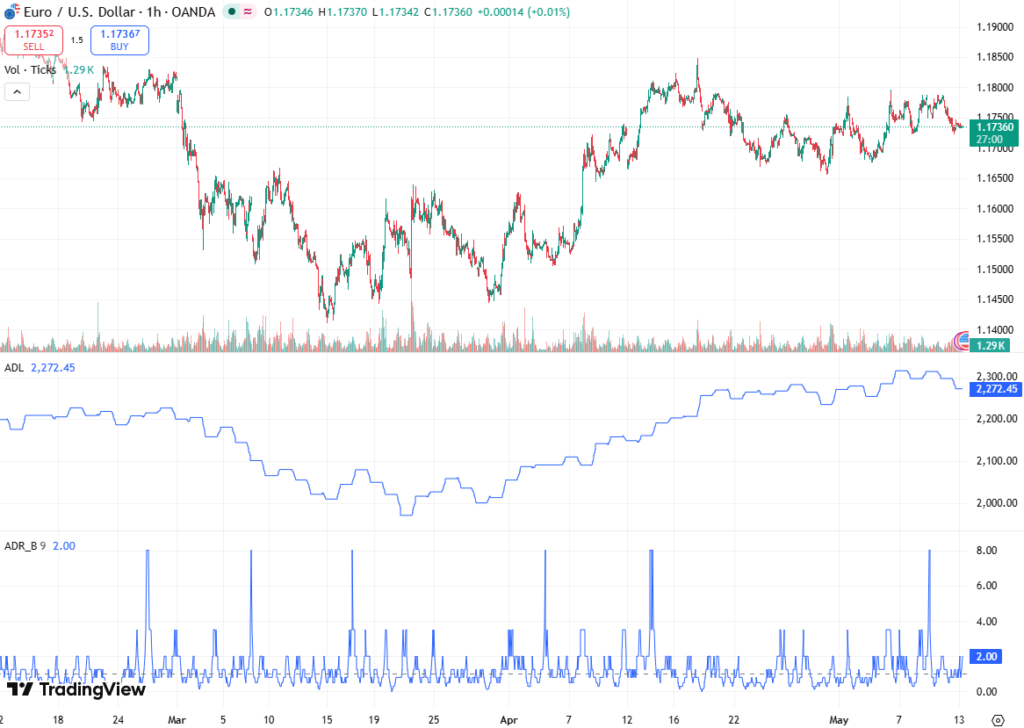
For bearish traders, this underscores the importance of waiting for a technical confirmation before adding to short positions, particularly given the underlying trend support above 1.1700. On the other hand, bullish participants may look for breakout opportunities above 1.1830, but must remain mindful of the USD-positive backdrop driven by Fed rate expectations and geopolitical tensions.
Conclusion
The EUR/USD pair is currently oscillating in a narrow range below mid-1.1700s, constrained by a combination of US interest rate expectations and geopolitical risks, particularly surrounding Iran. While the technical structure remains modestly constructive, momentum indicators point to a potential loss of short-term upside traction, warranting caution for bearish traders.
Traders should closely monitor key technical levels, namely the ascending channel support near 1.1715 and the 200-period SMA at 1.1692, to gauge the validity of further downside moves. Conversely, resistance at 1.1830 represents the immediate upside hurdle, with a breakout potentially signaling a renewed bullish push.
Ultimately, EUR/USD price action in the coming sessions will likely remain range-bound, influenced by Fed expectations, geopolitical developments, and macroeconomic releases, requiring disciplined positioning and active risk management for traders navigating this uncertain environment.


