
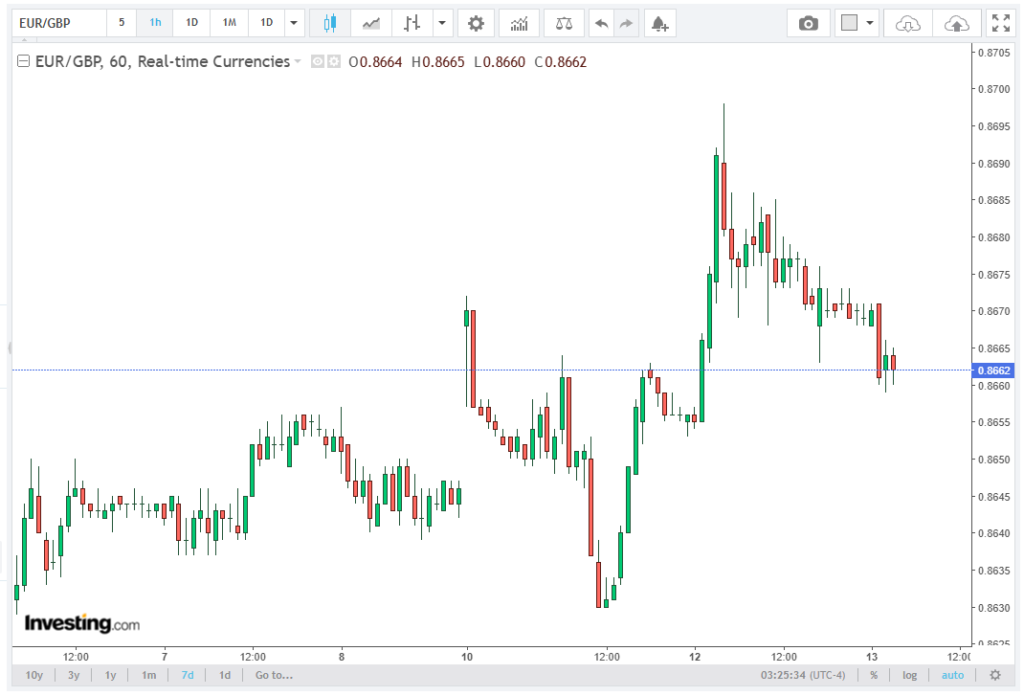
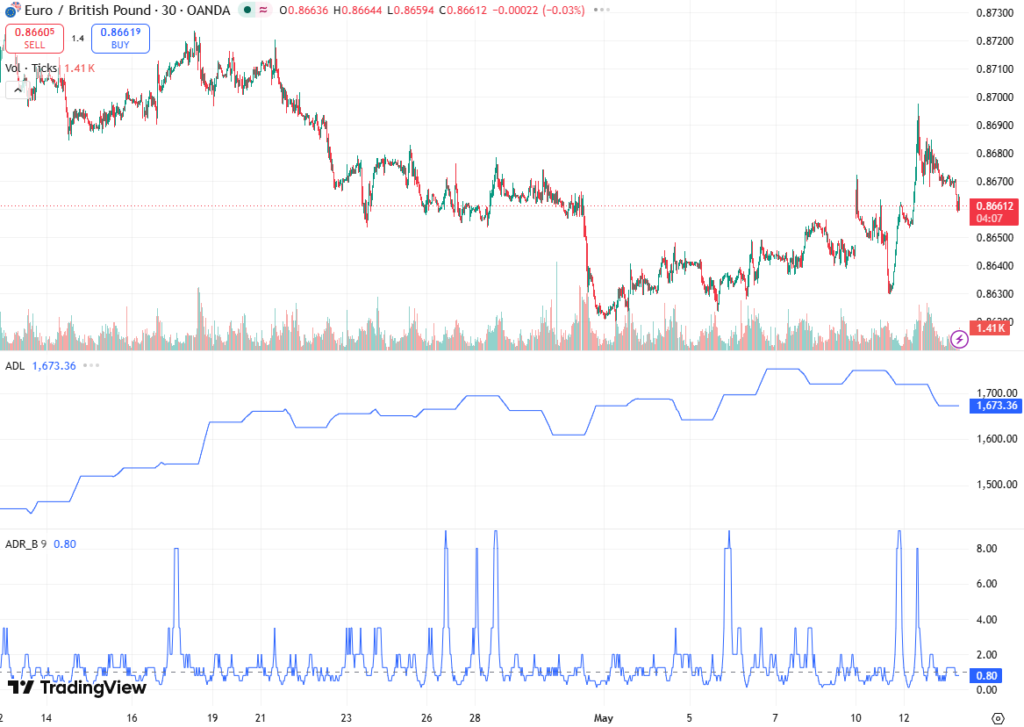
The EUR/GBP cross slid to 0.8660 during Wednesday’s early European session, reflecting heightened market caution ahead of key Eurozone economic data and ongoing geopolitical risks.
The Euro (EUR) lost ground against the British Pound (GBP) as traders assessed the potential impact of energy price volatility, US-Iran tensions, and domestic UK political instability. This comprehensive article by Nummvix addresses the issue in detail.
EUR/GBP Weakness Driven by Energy Exposure
In early European trading, the EUR/GBP pair fell from 0.8695 to 0.8660, a decline of roughly 0.4%, as concerns about Eurozone energy exposure intensified. The region imports nearly 60% of its energy, making it highly sensitive to Middle East conflicts and global oil price fluctuations. Brent crude futures surged above $94 per barrel earlier this week amid renewed speculation of potential US-Iran hostilities, further pressuring the Euro.
Reports indicate that the US President has expressed growing frustration over stalled Iran negotiations, increasing the likelihood of renewed military operations. According to CNN, some White House aides suggest a resumption of combat actions could occur if diplomatic channels fail, which could push oil prices higher and exacerbate Eurozone inflation risks.
Despite comments that the upcoming US-China summit in Beijing will prioritize trade discussions, market participants remain cautious. Any escalation in US-Iran tensions could increase energy costs for the Eurozone, further weighing on the EUR/GBP cross.
ECB Hawkishness May Cap Euro Losses
While geopolitical risks dominate sentiment, European Central Bank (ECB) commentary may provide some support to the Euro. ECB policymaker Joachim Nagel noted a rising likelihood of borrowing cost increases should energy-driven inflation accelerate.
The ECB’s main refinancing rate currently stands at 3.50%, and markets are pricing in a 20–25% probability of a 25-basis-point hike at the next policy meeting if geopolitical shocks continue to drive inflation above the 2% target. Such a hawkish bias could limit the EUR’s downside, particularly against the GBP, which faces its own political challenges.
UK Political Instability Pressures the Pound
The GBP remains vulnerable amid domestic political instability. UK Prime Minister Keir Starmer faces increasing pressure to announce a departure date after the Labour Party suffered historic losses in local elections, losing more than 1,100 council seats.
This political turbulence could negatively impact GBP liquidity, with analysts expecting intra-day volatility of 30–40 pips for the EUR/GBP pair if UK headlines worsen. Additionally, market positioning suggests short-term risk-off flows could favor the Euro, creating a potential technical floor near 0.8645, based on previous support levels.
Focus on Eurozone Q1 GDP
Attention now turns to the preliminary Eurozone GDP reading for Q1 2026, scheduled for later Wednesday. Economists forecast a 0.8% year-on-year growth, with quarterly growth projected at 0.2%.
If the actual GDP exceeds expectations, say 0.3% QoQ, it may reinforce Euro resilience, offsetting geopolitical and energy-related pressures. Conversely, a weaker reading of 0.1% QoQ could accelerate EUR/GBP declines, potentially targeting 0.8620, the next technical support level.
Technical and Market Outlook
Traders are closely watching several factors shaping EUR/GBP. Eurozone macro data, including Q1 GDP, industrial production, and inflation expectations, remain key drivers of euro performance.
Energy market volatility is also influential, with Brent crude trading near $94–$96 and natural gas futures up 5% week-to-date, affecting broader market sentiment. Geopolitical risks, particularly US-Iran tensions, could disrupt energy supply and heighten risk aversion.
On the policy front, the ECB’s main refinancing rate at 3.50% and hawkish commentary may help limit EUR losses. In the UK, political instability, including Labour Party setbacks and a potential Prime Minister transition, contributes to GBP volatility. Technically, traders are watching support at 0.8645 and resistance around 0.8695–0.8700 for potential trading signals.
Short-term EUR/GBP trading ranges are likely to be narrow but volatile, with potential spikes tied to news events. Analysts suggest a range-bound approach between 0.8645 and 0.8700 until the Q1 GDP data provides clearer guidance.
Conclusion
The EUR/GBP cross is under pressure, trading near 0.8660, amid geopolitical risks, energy market volatility, and UK political instability. While ECB hawkish signals may cushion some Euro downside, the GBP remains sensitive to domestic uncertainty.
Traders will closely monitor the Eurozone Q1 GDP reading, expected at 0.8% YoY and 0.2% QoQ, along with updates from the US-China summit and US-Iran relations. These factors are likely to drive near-term EUR/GBP volatility, with potential for technical breakouts above 0.8700 or declines toward 0.8645.
In summary, the EUR/GBP outlook is delicate, shaped by macro fundamentals, geopolitical tensions, and political risk, making it a key pair to watch for traders seeking exposure to European currencies.


