
The GBP/USD pair remains under pressure at the start of the new trading week, struggling to sustain momentum above the psychologically important 1.3600 level. Although the currency pair attracted modest dip-buying during the Asian session on Monday, the rebound lacked conviction as renewed US Dollar (USD) demand limited further upside. The brokers at Winseterra explore this topic in detail throughout this article.
Growing geopolitical tensions involving Iran, combined with rising expectations that the US Federal Reserve (Fed) could maintain a hawkish monetary policy stance for longer, have revived safe-haven flows into the Greenback. At the same time, the British Pound (GBP) continues to receive support from persistent UK inflation concerns and the possibility of additional tightening from the Bank of England (BoE).
Iran Tensions Revive Safe-Haven Demand for the US Dollar
Investor sentiment turned cautious after optimism surrounding a possible US-Iran peace agreement faded rapidly. Renewed hostilities in the Strait of Hormuz, coupled with ongoing disputes regarding Tehran’s nuclear ambitions, increased geopolitical uncertainty across global financial markets.
Historically, periods of geopolitical instability tend to strengthen the US Dollar due to its status as a global reserve and safe-haven currency. This dynamic re-emerged at the beginning of the week, helping the USD recover from recent weakness and placing downward pressure on GBP/USD.
In addition to geopolitical concerns, market participants continue to reassess the outlook for US interest rates. Expectations that the Fed could keep borrowing costs elevated for a longer period have supported US Treasury yields and boosted overall demand for the Dollar.
The combination of geopolitical risk and hawkish monetary policy expectations has therefore created a supportive backdrop for the USD, preventing GBP/USD from staging a meaningful recovery above the 1.3600 threshold.
Technical Outlook Remains Cautiously Constructive
From a technical perspective, the GBP/USD pair still shows signs of maintaining a mildly constructive bias despite recent consolidation.
A key factor supporting the pair is its ability to hold above the 100-period Exponential Moving Average (EMA), which currently acts as important dynamic support near the 1.3538 region. Holding above this moving average suggests that buyers still retain a degree of short-term control, even though upside momentum has weakened.
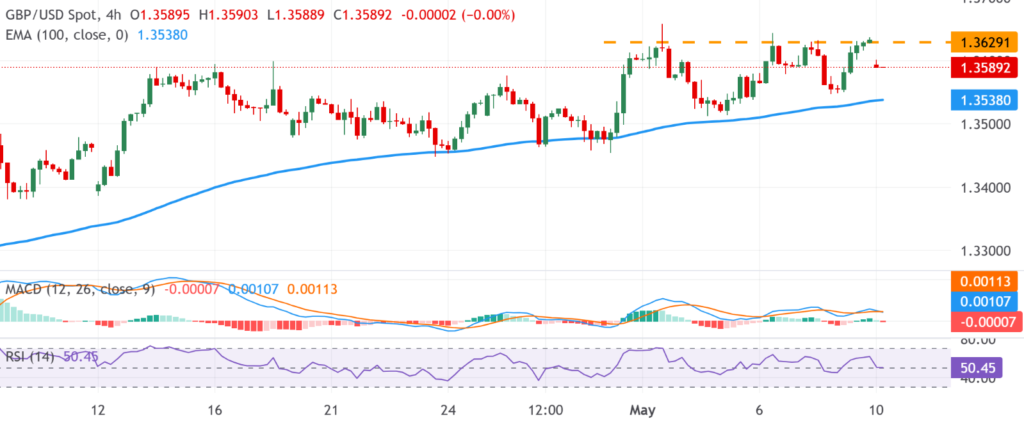
Momentum indicators are presenting a somewhat ambiguous picture. The Relative Strength Index (RSI) hovers near the neutral 50 level, suggesting a lack of decisive directional momentum. At the same time, the Moving Average Convergence Divergence (MACD) has dipped slightly below zero, signaling that bullish momentum may be starting to wane.
These technical signals suggest that while the broader uptrend remains intact, upside momentum is currently tentative rather than aggressive.
Resistance at 1.3635 Remains Critical
For bullish traders, the immediate focus remains on the 1.3635 resistance zone, which represents an important horizontal barrier for near-term price action.
A sustained move above this level could confirm renewed bullish momentum and potentially open the door for a continuation of the broader upward trend seen over the past month. However, analysts believe traders should wait for stronger follow-through buying and improving momentum indicators before positioning for a larger upside breakout.
Without a decisive break above resistance, GBP/USD may continue trading within a consolidation range as investors assess incoming macroeconomic developments and geopolitical headlines.
In the near term, market participants are likely to remain highly sensitive to developments involving Iran, US interest rate expectations, and upcoming central bank commentary.
Key Support Levels to Watch
On the downside, the first major support area is located near the 100-period EMA at 1.3538. This level continues to serve as a critical technical floor for the pair.
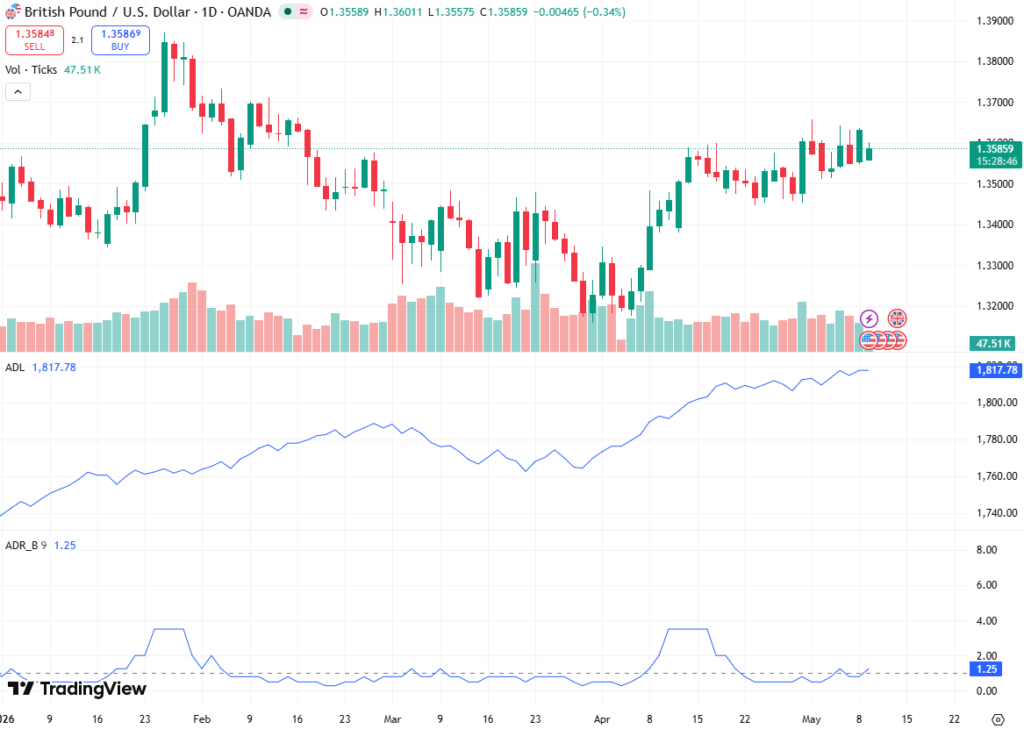
A confirmed breakdown below this support could expose GBP/USD to a deeper corrective move toward previous swing lows around the mid-1.3500 region. Such a scenario would likely strengthen bearish sentiment and increase the probability of a broader retracement.
However, as long as the pair continues to hold above the 100-period EMA, the short-term technical outlook remains relatively stable. Buyers may continue using dips as opportunities to accumulate positions, especially in the absence of major market-moving economic releases.
Conclusion
The GBP/USD pair continues to trade with a negative bias below the 1.3600 mark as renewed geopolitical tensions involving Iran revive safe-haven demand for the US Dollar. Hawkish Federal Reserve expectations have further strengthened the Greenback, limiting the pair’s recovery attempts.
At the same time, support from the Bank of England’s inflation-focused stance and improving UK political stability continues to provide resilience for the British Pound.
Technically, GBP/USD remains supported above its crucial 100-period EMA, suggesting that the broader bullish structure has not yet been invalidated. Nevertheless, mixed momentum indicators indicate that traders should remain cautious until a decisive breakout above 1.3635 or a breakdown below key support levels confirms the next directional move.


