
Gold (XAU/USD) remains under selling pressure for a second consecutive day, struggling to capitalize on an overnight bounce from a multi-day low around the $4,638 region. The combination of a bullish US Dollar (USD), hawkish Federal Reserve (Fed) expectations, and escalating US-Iran tensions continues to weigh on the precious metal, keeping investors cautious in the short term. Nummvix provides a complete overview of this issue in the article.
Strong US CPI Reinforces Hawkish Fed Expectations
On Tuesday, the US Bureau of Labor Statistics (BLS) reported that the headline Consumer Price Index (CPI) climbed to 3.8% year-on-year, up from 3.3% in the prior month, marking a near three-year high. Meanwhile, the core CPI, which excludes food and energy, advanced 0.4% month-on-month, lifting the yearly rate to 2.8%, a seven-month high and well above the Fed’s 2% target.
These figures have reaffirmed market expectations for a more hawkish Fed stance, prompting traders to price in a roughly 35% chance of a US rate hike by year-end. The strong inflation data not only supported the USD rally but also reinforced the market’s perception that the Fed may tighten monetary policy further, which generally undermines non-yielding assets like Gold. As a result, the USD retained Tuesday’s gains, rising to its highest level in over a week, and exerted downward pressure on Gold prices.
Geopolitical Risks Amplify USD Strength
Adding to the USD tailwind, geopolitical tensions between the US and Iran are further supporting the reserve currency. Prospects for a peace deal have dimmed after the US President criticized a ceasefire as unbelievably weak and on massive life support. Concurrently, Iran rejected a US proposal to end the ongoing conflict, citing disputes over Tehran’s nuclear program and control over the strategically critical Strait of Hormuz.
Such geopolitical uncertainty tends to benefit safe-haven currencies, with the USD emerging as the preferred choice amid rising market risk aversion, while non-yielding Gold faces downward pressure. Analysts note that renewed tensions in the Middle East could prolong the USD’s upward trajectory, making it challenging for Gold bulls to regain momentum in the near term.
US Treasury Yields Support the USD
The stronger-than-expected inflation data also pushed US Treasury yields higher, reinforcing the USD rally. The 30-year US government bond yield briefly touched 5.0%, approaching its yearly peak, while the two-year yield remains near 4%, reflecting rate-sensitive pressures. These elevated yields create a headwind for Gold, which does not offer interest, and enhance the appeal of USD-denominated assets.
In the current environment, Gold traders must contend with both monetary policy dynamics and geopolitical uncertainty, keeping the metal in a negative bias despite periodic short-term bounces.
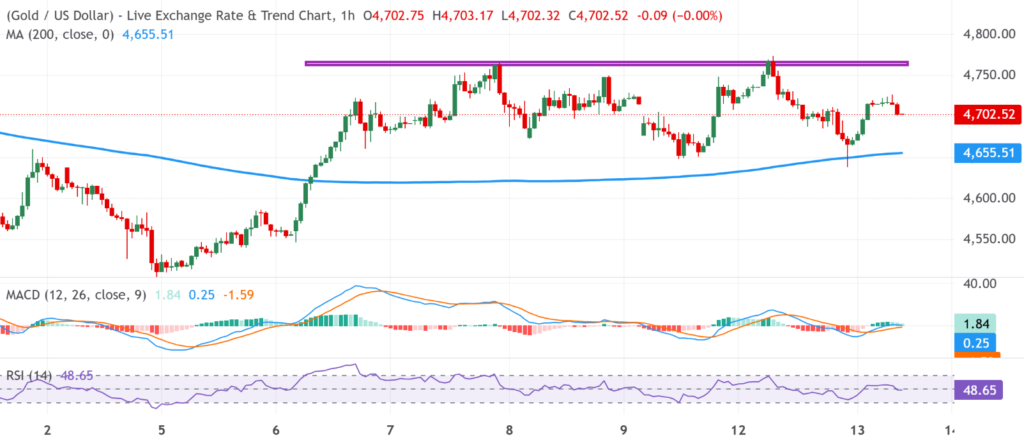
Technical Outlook: Gold Needs Confirmation Below Key Levels
From a technical perspective, Gold’s recent pullback from the $4,765-$4,770 resistance region formed a bearish double-top pattern on the 1-hour chart. The subsequent decline, however, found support near the 200-hour Simple Moving Average (SMA), indicating that dip-buying interest persists despite the negative momentum.
The Moving Average Convergence Divergence (MACD) histogram remains slightly positive, while the Relative Strength Index (RSI) hovers just below 50, signaling subdued but stabilizing momentum rather than a decisive downtrend. This implies that short-term retracements may occur before the trend resumes, and traders should monitor key technical levels carefully.
Immediate support for Gold is seen at the 200-hour SMA near $4,655.51. A break below this level could trigger further corrective pressure, targeting previous swing lows around $4,620-$4,630. On the upside, a sustained move above $4,770 would be necessary to invalidate the negative bias and signal a resumption of bullish momentum.
Market Sentiment and Upcoming Catalysts
Investor sentiment remains cautious, with many traders hesitant to aggressively position ahead of major geopolitical developments and economic releases. The upcoming US Producer Price Index (PPI) and further headlines on US-Iran relations will likely provide short-term impetus for both the USD and Gold, dictating the next directional move.
Additionally, market participants are watching the high-level meetings between US and Chinese leaders, which could influence risk appetite and indirectly affect Gold’s near-term trajectory. Any positive developments might alleviate geopolitical concerns, potentially reducing the USD’s safe-haven premium and giving Gold a chance to recover.
Conclusion
In summary, Gold remains under pressure, constrained by a strong USD driven by hawkish Fed expectations, elevated US Treasury yields, and geopolitical risks surrounding Iran. While technical indicators suggest some stabilization near the 200-hour SMA, a break below this support could trigger further losses, whereas a sustained rebound above $4,770 is necessary for a trend reversal.
Traders should remain alert to economic data releases, geopolitical developments, and technical signals, as these factors will continue to shape Gold’s near-term price action and the broader dynamics of the precious metals market.


