
Gold (XAU/USD) opened the week on a defensive note, trading below the $4,700 mark during the Asian session. The precious metal faced renewed selling pressure as geopolitical tensions between the US and Iran reignited, driving safe-haven demand for the US Dollar (USD). The brokers at Winseterra take a closer look at this topic in the article below.
Geopolitical Risks Keep Gold Under Pressure
The market initially held hopes for a US-Iran peace deal and the reopening of the Strait of Hormuz. However, optimism quickly faded as renewed hostilities emerged and both nations rejected each other’s peace proposals. Reports indicate that Iran has refused US demands to dismantle its nuclear facilities and halt uranium enrichment for 20 years.
This escalation has strengthened the USD as investors seek refuge in the world’s primary reserve currency. Consequently, Gold, which typically benefits from risk-off flows, struggled to gain traction. The XAU/USD pair failed to reclaim the $4,700 psychological barrier, signaling that the recent rebound from the $4,500 one-month low may encounter resistance.
Rising Oil Prices Rekindle Inflation Concerns
Geopolitical tensions coincided with a fresh leg up in Crude Oil (WTI and Brent), fueling renewed inflation fears. Higher energy costs tend to increase production and transportation expenses, translating into elevated Consumer Price Index (CPI) readings. Market participants now anticipate a stronger case for a hawkish Fed, with interest rate hikes potentially on the horizon.
Last Friday’s US Nonfarm Payrolls (NFP) report added further weight to this view. The economy generated 115K new jobs in April, exceeding expectations, while the Unemployment Rate remained at 4.3%. This data reinforces the notion that the US labor market remains resilient, potentially allowing the Fed to maintain or accelerate its tightening cycle, a scenario that generally favors the USD over Gold.
USD Bullishness Weighs on Gold
The CME Group’s FedWatch Tool currently reflects slightly over a 20% probability of a 25-basis-point (bps) rate hike by year-end. Even modest hawkish signals keep the USD bulls supported, making it difficult for Gold to sustain upward momentum. Traders are showing caution, refraining from aggressive positioning as they await key US inflation data scheduled for this week.
The Consumer Price Index (CPI) and Producer Price Index (PPI) releases, alongside monthly Retail Sales data and remarks from influential FOMC members, will likely dictate the next major moves in the XAU/USD pair. Until these events unfold, Gold’s trajectory remains vulnerable to USD strength, implying that any intraday rally above $4,700 may serve as a selling opportunity.
Technical Outlook: Mixed Signals
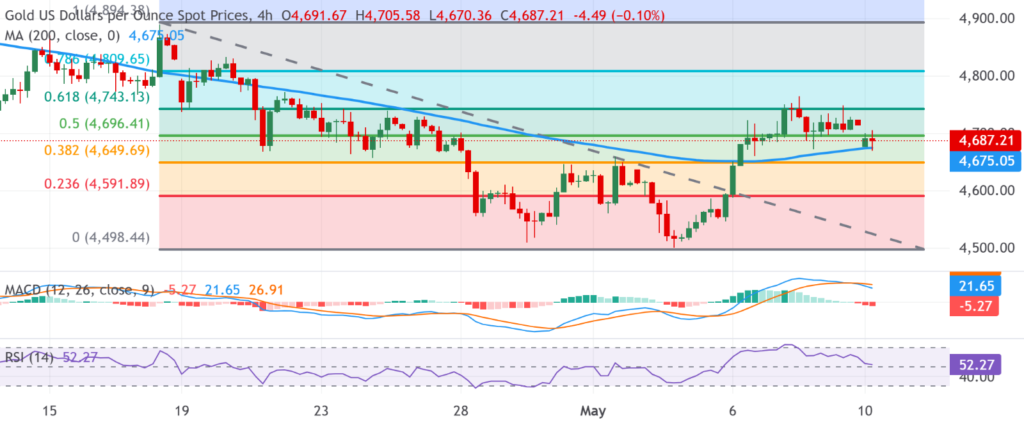
From a technical perspective, Gold shows a neutral-to-bearish bias. Last week’s attempts to surpass the 61.8% Fibonacci retracement level of the April-May downtrend proved unsuccessful, stalling momentum near the 200-period Simple Moving Average (SMA).
The Relative Strength Index (RSI) hovers slightly above 50, suggesting a mild positive bias, while the Moving Average Convergence Divergence (MACD) remains negative, indicating that bullish momentum is not yet convincing. This mixed technical setup reinforces traders’ hesitation to place directional bets, particularly in the context of geopolitical and macroeconomic uncertainty.
Key Support and Resistance Levels
On the upside, immediate resistance for Gold lies at the 50.0% Fibonacci retracement around $4,696, followed by the 61.8% level near $4,743 and the 78.6% retracement around $4,810. A sustained move above these levels could open the door to retesting the recent cycle high close to $4,894.
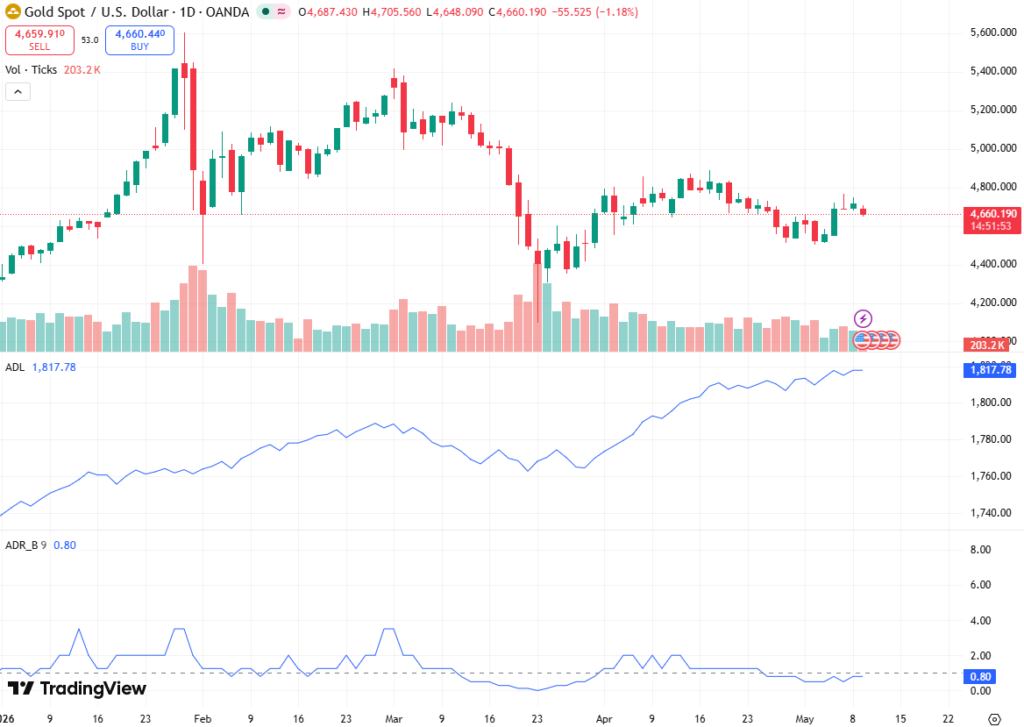
Conversely, support levels are seen at the 200-period SMA near $4,675, followed by the 38.2% Fibonacci retracement around $4,650. Further downside protection exists near the 23.6% retracement at $4,592, with the structural low anchored around $4,498 providing deeper defensive barriers.
Market Sentiment and Trader Positioning
Market participants appear to be in a wait-and-see mode, balancing the influence of geopolitical risks, oil-driven inflation concerns, and Fed policy expectations. While bearish sentiment could reemerge if USD strength persists, caution dominates as traders await concrete US CPI and PPI data.
The convergence of fundamental and technical factors indicates that the path of least resistance for Gold remains to the downside, at least in the near term. Short-term rallies above $4,700 may attract profit-taking, whereas the $4,675–$4,650 support zone will likely act as the first line of defense against deeper declines.
Conclusion
In summary, Gold remains under pressure below the $4,700 level, challenged by a strengthening USD amid renewed US-Iran tensions and rising inflation fears. Although technical indicators show mixed signals, fundamental drivers, including Crude Oil prices, hawkish Fed bets, and upcoming US economic releases, favor continued caution for bulls.
Traders should monitor the key support and resistance levels closely and remain vigilant ahead of the CPI, PPI, and Retail Sales data, which are poised to dictate the next meaningful leg in XAU/USD.


